A mass $m =100\, gms$ is attached at the end of a light spring which oscillates on a frictionless horizontal table with an amplitude equal to $0.16$ metre and time period equal to $2 \,sec$. Initially the mass is released from rest at $t = 0$ and displacement $x = - 0.16$ metre. The expression for the displacement of the mass at any time $t$ is
Medium


Download our appand get started for free
Experience the future of education. Simply download our apps or reach out to us for more information. Let's shape the future of learning together!No signup needed.*
Similar Questions
- 1View SolutionWhich of the diagrams shown in figure represents variation of total mechanical energy of a pendulum oscillating in water as function of time ?
- 2A body performs $S.H.M.$ Its kinetic energy $K$ varies with time $t$ as indicated by graphView Solution
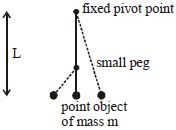
- 3A simple pendulum of length $L$ is constructed from a point object of mass $m$ suspended by a massless string attached to a fixed pivot point. $A$ small peg is placed a distance $2L/3$ directly below the fixed pivot point so that the pendulum would swing as shown in the figure below. The mass is displaced $5$ degrees from the vertical and released. How long does it take to return to its starting position?View Solution
- 4A potential is given by $V(x)=k(x+a)^2 / 2$ for $x < 0$ and $V(x)=k(x-a)^2 / 2$ for $x > 0$. The schematic variation of oscillation period $T$ for a particle performing periodic motion in this potential as a function of its energy $E$ isView Solution
- 5A weightless spring of length $60\, cm$ and force constant $200\, N/m$ is kept straight and unstretched on a smooth horizontal table and its ends are rigidly fixed. A mass of $0.25\, kg$ is attached at the middle of the spring and is slightly displaced along the length. The time period of the oscillation of the mass isView Solution
- 6An oscillator of mass $M$ is at rest in its equilibrium position in a potential $V\, = \,\frac{1}{2}\,k{(x - X)^2}.$ A particle of mass $m$ comes from right with speed $u$ and collides completely inelastically with $M$ and sticks to it . This process repeats every time the oscillator crosses its equilibrium position .The amplitude of oscillations after $13$ collisions is: $(M = 10,\, m = 5,\, u = 1,\, k = 1 ).$View Solution
- 7$Assertion :$ In simple harmonic motion, the velocity is maximum when the acceleration is minimum.View Solution
$Reason :$ Displacement and velocity of $S.H.M.$ differ in phase by $\frac{\pi }{2}$ - 8A particle excutes $SHM$ on a straight line path. The amplitude of oscillation is $2\,cm$. When the displacement of the particle from the mean position is $1\,cm$, the numerical value of magnitude of acceleration is equal to the numerical value of magnitude of velocity. The frequency of $SHM$ is (in $second^{-1}$)View Solution
- 9A simple pendulum is placed at a place where its distance from the earth's surface is equal to the radius of the earth. If the length of the string is $4 \mathrm{~m}$, then the time period of small oscillations will be ____ $s$. $\left[\right.$ take $\left.\mathrm{g}=\pi^2 \mathrm{~ms}^{-2}\right]$View Solution
- 10The total energy of a particle executing $S.H.M.$ is $80 \,J$. What is the potential energy when the particle is at a distance of $\frac{3}{4}$ of amplitude from the mean position..... $J$View Solution