The total energy of a particle executing $S.H.M.$ is $80 \,J$. What is the potential energy when the particle is at a distance of $\frac{3}{4}$ of amplitude from the mean position..... $J$
Medium
Download our app for free and get started
(d) $\frac{U}{E} = \frac{{\frac{1}{2}m{\omega ^2}{y^2}}}{{\frac{1}{2}m{\omega ^2}{a^2}}} = \frac{{{y^2}}}{{{a^2}}}$
==> $\frac{U}{{80}} = \frac{{{{\left( {\frac{3}{4}a} \right)}^2}}}{{{a^2}}} = \frac{9}{{16}}$
==> $U = 45\,J$

Download our appand get started for free
Experience the future of education. Simply download our apps or reach out to us for more information. Let's shape the future of learning together!No signup needed.*
Similar Questions
- 1The amplitude of a damped oscillator decreases to $0.9\,times$ its original magnitude in $5\,s.$ In another $10\,s$ it will decrease to $\alpha $ times its original magnitude, where $\alpha $ equalsView Solution
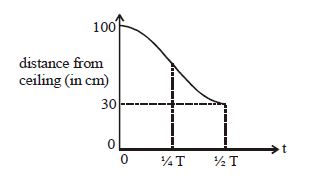
- 2A spring hangs vertically from the ceiling and a mass is attached to its free end. When the mass is pulled down and released, it oscillates vertically with simple harmonic motion of period $T$ . The variation with time $t$ of its distance from the ceiling is as shown. Which statement gives a correct deduction from this graph?View Solution
- 3View SolutionIdentify the function which represents a periodic motion.
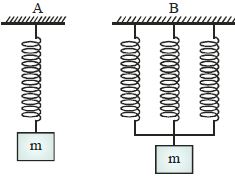
- 4The springs in figure. $A$ and $B$ are identical but length in $A$ is three times that in $B$. The ratio of period $T_A/T_B$ isView Solution
- 5A spring block system in horizontal oscillation has a time-period $T$. Now the spring is cut into four equal parts and the block is re-connected with one of the parts. The new time period of vertical oscillation will beView Solution
- 6A linear harmonic oscillator of force constant $2 \times 10^6\,Nm^{-1}$ and amplitude $0.01\, m$ has a total mechanical energy of $160\, J.$ ItsView Solution
- 7$x$ and $y$ displacements of a particle are given as $x(t) = a\,sin\,\omega t$ and $y(t) = a\,sin\,2\omega t.$ Its trajectory will look likeView Solution
- 8A rectangular block of mass $m$ and area of cross-section $A$ floats in a liquid of density $\rho $. If it is given a small vertical displacement from equilibrium it undergoes with a time period $T,$ thenView Solution
- 9View SolutionThe graph between velocity and position for a damped oscillation will be
- 10A block is placed on a frictionless horizontal table. The mass of the block is m and springs are attached on either side with force constants ${K_1}$ and ${K_2}$. If the block is displaced a little and left to oscillate, then the angular frequency of oscillation will beView Solution