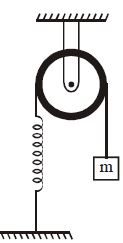
A mass $m = 8\,kg$ is attahced to a spring as shown in figure and held in position so that the spring remains unstretched. The spring constant is $200\,N/m$. The mass $m$ is then released and begins to undergo small oscillations. The maximum velocity of the mass will be ..... $m/s$ $(g = 10\,m/s^2)$
Medium
Download our app for free and get started
$\mathrm{T}=2 \pi \sqrt{\frac{\mathrm{M}}{\mathrm{K}}}$
or $\omega=\sqrt{\frac{\mathrm{K}}{\mathrm{M}}}=5 \mathrm{rad} / \mathrm{sec}$
and $A=m g / K=2 / 5 \mathrm{m}$
$\mathrm{v}_{\max }=\omega \mathrm{A}=2 \mathrm{m} / \mathrm{s}$

Download our appand get started for free
Experience the future of education. Simply download our apps or reach out to us for more information. Let's shape the future of learning together!No signup needed.*
Similar Questions
- 1A cuboidal piece of wood has dimensions $a, b$ and $c$. Its relative density is $d$. It is floating in a large body of water such that side a is vertical. It is pushed down a bit and released. The time period of $SHM$ executed by it is :View Solution
- 2Two particles oscillating in $SHM$ along two very close parallel path such that they have same mean position. The equation of $SHM$ of two particles are $x_1 = A\, sin\,\omega t$ and $x_2 = A\,sin(\omega t + \phi )$ respectively. If maximum distance between them is $\frac{6A}{5}$ then $\phi $ equal to ..... $^o$View Solution
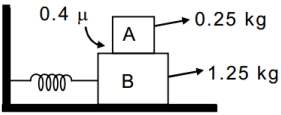
- 3Maximum amplitude(in $cm$) of $SHM$ so block A will not slip on block $B , K =100 N / m$View Solution
- 4Two pendulums begins to swing simultaneously. The first pendulum makes $11$ full oscillations when the other makes $9$. The ratio of length of the two pendulums isView Solution
- 5A mass of $0.2\,kg$ is attached to the lower end of a massless spring of force-constant $200\, N/m,$ the upper end of which is fixed to a rigid support. Which of the following statements is/are true ?View Solution
- 6In forced oscillation of a particle the amplitude is maximum for a frequency $\omega_{1}$ of the force, while the energy is maximum for a frequency $\omega_{2}$ of the force, thenView Solution
- 7The distance covered by a particle undergoing $SHM$ in one time period is (amplitude $= A$)View Solution
- 8View SolutionA particle executes SHM of amplitude A. The distance from the mean position when its's kinetic energy becomes equal to its potential energy is on
- 9A uniform rod of length $2.0 \,m$ is suspended through an end and is set into oscillation with small amplitude under gravity. The time period of oscillation is approximately .... $\sec$View Solution
- 10A simple pendulum has time period $T_1$. The point of suspension is now moved upward according to equation $y = k{t^2}$ where $k = 1\,m/se{c^2}$. If new time period is $T_2$ then ratio $\frac{{T_1^2}}{{T_2^2}}$ will beView Solution