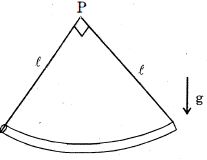
A mass of $0.2\,kg$ is attached to the lower end of a massless spring of force-constant $200\, N/m,$ the upper end of which is fixed to a rigid support. Which of the following statements is/are true ?
Advanced


Download our appand get started for free
Experience the future of education. Simply download our apps or reach out to us for more information. Let's shape the future of learning together!No signup needed.*
Similar Questions
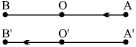
- 1Two particles undergo $SHM$ along parallel lines with the same time period $(T)$ and equal amplitudes. At a particular instant, one particle is at its extreme position while the other is at its mean position. They move in the same direction. They will cross each other after a further timeView Solution
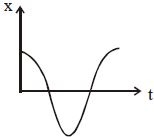
- 2Dispacement time graph of a particle executing $SHM$ is as shown in the figure. Corresponding graph between $PE$ and time isView Solution
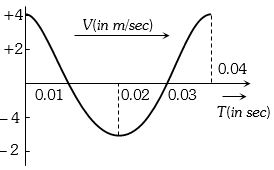
- 3The velocity-time diagram of a harmonic oscillator is shown in the adjoining figure. The frequency of oscillation is ..... $Hz$View Solution
- 4A simple pendulum of mass $m$ executes $S.H.M.$ with total energy $E$. If at an instant it is at one of extreme positions, then its linear momentum after a phase shift of $\frac{\pi}{3} \,rad$ will beView Solution
- 5The phase (at a time $t$) of a particle in simple harmonic motion tellsView Solution
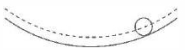
- 6A ball is rolling without slipping in a spherical shallow bowl (radius $R$ ) as shown in the figure and is executing simple harmonic motion. If the radius of the ball is doubled, then the time period of oscillationView Solution
- 7Two masses $m_1$ and $m_2$ are suspended together by a massless spring of constant $K$. When the masses are in equilibrium, $m_1$ is removed without disturbing the system. The amplitude of oscillations isView Solution

- 8View SolutionThe velocity of a particle performing simple harmonic motion, when it passes through its mean position is
- 9Four simple harmonic vibrations:View Solution
${y_1} = 8\,\cos\, \omega t;\,{y_2} = 4\,\cos \,\left( {\omega t + \frac{\pi }{2}} \right)$ ;
${y_3} = 2\cos \,\left( {\omega t + \pi } \right);\,{y_4} = \,\cos \,\left( {\omega t + \frac{{3\pi }}{2}} \right)$ ,
are superposed on each other. The resulting amplitude and phase are respectively;
- 10A circular arc of mass $m$ is connected with the help of two massless strings as shown in the figuw in vertical plane. About point $P$, small oscillations are given in the plane of the arc. Time period of the oscillations of $SHM$ will beView Solution