A mass $M$ is suspended from a spring of negligible mass. The spring is pulled a little and then released so that the mass executes $S.H.M.$ of time period $T$. If the mass is increased by m, the time period becomes $5T/3$. Then the ratio of $m/M$ is
AIEEE 2003,AIIMS 2016, Medium
Download our app for free and get started
(d) $T \propto \sqrt m $
==> $\frac{{{T_2}}}{{{T_1}}} = \sqrt {\frac{{{m_2}}}{{{m_1}}}} $
==> $\frac{5}{3} = \sqrt {\frac{{M + m}}{M}} $
==> $\frac{{25}}{9} = \frac{{M + m}}{M}$
==> $\frac{m}{M} = \frac{{16}}{9}$

Download our appand get started for free
Experience the future of education. Simply download our apps or reach out to us for more information. Let's shape the future of learning together!No signup needed.*
Similar Questions
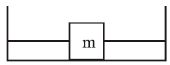
- 1A block of mass $m$ is having two similar rubber ribbons attached to it as shown in the figure. The force constant of each rubber ribbon is $K$ and surface is frictionless. The block is displaced from mean position by $x\,cm$ and released. At the mean position the ribbons are underformed. Vibration period isView Solution
- 2The time period of a particle executing $S.H.M.$ is $8 \,s$. At $t=0$ it is at the mean position. The ratio of distance covered by the particle in $1^{\text {st }}$ second to the $2^{\text {nd }}$ second is .............. $s$View Solution
- 3If a particle under S.H.M. has time period 0.1 sec and amplitude $2 \times 10^{-3}$. It has maximum velocityView Solution
- 4The potential energy of a particle $\left(U_x\right)$ executing $S.H.M$. is given byView Solution
- 5View SolutionIn case of damped oscillation frequency of oscillation is ............
- 6The total energy of a particle executing $S.H.M.$ is $80 \,J$. What is the potential energy when the particle is at a distance of $\frac{3}{4}$ of amplitude from the mean position..... $J$View Solution
- 7The $K.E.$ and $P.E.$ of a particle executing $SHM$ with amplitude $A$ will be equal when its displacement isView Solution
- 8A particle of mass $200 \,gm$ executes $S.H.M.$ The restoring force is provided by a spring of force constant $80 \,N / m$. The time period of oscillations is .... $\sec$View Solution
- 9The distance covered by a particle undergoing $SHM$ in one time period is (amplitude $= A$)View Solution
- 10A circular arc of mass $m$ is connected with the help of two massless strings as shown in the figuw in vertical plane. About point $P$, small oscillations are given in the plane of the arc. Time period of the oscillations of $SHM$ will beView Solution