Question
A mercury lamp is a convenient source for studying frequency dependence of photoelectric emission, since it gives a number of spectral lines ranging from the UV to the red end of the visible spectrum. In our experiment with rubidium photo-cell, the following lines from a mercury source were used: $\lambda_1=3650\ \mathring{\text{A}},\ \lambda_2=4047\ \mathring{\text{A}},\ \lambda_3=4358\ \mathring{\text{A}},\ \lambda_4=5461\ \mathring{\text{A}},\ \lambda_5=6907\ \mathring{\text{A}},$ The stopping voltages, respectively, were measured to be: $V_{01} = 1.28 V, V_{02} = 0.95 V, V_{03} = 0.74 V, V_{04} = 0.16 V, V_{05} = 0 V$ Determine the value of Planck’s constant h, the threshold frequency and work function for the material. [Note: You will notice that to get h from the data, you will need to know e (which you can take to be $1.6 \times 10^{–19}$ C). Experiments of this kind on Na, Li, K, etc. were performed by Millikan, who, using his own value of e (from the oil-drop experiment) confirmed Einstein’s photoelectric equation and at the same time gave an independent estimate of the value of h.]
Answer


Einstein's photoelectric equation is given as:
$\text{eV}_\circ=\text{hv}-\phi_\circ$
$\text{V}_\circ=\frac{\text{h}}{\text{e}}\text{v}-\frac{\phi_\circ}{\text{e}}....(1)$
Where,
$\text{V}_\circ$ = Stopping potential
h = Planck's constant
e = Charge on an electron
$\phi_\circ$ = Work function of a material
It can be concluded from equation (1) that potential $\text{V}_\circ$ is directly proportional to frequency v.
Frequency is also given by the relation:
$\text{v}=\frac{\text{Speed of light (c)}}{\text{Wavelength}\ (\lambda)}$
This relation can be used to obtain the frequencies of the various lines of the given wavelengths.
$\text{v}_1=\frac{\text{c}}{\lambda_1}=\frac{3\times10^8}{3650\times10^{-10}}=8.219\times10^{14}\ \text{Hz}$
$\text{v}_2=\frac{\text{c}}{\lambda_2}=\frac{3\times10^8}{4047\times10^{-10}}=7.412\times10^{14}\ \text{Hz}$
$\text{v}_3=\frac{\text{c}}{\lambda_3}=\frac{3\times10^8}{4358\times10^{-10}}=6.884\times10^{14}\ \text{Hz}$
$\text{v}_4=\frac{\text{c}}{\lambda_4}=\frac{3\times10^8}{5461\times10^{-10}}=5.493\times10^{14}\ \text{Hz}$
$\text{v}_5=\frac{\text{c}}{\lambda_5}=\frac{3\times10^8}{6907\times10^{-10}}=4.343\times10^{14}\ \text{Hz}$
The given quantities can be listed in tabular form as:
Frequency $\times 10^{14}$ Hz 8.219 7.412 6.884 5.493 4.343
Stopping potential $\text{V}_\circ$ 1.28 0.95 0.74 0.16 0
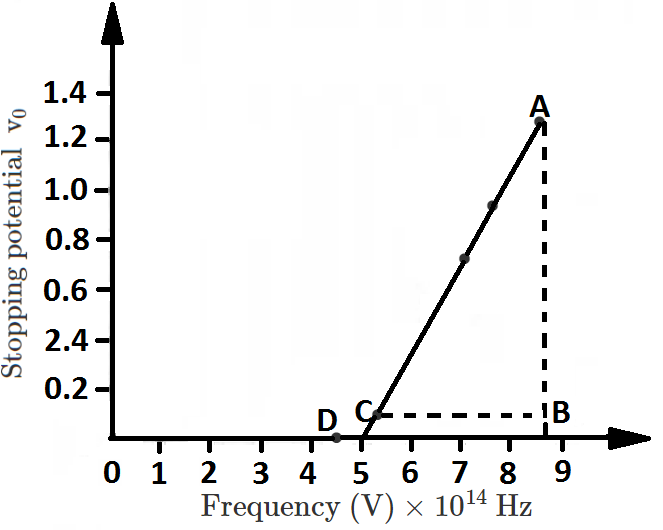
The following figure shows a graph between vand $\text{V}_\circ.$

It can be observed that the obtained curve is a straight line. It intersects the v-axis at $5 \times 10^{14}$ Hz, which is the threshold frequency $(\text{V}_\circ)$ of the material. Point D corresponds to a frequency less than the threshold frequency. Hence, there is no photoelectric emission for the $\lambda_{5}$ line, and therefore, no stopping voltage is required to stop the current.
Slope of the straight line $=\frac{\text{AB}}{\text{CB}}=\frac{1.28-0.16}{(8.214-5.493)\times10^{14}}$
From equation (1), the slope $\frac{\text{h}}{\text{e}}$ can be written as:
$\frac{\text{h}}{\text{e}}=\frac{1.28-0.16}{(8.214-5.493)\times10^{14}}$
$\therefore\ \text{h}=\frac{1.12\times1.6\times10^{19}}{2.726\times10^{14}}$
$= 6.573 \times 10^{-34} Js$
The work function of the metal is given as:
$\phi_\circ=\text{hv}_\circ$
$= 6.573 \times 10^{-34} \times 5 \times 10^{14}$
$= 3.286 \times 10^{-19} J$
$=\frac{3.286\times10^{-19}}{1.6\times10^{-18}} $
$= 0.054 eV$

Need a full question paper?

Generate a complete, print-ready paper with questions like this in minutes — across 16+ boards, with answer keys.

Start Generating Free

Similar questions

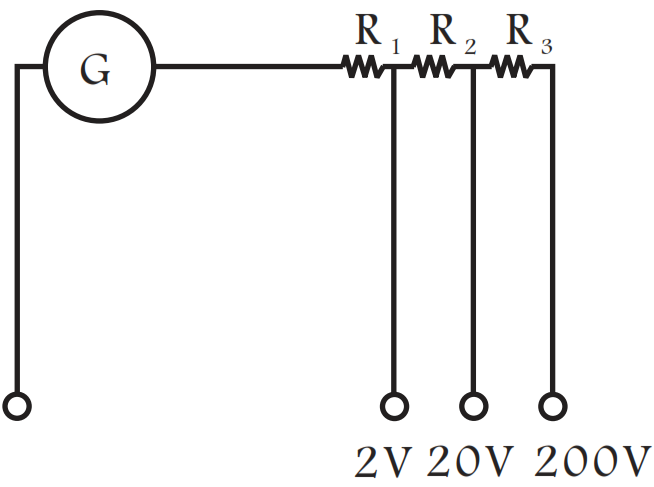
A multirange voltmeter can be constructed by using a galvanometer circuit as shown in Fig. We want to construct a voltmeter that can measure 2V, 20V and 200V using a galvanometer of resistance 10Ω and that produces maximum deflection for current of 1mA. Find $R_1, R_2$ and $R_3$ that have to be used.
An eye can distinguish between two points of an object if they are separated by more than 0.22mm when the object is placed at 25cm from the eye. The object is now seen by a compound microscope having a 20D objective and 10D eyepiece separated by a distance of 20cm. The final image is formed at 25cm from the eye. What is the minimum separation between two points of the object which can now be distinguished?
Two convex lenses, each of focal length 10cm, are placed at a separation of 15cm with their principal axes coinciding,
  1. Show that a light beam coming parallel to the principal axis diverges as it comes out of the lens system.
  2. Find the location of the virtual image formed by the lens system of an object placed far away.
  3. Find the focal length of the equivalent lens.
(Note that the sign of the focal length is positive although the lens system actually diverges a parallel beam incident on it).
A long, straight wire is fixed horizontally and carries a current of 50.0A. A second wire having linear mass density $1.0 \times 10^{-4}kg/m$ is placed parallel to and directly above this wire at a separation of 5.0mm. What current should this second wire carry such that the magnetic repulsion can balance its weight?


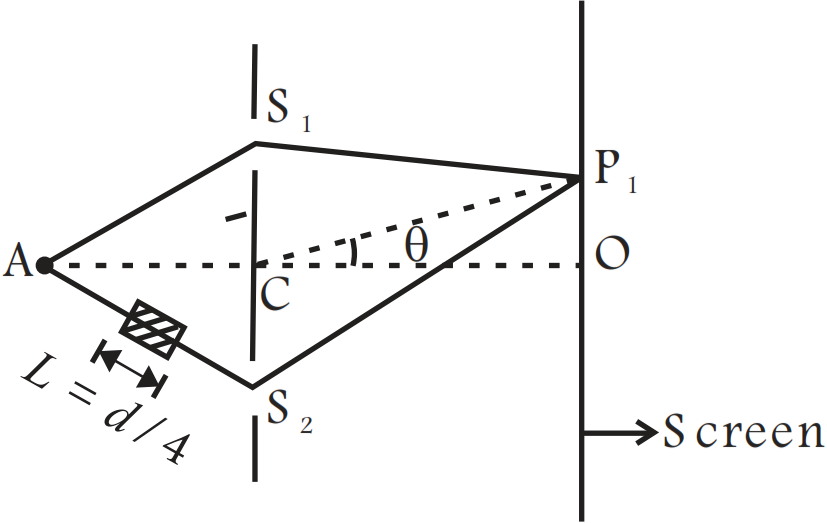
$AC = CO = D, S_1C = S_2C = d < < D$
A small transparent slab containing material of $\mu = 1.5$ is placed along $AS_2 $(Fig). What will be the distance from O of the principal maxima and of the first minima on either side of the principal maxima obtained in the absence of the glass slab.
A heavy but uniform rope of length L is suspended from a ceiling.
  1. Write the velocity of a transverse wave travelling on the string as a function of the distance from the lower.
  2. If the rope is given a sudden sideways jerk at the bottom, how long will it take for the pulse to reach the ceiling?
  3. A particle is dropped from the ceiling at the instant the bottom end is given the jerk. Where will the particle meet the pulse ?
The plates of a capacitor of capacitance $10\mu\text{F},$ charged to $60\mu\text{C},$ are joined together by a wire of resistance $10\Omega$ at t = 0. Find the charge on the capacitor in the circuit at (a) t = 0 (b) $\text{t}=30\mu\text{s}$ (c) $\text{t}=120\mu\text{s}$ and (d) t = 1.0ms.
  1. Using Ampere's circuital law, obtain the expression for the magnetic field due to a long solenoid at a point inside the solenoid on its axis.
  2. In what respect is a toroid different from a solenoid? Draw and compare the pattern of the magnetic field lines in the two cases.
  3. How is the magnetic field inside a given solenoid made strong?
Quite often, connecting wires carrying currents in opposite directions are twisted together in using electrical appliances. Explain how it avoids unwanted magnetic fields.
The magnetic field B and the magnetic intensity H in material are found to be 1.6T and 1000A/m reepectively. Calculate the relative permeability $\mu_\text{r}$ and the susceptibility x of the material.