An eye can distinguish between two points of an object if they are separated by more than 0.22mm when the object is placed at 25cm from the eye. The object is now seen by a compound microscope having a 20D objective and 10D eyepiece separated by a distance of 20cm. The final image is formed at 25cm from the eye. What is the minimum separation between two points of the object which can now be distinguished?
Download our app for free and get started
For the given compound microscope$\text{f}_0=\frac{1}{20\text{D}}=0.05\text{m}=5\text{cm},$ $\text{f}_\text{e}=\frac{1}{10\text{D}}=0.1\text{m}=10\text{cm.}$
D = 25cm, separation between objective & eyepiece= 20cm
For the minimum separation between two points which can be distinguished by eye using the microscope, the magnifying power should be maximum.
For the eyepiece$, v_0 = -25cm, f_e = 10cm$
So, $\frac{1}{\text{u}_\text{e}}=\frac{1}{\text{v}_\text{e}}-\frac{1}{\text{f}_\text{e}}=\frac{1}{-25}-\frac{1}{10}$
$=-\Big[\frac{2+5}{50}\Big]\Rightarrow\text{u}_\text{e}=-\frac{50}{7}\text{cm}$
So, the image distance for the objective lens should be,
$\text{v}_0=20-\frac{50}{7}=\frac{90}{7}\text{cm}$
Now, for the objective lens,
$\frac{1}{\text{u}_0}=\frac{1}{\text{v}_0}-\frac{1}{\text{f}_0}=\frac{7}{90}-\frac{1}{5}=-\frac{11}{90}$
$\Rightarrow\text{u}_\text{o}=-\frac{90}{11}\text{cm}$
So, the maximum magnifying power is given by,
$\text{m}=\frac{-\text{V}_0}{\text{u}_0}\Big[1+\frac{\text{D}}{\text{f}_\text{e}}\Big]$
$=\frac{\big(\frac{90}{7}\big)}{\big(-\frac{90}{11}\big)}\Big[1+\frac{25}{10}\Big]$
$=\frac{11}{7}\times3.5=5.5$
Thus, minimum separation eye can distinguish $=\frac{0.22}{5.5}\text{mm}=0.04\text{mm}$
D = 25cm, separation between objective & eyepiece= 20cm
For the minimum separation between two points which can be distinguished by eye using the microscope, the magnifying power should be maximum.
For the eyepiece$, v_0 = -25cm, f_e = 10cm$
So, $\frac{1}{\text{u}_\text{e}}=\frac{1}{\text{v}_\text{e}}-\frac{1}{\text{f}_\text{e}}=\frac{1}{-25}-\frac{1}{10}$
$=-\Big[\frac{2+5}{50}\Big]\Rightarrow\text{u}_\text{e}=-\frac{50}{7}\text{cm}$
So, the image distance for the objective lens should be,
$\text{v}_0=20-\frac{50}{7}=\frac{90}{7}\text{cm}$
Now, for the objective lens,
$\frac{1}{\text{u}_0}=\frac{1}{\text{v}_0}-\frac{1}{\text{f}_0}=\frac{7}{90}-\frac{1}{5}=-\frac{11}{90}$
$\Rightarrow\text{u}_\text{o}=-\frac{90}{11}\text{cm}$
So, the maximum magnifying power is given by,
$\text{m}=\frac{-\text{V}_0}{\text{u}_0}\Big[1+\frac{\text{D}}{\text{f}_\text{e}}\Big]$
$=\frac{\big(\frac{90}{7}\big)}{\big(-\frac{90}{11}\big)}\Big[1+\frac{25}{10}\Big]$
$=\frac{11}{7}\times3.5=5.5$
Thus, minimum separation eye can distinguish $=\frac{0.22}{5.5}\text{mm}=0.04\text{mm}$

Download our appand get started for free
Experience the future of education. Simply download our apps or reach out to us for more information. Let's shape the future of learning together!No signup needed.*
Similar Questions
- 1View Solution
- Draw a labelled ray diagram to obtain the real image formed by an astronomical telescope in normal adjustment position. Define its magnifying power.
- You are given three lenses of power 0.5 D, 4 D and 10 D to design a telescope:
- Which lenses should he used as objective and eyepiece? Justify your answer.
- Why is the aperture of the objective preferred to be large?
- 2A hemispherical portion of the surface of a solid glass sphere $(\mu=1.5)$ of radius r is silvered to make the inner side reflecting. An object is placed on the axis of the hemisphere at a distance 3r from the centre of the sphere. The light from the object is refracted at the unsilvered part, then reflected from the silvered part and again refracted at the unsilvered part. Locate the final image formed.View Solution
- 3View SolutionA Cassegrain telescope uses two mirrors. Such a telescope is built with the mirrors 20 mm apart. If the radius of curvature of the large mirror is 220 mm and the small mirror is 140 mm, where will the final image of an object at infinity be?
- 4Derive the lens formula, $\frac{1}{\text{f}} = \frac{1}{\text{v}} - \frac{1}{\text{u}}$ for a concave lens, using the necessary ray diagram.View Solution
Two lenses of powers 10 D and – 5 D are placed in contact.- Calculate the power of the new lens.
- Where should an object be held from the lens, so as to obtain a virtual image of magnification 2?
- 5With the help of a ray diagram, show the formation of image of a point object due to refraction of light at a spherical surface separating two media of refractive indices $n_1$ and $n_2 (n_2 > n_1)$ respectively. Using this diagram, derive the relation.View Solution
$\frac{\text{n}_2}{\text{v}}-\frac{\text{n}_1}{\text{u}}=\frac{\text{n}_1-\text{n}_2}{\text{R}}$
Write the sign conventions used. What happens to the focal length of convex lens when it is immersed in water? - 6View SolutionAn optical instrument used for angular magnification has a 25D objective and a 20D eyepiece. The tube length is 25cm when the eye is least strained.
- Whether it is a microscope or a telescope?
- What is the angular magnification produced?
- 7A point object 'O' is kept in a medium of refractive index $n_1$ in front of a convex spherical surface of radius of curvature R which separates the second medium of refractive index $n_2$ from the first one, as shown in the figure. Draw the ray diagram showing the image formation and deduce the relationship between the object distance and the image distance in terms of $n_1, n_2$ and R.View Solution
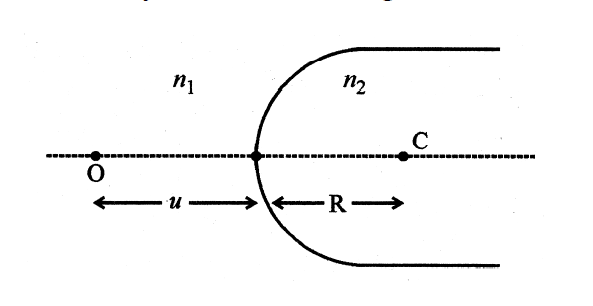
- hen the image formed above acts as a virtual object for concave spherical, surface separating the medium $n_2$ from $n_1 (n_2> n_1),$ draw this ray diagram and write the similar (similar to (a) relation. Hence obtain the expression for the lens maker's formula.
- 8View Solution
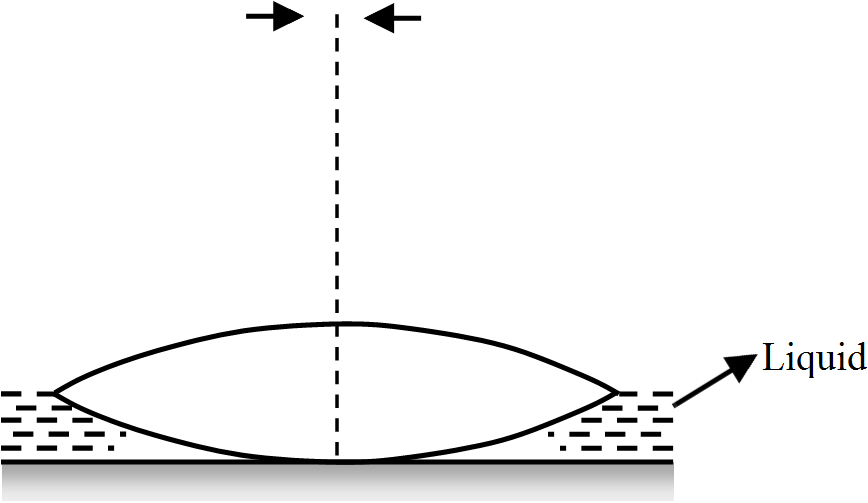
- An equiconvex lens with radii of curvature of magnitude r each, is put over a liquid layer poured on top of a plane mirror. A small needle, with its tip on the principal axis of the lens, is moved along the axis until its inverted real image coincides with the needle itself. The distance of the needle from the lens is measured to be 'a'. On removing the liquid layer and repeating the experiment the distance is found to be 'b'.
- If r = 10cm, a = 15cm, b = 10cm, find the refractive index of the liquid.
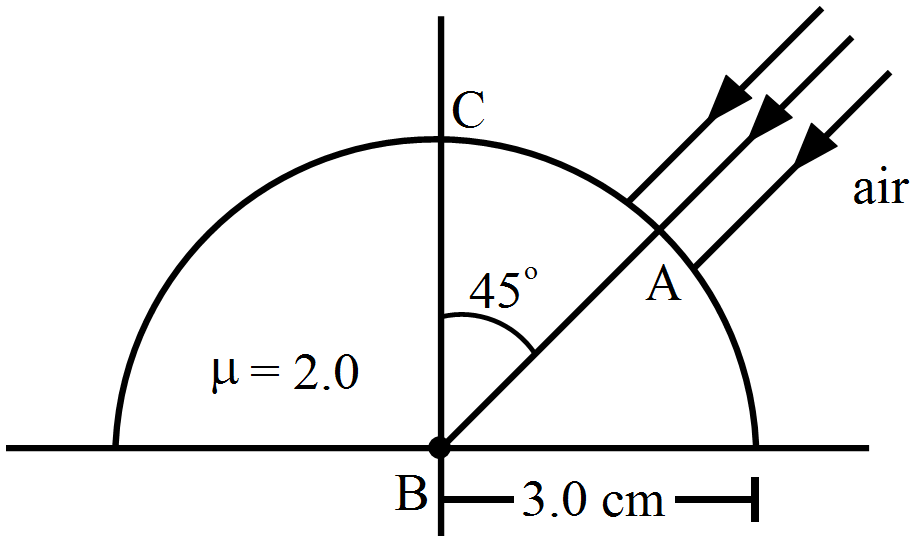
- 9View SolutionFigure shows a transparent hemisphere of radius 3.0cm made of a material of refractive index 2.0.
- A narrow beam of parallel rays is incident on the hemisphere as shown in the figure. Are the rays totally reflected at the plane surface?
- Find the image formed by the refraction at the first surface.
- Find the image formed by the reflection or by the refraction at the plane surface.
- Trace qualitatively the final rays as they come out of the hemisphere.
- 10View SolutionA pin of length 2.00cm is placed perpendicular to the principal axis of a converging lens. An inverted image of size 1.00cm is formed at a distance of 40.0cm from the pin. Find the focal length of the lens and its distance from the pin.