A metal wire of length $0.5 m$ and cross-sectional area $10^{-4}\; m ^{2}$ has breaking stress $5 \times 10^{8}\; Nm ^{-2}$. A block of $10\; kg$ is attached at one end of the string and is rotating in a horizontal circle. The maximum linear velocity of block will be $ms ^{-1}$.
JEE MAIN 2022, Diffcult


Download our appand get started for free
Experience the future of education. Simply download our apps or reach out to us for more information. Let's shape the future of learning together!No signup needed.*
Similar Questions
- 1The upper end of a wire of radius $4\, mm$ and length $100\, cm$ is clamped and its other end is twisted through an angle of $30°$. Then angle of shear is ..... $^o$View Solution
- 2A steel wire of diameter $0.5 mm$ and Young's modulus $2 \times 10^{11} N m ^{-2}$ carries a load of mass $M$. The length of the wire with the load is $1.0 m$. A vernier scale with $10$ divisions is attached to the end of this wire. Next to the steel wire is a reference wire to which a main scale, of least count $1.0 mm$, is attached. The $10$ divisions of the vernier scale correspond to $9$ divisions of the main scale. Initially, the zero of vernier scale coincides with the zero of main scale. If the load on the steel wire is increased by $1.2 kg$, the vernier scale division which coincides with a main scale division is. . . . Take $g =10 m s ^{-2}$ and $\pi=3.2$.View Solution
- 3A uniform heavy rod of weight $10\, {kg} {ms}^{-2}$, crosssectional area $100\, {cm}^{2}$ and length $20\, {cm}$ is hanging from a fixed support. Young modulus of the material of the rod is $2 \times 10^{11} \,{Nm}^{-2}$. Neglecting the lateral contraction, find the elongation of rod due to its own weight. (In $\times 10^{-10} {m}$)View Solution
- 4A wire of length $L$ is hanging from a fixed support. The length changes to $L _{1}$ and $L _{2}$ when masses $1 \,kg$ and $2 \,kg$ are suspended respectively from its free end. Then the value of $L$ is equal to ..................View Solution
- 5View SolutionWhich is correct relation
- 6A uniform metal rod of $2\, mm^2$ cross section fixed between two walls is heated from $0\,^oC$ to $20\,^oC$. The coefficient of linear expansion of rod is $12\times10^{-6}/^oC$. Its Young's modulus of elasticity is $10^{11} \,N/m^2$. The energy stored per unit volume of rod will be ....... $J/m^3$View Solution
- 7The interatomic distance for a metal is $3 \times {10^{ - 10}}\,m$. If the interatomic force constant is $3.6 \times {10^{ - 9}}\,N/{{\buildrel _{\circ} \over {\mathrm{A}}}}$, then the Young's modulus in $N/{m^2}$ will beView Solution
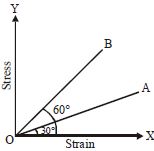
- 8The stress versus strain graphs for wires of two materials $A$ and $B$ are as shown in the figure. If $Y_A$ and $Y_B$ are the Young's modulus of the materials, thenView Solution
- 9The work done in increasing the length of a metre long wire of cross-sectional area ........ $J.$ $1\,mm^2$ through $1\,mm$ will be $(Y = 2 \times 10^{11}\,Nm^{-2})$View Solution
- 10For a constant hydraulic stress on an object, the fractional change in the object's volume $\left( {\frac{{\Delta V}}{V}} \right)$ and its bulk modulus $(B)$ are related asView Solution