The interatomic distance for a metal is $3 \times {10^{ - 10}}\,m$. If the interatomic force constant is $3.6 \times {10^{ - 9}}\,N/{{\buildrel _{\circ} \over {\mathrm{A}}}}$, then the Young's modulus in $N/{m^2}$ will be
Medium


Download our appand get started for free
Experience the future of education. Simply download our apps or reach out to us for more information. Let's shape the future of learning together!No signup needed.*
Similar Questions
- 1The maximum elongation of a steel wire of $1 \mathrm{~m}$ length if the elastic limit of steel and its Young's modulus, respectively, are $8 \times 10^8 \mathrm{~N} \mathrm{~m}^{-2}$ and $2 \times 10^{11} \mathrm{~N} \mathrm{~m}^{-2}$, is:View Solution
- 2The work done per unit volume to stretch the length of area of cross-section $2 \,mm ^2$ by $2 \%$ will be ....... $MJ / m ^3$ $\left[Y=8 \times 10^{10} \,N / m ^2\right]$View Solution
- 3A wire can be broken by applying a load of $20\, kg$ weight. The force required to break the wire of twice the diameter is .......... $kg\, wt$View Solution
- 4When load of $5\,kg$ is hung on a wire then extension of $3\,m$ takes place, then work done will be ....... $joule$View Solution
- 5The elastic energy stored in a wire of Young's modulus $Y$ isView Solution
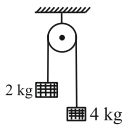
- 6Two blocks of mass $2 \mathrm{~kg}$ and $4 \mathrm{~kg}$ are connected by a metal wire going over a smooth pulley as shown in figure. The radius of wire is $4.0 \times 10^{-5}$ $\mathrm{m}$ and Young's modulus of the metal is $2.0 \times 10^{11} \mathrm{~N} / \mathrm{m}^2$. The longitudinal strain developed in the wire is $\frac{1}{\alpha \pi}$. The value of $\alpha$ is [Use $\mathrm{g}=10 \mathrm{~m} / \mathrm{s}^2$ )View Solution
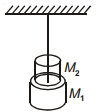
- 7The length of wire, when $M_1$ is hung from it, is $I_1$ and is $I_2$ with both $M_1$ and $M_2$ hanging. The natural length of wire is ........View Solution
- 8View SolutionThe longitudinal strain is only possible in
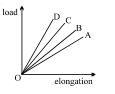
- 9View SolutionThe load versus strain graph for four wires of the same material is shown in the figure. The thickest wire is represented by the line
- 10The upper end of a wire $1\,m$ long and $4\,mm$ radius is clamped. The lower end is twisted by an angle of $30^o$. The angle of shear is ...... $^o$View Solution