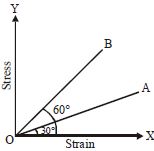
The stress versus strain graphs for wires of two materials $A$ and $B$ are as shown in the figure. If $Y_A$ and $Y_B$ are the Young's modulus of the materials, then
Medium


Download our appand get started for free
Experience the future of education. Simply download our apps or reach out to us for more information. Let's shape the future of learning together!No signup needed.*
Similar Questions
- 1Steel and copper wires of same length are stretched by the same weight one after the other. Young's modulus of steel and copper are $2 \times {10^{11}}\,N/{m^2}$ and $1.2 \times {10^{11}}\,N/{m^2}$. The ratio of increase in lengthView Solution
- 2View SolutionA solid expands upon heating because
- 3When a rubber ball is taken to the bottom of a sea of depth $1400 \,m$, its volume decreases by $2 \%$. The Bulk modulus of rubber ball is .................. $\times 10^8 N / m ^2$ [density of water is $1 \,g cc$ and $g=10 \,m / s ^2$ ]View Solution
- 4The area of cross section of the rope used to lift a load by a crane is $2.5 \times 10^{-4} m ^{2}$. The maximum lifting capacity of the crane is $10$ metric tons. To increase the lifting capacity of the crane to $25$ metric tons, the required area of cross section of the rope should be.$.........\times 10^{-4} \,m ^{2}$ (take $g =10\, ms ^{-2}$ )View Solution
- 5A uniformly tapering conical wire is made from a material of Young's modulus $Y$ and has a normal, unextended length $L.$ The radii, at the upper and lower ends of this conical wire, have values $R$ and $3R,$ respectively. The upper end of the wire is fixed to a rigid support and a mass $M$ is suspended from its lower end. The equilibrium extended length, of this wire, would equalView Solution
- 6View SolutionIn the three states of matter, the elastic coefficient can be
- 7If a spring extends by $x$ on loading, then the energy stored by the spring is (if $T$ is tension in the spring and $k$ is spring constant)View Solution
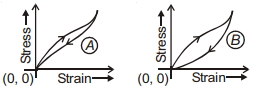
- 8View SolutionTwo different types of rubber are found to have the stress-strain curves as shown. Then
- 9A steel wire can sustain $100\,kg$ weight without breaking. If the wire is cut into two equal parts, each part can sustain a weight of ......... $kg$View Solution
- 10A copper wire of length $1.0\, m$ and a steel wire of length $0.5\, m$ having equal cross-sectional areas are joined end to end. The composite wire is stretched by a certain load which stretches the copper wire by $1\, mm$. If the Young's modulii of copper and steel are respectively $1.0\times10^{11}\, Nm^{-2}$ and $2.0\times10^{11}\, Nm^{- 2}$, the total extension of the composite wire is ........ $mm$View Solution