In $n_e$ and $v_d$ be the number of electrons and drift velocity in a semiconductor. When the temperature is increased
Easy


Download our appand get started for free
Experience the future of education. Simply download our apps or reach out to us for more information. Let's shape the future of learning together!No signup needed.*
Similar Questions
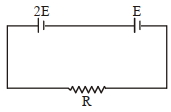
- 1Two cells of emf $2\, E$ and $E$ with internal resistance $r _{1}$ and $r _{2}$ respectively are connected in series to an external resistor $R$ (see $figure$). The value of $R ,$ at which the potential difference across the terminals of the first cell becomes zero isView Solution
- 2Two cells of $e.m.f.$ $E_1$ and $E_2$ are joined in series and the balancing length of the potentiometer wire is $625$ $cm$. If the terminals of $E_1$ are reversed, the balancing length obtained is $125 \,cm$. Given $E_2 > E_1$, the ratio $E_1: E_2$ will beView Solution
- 3The resistance of a conductor at $15^{\circ} {C}$ is $16\, \Omega$ and at $100\, {C}$ is $20\, \Omega$. What will be the temperature coefficient of resistance of the conductor?View Solution
- 4When a current $I$ is passed through a wire of constant resistance, it produces a potential difference $V$ across its ends. The graph drawn between $\log\, I$ and $\log\, V$ will beView Solution
- 5A series combination of two resistors $1\,\Omega $ each is connected to a $12\,V$ battery of internal resistance $0.4\,\Omega $. The current flowing through it will be ............... $A$View Solution
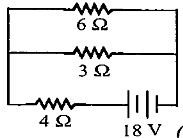
- 6The total power dissipated in watt in the circuit shown here is ............. $W$View Solution
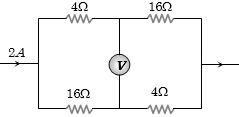
- 7In the circuit shown below, The reading of the voltmeter $V$ is ...........View Solution
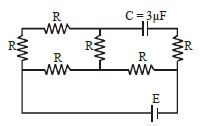
- 8In steady state the potential difference across the capacitor is $10\,\, V.$ Each resistance is of $3\,\Omega $. The cell is ideal. The $emf$ of the cell is .............. $\mathrm{V}$View Solution
- 9Equal potentials are applied on an iron and copper wire of same length. In order to have the same current flow in the two wires, the ratio $r$ (iron)/$r$ (copper) of their radii must be (Given that specific resistance of iron = $1.0 \times {10^{ - 7}}$ $ ohm-m$ and specific resistance of copper = $1.7 \times {10^{ - 8}}\,ohm-m$)View Solution
- 10The charge flowing in a conductor changes with time as $Q ( t )=\alpha t -\beta t ^2+\gamma t ^3$. Where $\alpha, \beta$ and $\gamma$ are constants. Minimum value of current is :View Solution