Question
A metallic loop is placed in a nonuniform magnetic field. Will an emf be induced in the loop?

Answer

As the magnetic field is non uniform thus it will induce only small electric field in different directions so there would be no net current in the loop.

Need a full question paper?

Generate a complete, print-ready paper with questions like this in minutes — across 16+ boards, with answer keys.

Start Generating Free

Similar questions

The charge density of two uniformly charged parallel infinite plane sheets ' 1 ' and ' 2 ' are $+\sigma$ and $-2 \sigma$ respectively. Find the magnitude and direction of the net electric field (i) at any point between these two sheets and (ii) at any point outisde these two sheets but near sheet ' 1 '.
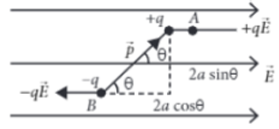
When electric dipole is placed in uniform electric field, its two charges experience equal and opposite forces, which cancel each other and hence net force on electric dipole in uniform electric field is zero. However these forces are not collinear, so they give rise to some torque on the dipole. Since net force on electric dipole in uniform electric field is zero. so no work is done in moving the electric dipole in uniform electric field. However some work is done in rotating the dipole against the torque acting on it.
Image
$(i)$ The dipole moment of a dipole in a uniform external field $\vec{E}$ is $\vec{P}$. Then the torque $\vec{\tau}$ acting on the dipole is
$(a) \vec{\tau}=2(\vec{P}+\vec{E})$
$(b) \vec{\tau}=\vec{P} \cdot \vec{E}$
$(c) \vec{\tau}=(\vec{P}+\vec{E})$
$(d) \vec{\tau}=\vec{P} \times \vec{E}$

$(ii)$ An electric dipole consists of two opposite charges, each of magnitude $1.0 \mu C$ separated by a distance of $2.0 \ cm$ . The dipole is placed in an external field of $10^5 NC ^{-1}$. The maximum torque on the dipole is
$(a) 4 \times 10^{-3} Nm$
$(b) 2 \times 10^{-3} Nm$
$(c) 1 \times 10^{-3} Nm$
$(d) 0.2 \times 10^{-3} Nm$

$(iii)$ Torque on a dipole in uniform electric field is minimum when $\theta$ is equal to
$(a) 0^{\circ}$
$(b) 90^{\circ}$
$(c) 180^{\circ}$
$(d)$ Both $0^{\circ}$ and $180^{\circ}$

$(iv)$ When an electric dipole is held at an angle in a uniform electric field, the net force $F$ and torque on the dipole are
$(a) F =0, \tau=0$
$(b) F \neq 0, \tau \neq 0$
$(c) F \neq 0, \tau=0$
$(d) F =0, \tau \neq 0$
OR
An electric dipole of moment $p$ is placed in an electric field of intensity $E$. The dipole acquires a position such that the axis of the dipole makes an angle $\theta$ with the direction of the field. Assuming that the potential energy of the dipole to be zero when $\theta=90^{\circ},$ the torque and the potential energy of the dipole will respectively be
$(a) pE \sin \theta,- pE \cos \theta$
$(b) pE \cos \theta,- pE \sin \theta$
$(c) pE \sin \theta, 2 pE \cos \theta$
$(d) pE \sin \theta,-2 pE \cos \theta$
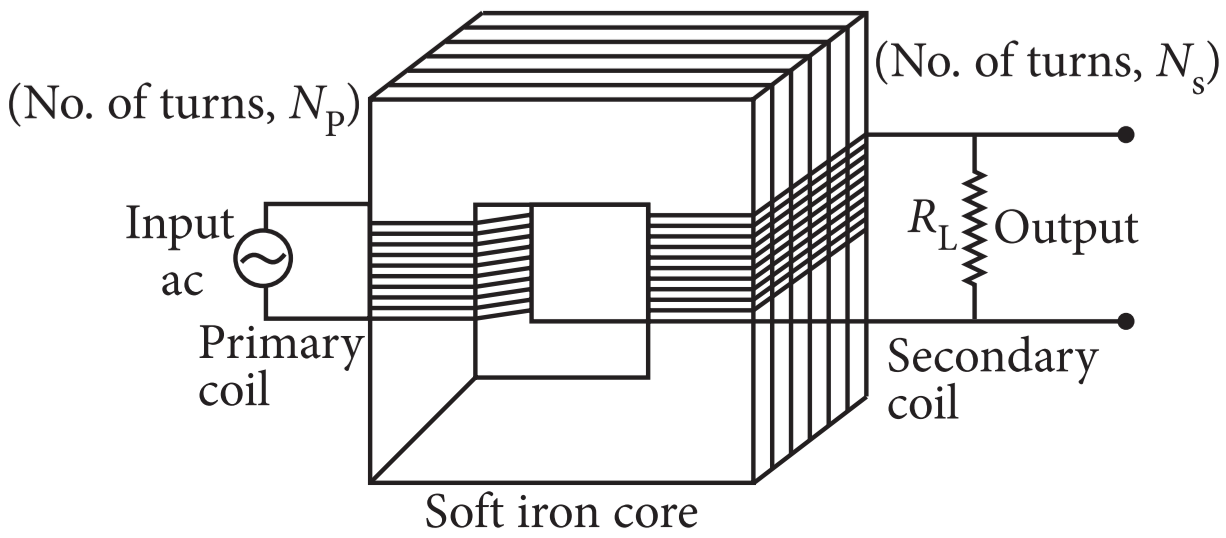
A transformer is an electrical device which is used for changing the a.c. voltages. It is based on the phenomenon of mutual induction i.e. whenever the amount of magnetic flux linked with a coil changes, an $\text{e.m.f.}$ is induced in the neighbouring coil. For an ideal transformer, the resistances of the primary and secondary windings are negligible.

It can be shown that $\frac{\text{E}_\text{S}}{\text{E}_\text{P}}=\frac{\text{I}_\text{P}}{\text{I}_\text{S}}=\frac{\text{n}_\text{S}}{\text{n}_\text{P}}=\text{K}$
where the symbols have their standard meanings.
For a step up transformer, $\text{n}_\text{S} > \text{n}_\text{P}; \text{E}_\text{S} > \text{E}_\text{P}; \text{k} > \text{I}; \therefore \text{I}_\text{S} < \text{I}_\text{P}$
For a step down transformer, $\text{n}_\text{S} > \text{n}_\text{P}; \text{E}_\text{S} > \text{E}_\text{P}; \text{k} > \text{I};$
The above relations are on the assumptions that efficiency of transfonner is $100\%.$
lnfact, efficiency $\eta=\frac{\text{output power}}{\text{intput power }}=\frac{\text{E}_\text{S}\text{I}_\text{S}}{\text{E}_\text{P}\text{I}_\text{P}}$
  1. Which of the following quantity remains constant in an ideal transformer?
  1. Current.
  2. Voltage.
  3. Power.
  4. All of these.
  1. Transformer is used to.
  1. Convert ac to de voltage.
  2. Convert de to ac voltage.
  3. Obtain desired de power.
  4. Obtain desired ac voltage and current.
  1. The number of tums in primary coil of a transformer is 20 and the number of turns in a secondary is 10. If the voltage across the primary is ac 220V, what is the voltage across the secondary?
  1. $ac\ 100V$
  2. $ac\ 120V$
  3. $ac\ 110V$
  4. $ac\ 220V$
  1. In a transformer the number of primary turns is four times that of the secondary turns. Its primary is connected to an a.c. source of voltage $V.$ Then,
  1. Current through its secondary is about four times that of the current through its primary.
  2. Voltage across its secondary is about four times that of the voltage across its primary.
  3. Voltage across its secondary is about two times that of the voltage across its primary.
  4. voltage across its secondary is about $\frac{1}{2\sqrt{2}}$ times that of the voltage across its primary.
  1. A transformer is used to light $100W-110V$ lamp from $220V$ mains. If the main current is $0.5A$, the efficiency of the transformer is:
  1. $95\%$
  2. $99\%$
  3. $90\%$
  4. $96\%$
A convex or converging lens is thicker at the centre than at the edges. It converges a parallel beam of light on refraction through it. It has a real focus. Convex lens is of three types: $(i)$ Double convex lens $(ii)$ Plano$-$convex lens $(iii)$ Concavo$-$convex lens. Concave lens is thinner at the centre than at the edges. It diverges a parallel beam of light on refraction th rough it. It has a virtual focus.
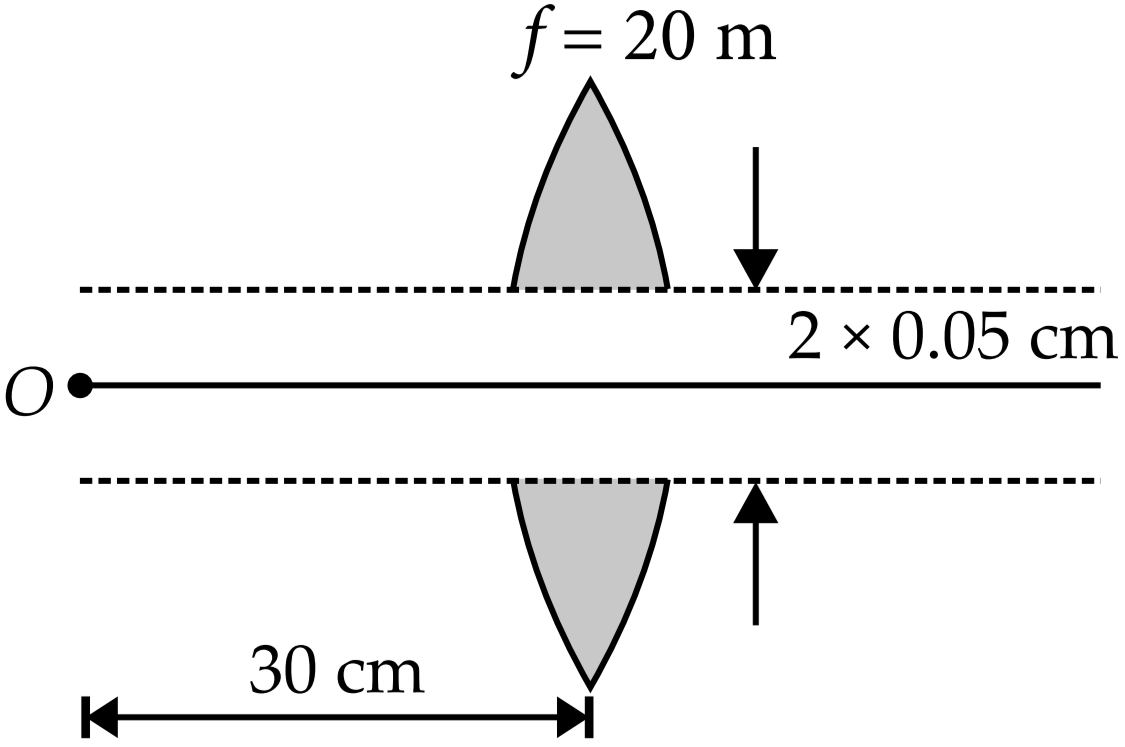
  1. A point object $O$ is placed at a distance of $0.3m$ from a convex lens $($focal length $0.2m)$ cut into two halves each of which is displaced by $0.0005$ mas shown in figure.

What will be the location of the image?
  1. $30\ cm$ right of lens.
  2. $60\ cm$ right of lens.
  3. $70\ cm$ left of lens.
  4. $40\ cm$ left of lens.
  1. Two thin lenses are in contact and the focal length of the combination is $80\ cm.$ If the focal length of one lens is $20\ cm,$ the focal length of the other would be.
  1. $26.7\ cm$
  2. $60\ cm$
  3. $80\ cm$
  4. $20\ cm$
  1. A spherical air bubble is embedded in a piece of glass. For a ray of light passing through the bubble, it behaves tike a.
  1. Converging lens.
  2. Diverging lens.
  3. Piano$-$converging lens.
  4. Piano$-$diverging lens.
  1. Lens used in magnifying glass is:
  1. Concave lens.
  2. Convex lens.
  3. Both $(a)$ and $(b).$
  4. None of the above.
  1. The magnification of an image by a convex lens is positive only when the object is placed.
  1. At its focus $F.$
  2. Between $F$ and $2F.$
  3. At $2F.$
  4. Between $F$ and optical centre.
Microwave oven: The spectrum of electromagnetic radiation contains a part known as microwaves. These waves have frequency and energy smaller than visible light and wavelength larger than it. What is the principle of a microwave oven and how does it work? Our objective is to cook food or warm it up. All food items such as fruit, vegetables, meat, cereals, etc., contain water as a constituent. Now, what does it mean when we say that a certain object has become warmer? When the temperature of a body rises, the energy of the random motion of atoms and molecules increases and the molecules travel or vibrate or rotate with higher energies. The frequency of rotation of water molecules is about 2.45 gigahertz (GHz). If water receives microwaves of this frequency, its molecules absorb this radiation, which is equivalent to heating up water. These molecules share this energy with neighbouring food molecules, heating up the food. One should use porcelain vessels and non-metal containers in a microwave oven because of the danger of getting a shock from accumulated electric charges. Metals may also melt from heating. The porcelain container remains unaffected and cool, because its large molecules vibrate and rotate with much smaller frequencies, and thus cannot absorb microwaves. Hence, they do not get eaten up. Thus, the basic principle of a microwave oven is to generate microwave radiation of appropriate frequency in the working space of the oven where we keep food. This way energy is not wasted in heating up the vessel. In the conventional heating method, the vessel on the burner gets heated first and then the food inside gets heated because of transfer of energy from the vessel. In the microwave oven, on the other hand, energy is directly delivered to water molecules which is shared by the entire food.

(i) As compared to visible light microwave has frequency and energy
(a) Frequency is less but energy is more
(b) less than visible light
(c) more than visible light
(d) equal to visible light

(ii) When the temperature of a body rises
(a) the energy of the random motion of atoms and molecules decreases.
(b) the energy of the random motion of atoms and molecules remains same.
(c) the energy of the random motion of atoms and molecules increases
(d) the random motion of atoms and molecules becomes streamlined.

(iii) he frequency of rotation of water molecules is about
(a) 2.45 THz
(b) 2.45 kHz
(c) 2.45 MHz
(d) 2.45 GHz

OR

In the microwave oven
(a) Energy is directly delivered to the food grains.
(b) The vessel gets heated first and then the water molecules collect heat from the body of the vessel
(c) Energy is directly delivered to water molecules which is shared by the entire food
(d) The vessel gets heated first, and then the food grains inside

(iv) Why should one use porcelain vessels and non-metal containers in a microwave oven?
(a) Because it will prevent the food items to become hot
(b) Because it will get too much hot
(c) Because of the danger of getting a shock from accumulated electric charges
(d) Because it may crack due to high frequency
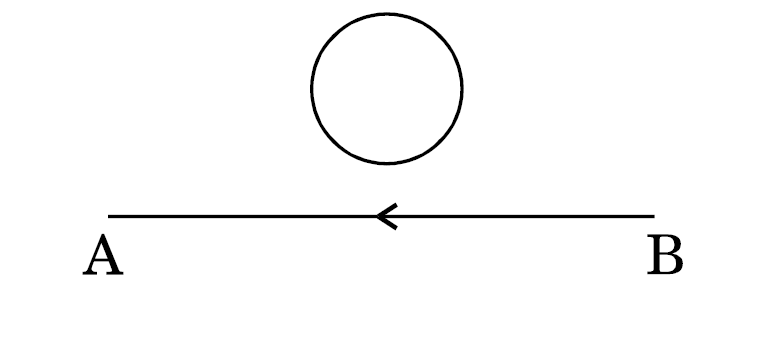
The electric current flowing in a wire in the direction from B to A is decreasing. Find out the direction of the induced current in the metallic loop kept above the wire as shown.
For a single slit of width "a", the first minimum of the interference pattem of a monochromatic light of wavelength$\lambda$. Occurs at an angle of$\frac{\lambda}{\text{a}}$. At the same angle of$\frac{\lambda}{\text{a}},$ we get a maximum for two narrow slits separated by a distance "a". Explain.
A charge is a property associated with the matter due to which it experiences and produces an electric and magnetic field. Charges are scalar in nature and they add up like real numbers. Also, the total charge of an isolated system is always conserved. When the objects rub against each other charges acquired by them must be equal and opposite.
Image
(i) The cause of charging is:
(a) the actual transfer of atoms
(b) the actual transfer of protons
(c) the actual transfer of electrons
(d) the actual transfer of neutrons

(ii) Pick the correct statement.
i. The glass rod gives protons to silk when they are rubbed against each other.
ii. The glass rod gives electrons to silk when they are rubbed against each other.
iii. The glass rod gains protons from silk when they are rubbed against each other.
iv. The glass rod gains electrons when they are rubbed against each other.
(a) Option (i) (b) Option (iv) (c) Option (iii) (d) Option (ii)

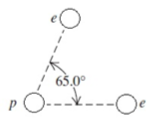
(iii) If two electrons are each $1.5 \times 10^{-10} m$ from a proton, as shown in Figure, magnitude of the net electric force they will exert on the proton is
Image

(a) $1.97 \times 10^{-8} N$
(b) $3.83 \times 10^{-8} N$
(c) $4.63 \times 10^{-8} N$
(d) $2.73 \times 10^{-8} N$

(iv) A charge is a property associated with the matter due to which it produces and experiences:
(a) electric effects only
(b) magnetic effects only
(c) both electric and magnetic effects
(d) non magnetic effects only

OR

The cause of quantization of electric charges is:
(a) transfer of an integral number of electrons
(b) transfer of an integral number of neutrons
(c) transfer of an integral number of protons
(d) transfer of an integral number of Atom
Draw a neat labelled diagram of human eye. Explain shortsightedness and longsightedness eye defects giving their cause and method of removal showing ray diagram.
What are signals ? What do you mean by analog and digital signals ?