Question
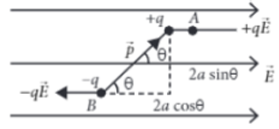
When electric dipole is placed in uniform electric field, its two charges experience equal and opposite forces, which cancel each other and hence net force on electric dipole in uniform electric field is zero. However these forces are not collinear, so they give rise to some torque on the dipole. Since net force on electric dipole in uniform electric field is zero. so no work is done in moving the electric dipole in uniform electric field. However some work is done in rotating the dipole against the torque acting on it.
Image
$(i)$ The dipole moment of a dipole in a uniform external field $\vec{E}$ is $\vec{P}$. Then the torque $\vec{\tau}$ acting on the dipole is
$(a) \vec{\tau}=2(\vec{P}+\vec{E})$
$(b) \vec{\tau}=\vec{P} \cdot \vec{E}$
$(c) \vec{\tau}=(\vec{P}+\vec{E})$
$(d) \vec{\tau}=\vec{P} \times \vec{E}$

$(ii)$ An electric dipole consists of two opposite charges, each of magnitude $1.0 \mu C$ separated by a distance of $2.0 \ cm$ . The dipole is placed in an external field of $10^5 NC ^{-1}$. The maximum torque on the dipole is
$(a) 4 \times 10^{-3} Nm$
$(b) 2 \times 10^{-3} Nm$
$(c) 1 \times 10^{-3} Nm$
$(d) 0.2 \times 10^{-3} Nm$

$(iii)$ Torque on a dipole in uniform electric field is minimum when $\theta$ is equal to
$(a) 0^{\circ}$
$(b) 90^{\circ}$
$(c) 180^{\circ}$
$(d)$ Both $0^{\circ}$ and $180^{\circ}$

$(iv)$ When an electric dipole is held at an angle in a uniform electric field, the net force $F$ and torque on the dipole are
$(a) F =0, \tau=0$
$(b) F \neq 0, \tau \neq 0$
$(c) F \neq 0, \tau=0$
$(d) F =0, \tau \neq 0$
OR
An electric dipole of moment $p$ is placed in an electric field of intensity $E$. The dipole acquires a position such that the axis of the dipole makes an angle $\theta$ with the direction of the field. Assuming that the potential energy of the dipole to be zero when $\theta=90^{\circ},$ the torque and the potential energy of the dipole will respectively be
$(a) pE \sin \theta,- pE \cos \theta$
$(b) pE \cos \theta,- pE \sin \theta$
$(c) pE \sin \theta, 2 pE \cos \theta$
$(d) pE \sin \theta,-2 pE \cos \theta$
Answer

When electric dipole is placed in uniform electric field, its two charges experience equal and opposite forces, which cancel each other and hence net force on electric dipole in uniform electric field is zero. However these forces are not collinear, so they give rise to some torque on the dipole. Since net force on electric dipole in uniform electric field is zero. so no work is done in moving the electric dipole in uniform electric field. However some work is done in rotating the dipole against the torque acting on it.
Image
$(i) (d) \vec{\tau}=\vec{P} \times \vec{E}$
Explanation: As $\tau=$ either force $\times$ perpendicular distance between the two forces
$= qaE \sin \theta \text { or } \tau= PE \sin \theta$
$\text { or } \vec{P} \times \vec{E}(\because qa = P )$

$(ii) (b) 2 \times 10^{-3} Nm$
Explanation: The maximum torque on the dipole in an external field is given by
$\tau= pE = q (2 a ) \times E$
Here $, q =1 \mu C =10^{-6} C , 2 a =2 \ cm=2 \times 10^{-2} m, E =10^5 NC ^{-1}, \tau=?$
$\therefore \tau=10^{-6} \times 2 \times 10^{-2} \times 10^5=2 \times 10^{-3} Nm $

$(iii) (d)$ Both $0^{\circ}$ and $180^{\circ}$
Explanation: When $\theta$ is $0$ or $180^{\circ}$, the $\tau$ is minimum, which means the dipole moment should be parallel to the direction of the uniform electric field.

$(iv) (d) F =0, \tau \neq 0$
Explanation: Net force is zero and torque acts on the dipole, trying to align $p$ with $E$ .

OR
$(a) pE \sin \theta,- pE \cos \theta$
Explanation: Torque, $\tau= pE \sin \theta$ and potential energy
$U=-p E \cos \theta$

Need a full question paper?

Generate a complete, print-ready paper with questions like this in minutes — across 16+ boards, with answer keys.

Start Generating Free

Similar questions

A charge of $1.6 \times 10^{-7} C$ is uniformly distributed on the surface of a spherical conductor of radius 12 cm . What will be the electric field?(a) Inside the sphere(b) Just outside the sphere(c) At any point located 18 cm from the centre of the sphere.
A short magnet oscillates in an oscillation magnetometern with a time period of 0.10s where the earth's horizontal magnetic field is $24\mu\text{T}.$ A downward current of 18 A is established in a vertical wire placed 20cm east of the magnet. Find the new time period.
What is power factor? Explain.
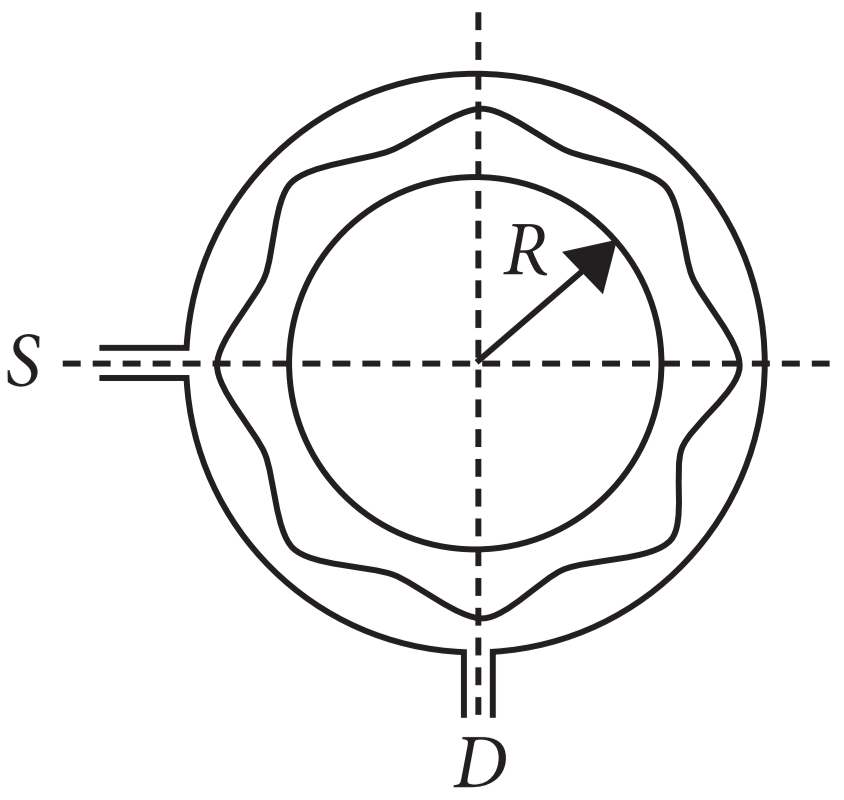
A narrow tube is bent in the form of a circle of radius $R,$ as shown in figure. Two small holes $S$ and $D$ are made in the tube at the positions at right angle to each other. $A$ source placed at $S$ generates a wave of intensity $I_0$ which is equally divided into two parts: one part travels along the longer path, while the other travels along the shorter path. Both the waves meet at point Dwhere a detector is place
  1. If a maxima is formed at a detector, then the magnitude of wavelength $\lambda$ of the wave produced is given by:
  1. $\pi\text{R}$
  2. $\frac{\pi\text{R}}{2}$
  3. $\frac{\pi\text{R}}{4}$
  4. All of these.
  1. If the in tensity ratio of two coherent sources used in Young's double slit experiment is $49 : 1,$ then the ratio between the maximum and minimum intensities in the interference pattern is:
  1. $1 : 9$
  2. $9 : 16$
  3. $25 : 16$
  4. $16 : 9$
  1. The maximum intensity produced at $D$ is given by:
  1. $4I_0$
  2. $2I_0$
  3. $I_0$
  4. $3I_0$
  1. ln a Young's double slit experiment, the intensity at a point where the path difference is $\frac{\lambda}{6} \ (\lambda - $ wavelength of the light$)$ is $I$. If $I_0$ denotes the maximum intensity, then $ I/I_0$ is equal to:
  1. $\frac{1}{2}$
  2. $\frac{\sqrt3}{2}$
  3. $\frac{1}{\sqrt2}$
  4. $\frac{3}{4}$
  1. Two identical light waves, propagating in the same direction, have a phase differenced. After they superpose the intensity of the resulting wave will be proportional to:
  1. $\cos\delta$
  2. $\cos\Big(\frac{\delta}{2}\Big)$
  3. $\cos^2\Big(\frac{\delta}{2}\Big)$
  4. $\cos^2\delta$
In tug of war, the team that exerts a larger tangential force on the ground wins. Consider the period in which a team is dragging the opposite team by applying a larger tangential force on the ground. List which of the following works are positive, which are negative and which are zero?
  1. Work by the winning team on the losing team.
  2. Work by the losing team on the winning team.
  3. Work by the ground on the winning team.
  4. Work by the ground on the losing team.
  5. Total external work on the two teams.
A hot body is placed in a closed room maintained at a lower temperature. Is the number of photons in the room increasing?
In a plane electromagnetic wave, the electric field oscillates sinusoidally at a frequency of $2.0 \times 10^{10} Hz$ and amplitude $48 V m ^{-1}$.
(a) What is the wavelength of the wave?
(b) What is the amplitude of the oscillating magnetic field?
(c) Show that the average energy density of the E field equals the average energy density of the B field $\left[ c =3 \times 10^8 m s ^{-1}\right]$.
The power averaged over one full cycle of $a.c.$ is known as average power. It is also known as true power.
$\text{P}_\text{av}=\text{V}_\text{rms}\text{I}_\text{rms}\cos\phi=\frac{\text{V}_0\text{I}_0}{2}\cos\phi$
Root mean square or simply rms watts refer to continuous power.
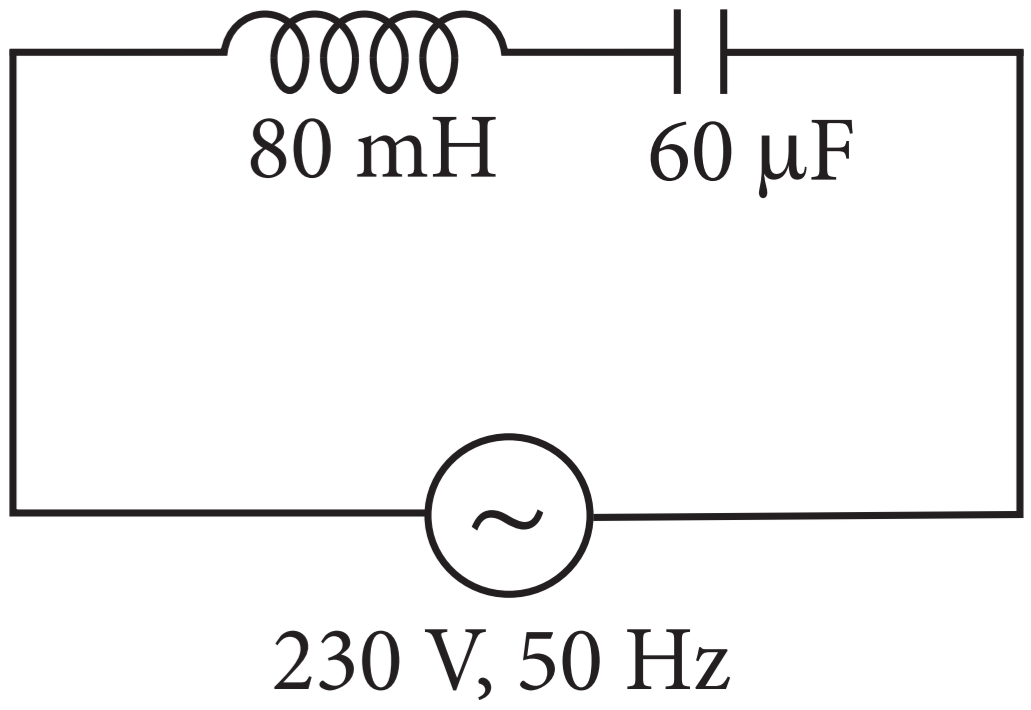
A circuit containing a $80\ mH$ inductor and a $60\ \mu\text{F}$ capacitor in series is connected to a $230V, 50Hz$ supply. The resistance of the circuit is negligible.
  1. The value of current amplitude is:
  1. $15A$
  2. $11.63A$
  3. $17.65A$
  4. $6.33A$
  1. Find rms value.
  1. $6A$
  2. $5.25A$
  3. $8.23A$
  4. $7.52A$
  1. The average power transferred to inductor is:
  1. Zero
  2. $7W$
  3. $2.5W$
  4. $5W$
  1. The average power transferred to the capacitor is:
  1. $5W$
  2. Zero
  3. $11W$
  4. $15W$
  1. What is the total average power absorbed by the circuit?
  1. Zero
  2. $10W$
  3. $2.5W$
  4. $15W$
Out of the two magnetic materials, 'A' has relative permeability slightly greater than unity while 'B' has less than unity. Identify the nature of the materials 'A' and 'B'. Will their susceptibilities be positive or negative?
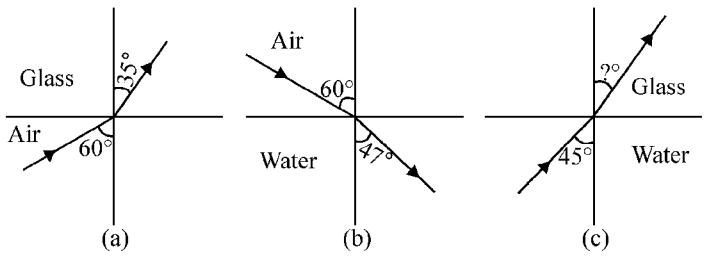
Figure (a) and (b) show refraction of a ray in air incident at 60 deg with the normal to a glass-air and water-air interface, respectively. Predict the angle of refraction in glass when the angle of incidence in water is 45 deg with the normal to a water-glass interface [Fig. (c)].
Image