Question
A metallic loop is placed in a nonuniform magnetic field. Will an emf be induced in the loop?

Answer

As the magnetic field is non uniform thus it will induce only small electric field in different directions so there would be no net current in the loop.

Need a full question paper?

Generate a complete, print-ready paper with questions like this in minutes — across 16+ boards, with answer keys.
Start Generating Free

Similar questions

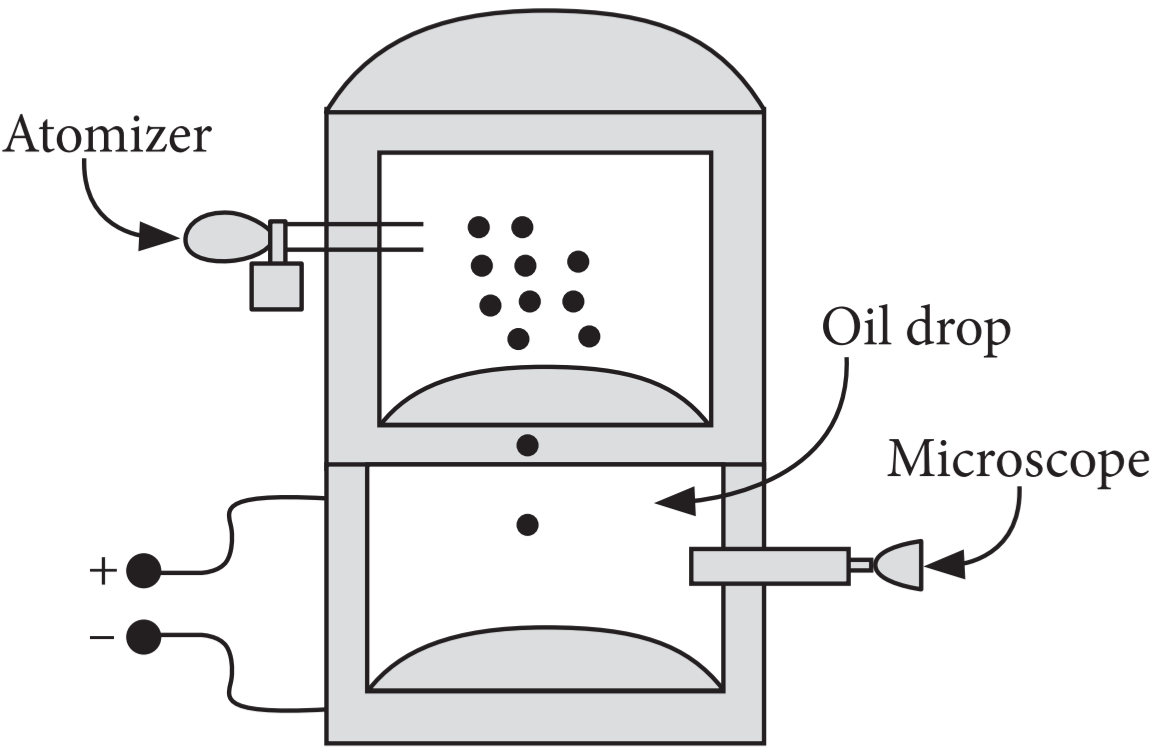
In $1909,$ Robert Millikan was the first to find the charge of an electron in his now $-$ famous oil $-$ drop experiment. In that experiment, tiny oil drops were sprayed into a uniform electric field between a horizontal pair of oppositely charged plates. The drops were observed with a magnifying eyepiece, and the electric field was adjusted so that the upward force on some negatively charged oil drops was just sufficient to balance the downward force of gravity. That is, when suspended, upward force $qE$ just equaled Mg. Millikan accurately measured the charges on many oil drops and found the values to be whole number multiples of $1.6 \times 10^{-19}C$ the charge of the electron. For this, he won the Nobel Prize.
  1. If a drop of mass $1.08 \times 10^{-14}kg$ remains stationary in an electric field of $1.68 \times 10^5NC^{-1},$ then the charge of this drop is:
  1. Extra electrons on this particular oil drop $($given the presently known charge of the electron$)$ are:
  2. $6.40 \times 10^{-19}C$
  3. $3.2 \times 10^{-19}C$
  4. $1.6 \times 10^{-19}C$
  5. $4.8 \times 10^{-19}C$
  6. $3$
  7. $5$
  8. $8$
  9. $4$
  1. A negatively charged oil drop is prevented from falling under gravity by applying a vertical electric field $100V m^{-1}$. If the mass of the drop is $1.6 \times 10^{-3}g,$ the number of electrons carried by the drop is $(g = 10m s^{-2})$
  1. $8\mu\text{C}$
  2. $20\mu\text{C}$
  3. $12\mu\text{C}$
  4. $4\mu\text{C}$
  5. If in Millikan's oil drop experiment, charges on drops are found to be $8\mu\text{C, }12\mu\text{C, }20\mu\text{C, }$ then quanta of charge is:
  6. Charge is never quantized.
  7. Charge has no definite value.
  8. Charge is quantized.
  9. Charge on oil drop always increases.
  10. The important conclusion given by Millikan's experiment about the charge is:
  11. $10^{18}$
  12. $10^{15}$
  13. $10^{12}$
  14. $10^9$
In an $a.c$. circuit, values of voltage and current change every instant. Therefore, power of an $a.c$. circuit at any instant is the product of instantaneous voltage $(E)$ and instantaneous current $(I)$. The average power supplied to a pure resistance $R$ over a complete cycle of $a.c$. is $\text{P} = \text{E}_\text{V}\text{I}_\text{V}.$ When circuit is inductive, average power per cycle is $\text{E}_\text{V}\text{I}_\text{V}\cos\phi.$

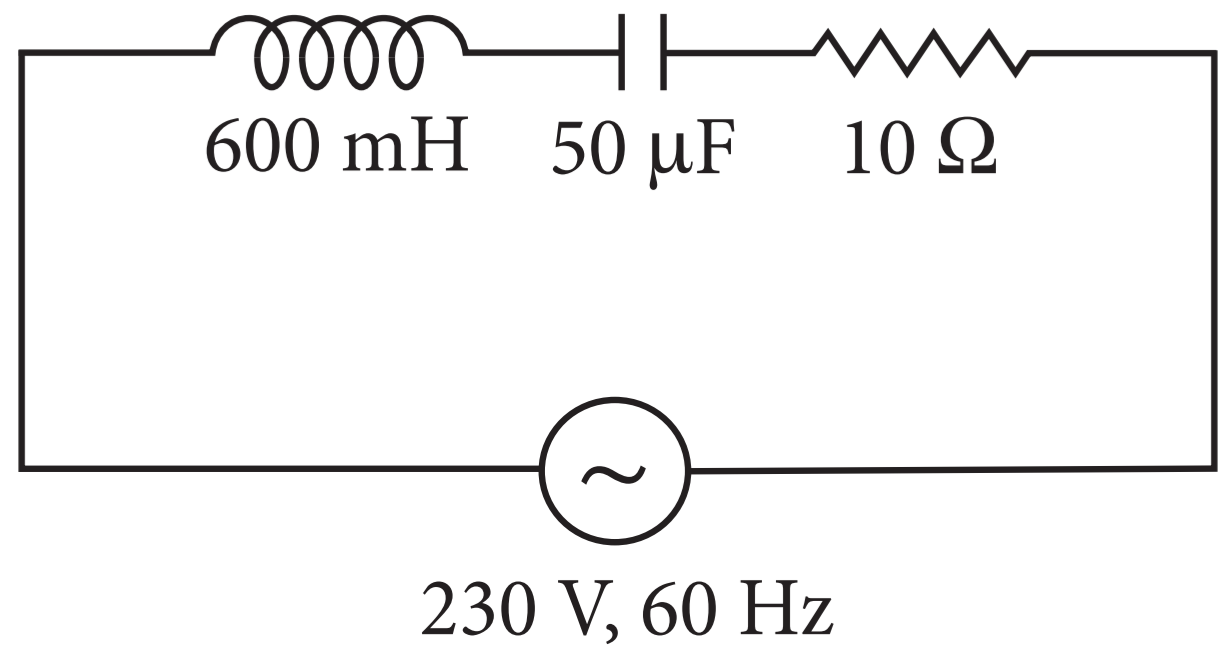
In an $a.c$. circuit $, 600mH$ inductor and a $15\Omega$ capacitor are connected in series with $10\Omega$ resistance. The $a.c$. supply to the circuit is $230V, 60Hz$.
  1. The average power transferred per cycle to resistance is:
  1. $10.42W$
  2. $15.25W$
  3. $17.42W$
  4. $13.45W$
  1. The average power transferred per cycle to capacitor is:
  1. Zero
  2. $10.42W$
  3. $17.42W$
  4. $15W$
  1. The average power transferred per cycle to inductor is:
  1. $25W$
  2. $17.42W$
  3. $16.52W$
  4. Zero
  1. The total power transferred per cycle by all the three circuit elements is:
  1. $17.42W$
  2. $10.45W$
  3. $12.45W$
  4. Zero
  1. The electrical energy spend in running the circuit for one hour is:
  1. $7.5 \times 10^5$ Joule
  2. $10 \times 10^3$ Joule
  3. $9.4 \times 10^3$ Joule
  4. $6.2 \times 10^4$ Joule
Radio waves are produced by the accelerated motion of charges in conducting wires. Microwaves are produced by special vacuum tubes. Infrared waves are produced by hot bodies and molecules also known as heat waves. UV rays are produced by special lamps and very hot bodies like Sun.
  1. Solar radiation is:
  1. Transverse electromagnetic wave.
  2. Longitudinal electromagnetic waves.
  3. Both longitudinal and transverse electromagnetic waves.
  4. None of these.
  1. What is the cause of greenhouse effect?
  1. Infrared rays.
  2. Ultraviolet rays
  3. X-rays.
  4. Radiowaves.
  1. Biological importance of ozone layer is:
  1. It stops ultraviolet rays.
  2. It layer reduces greenhouse effect.
  3. It reflects radiowaves.
  4. None of these.
  1. Ozone is found in.
  1. Stratosphere.
  2. Ionosphere.
  3. Mesosphere.
  4. Troposphere.
  1. Earth's atmosphere is richest in.
  1. Ultraviolet.
  2. Infrared.
  3. X-rays.
  4. Microwave.
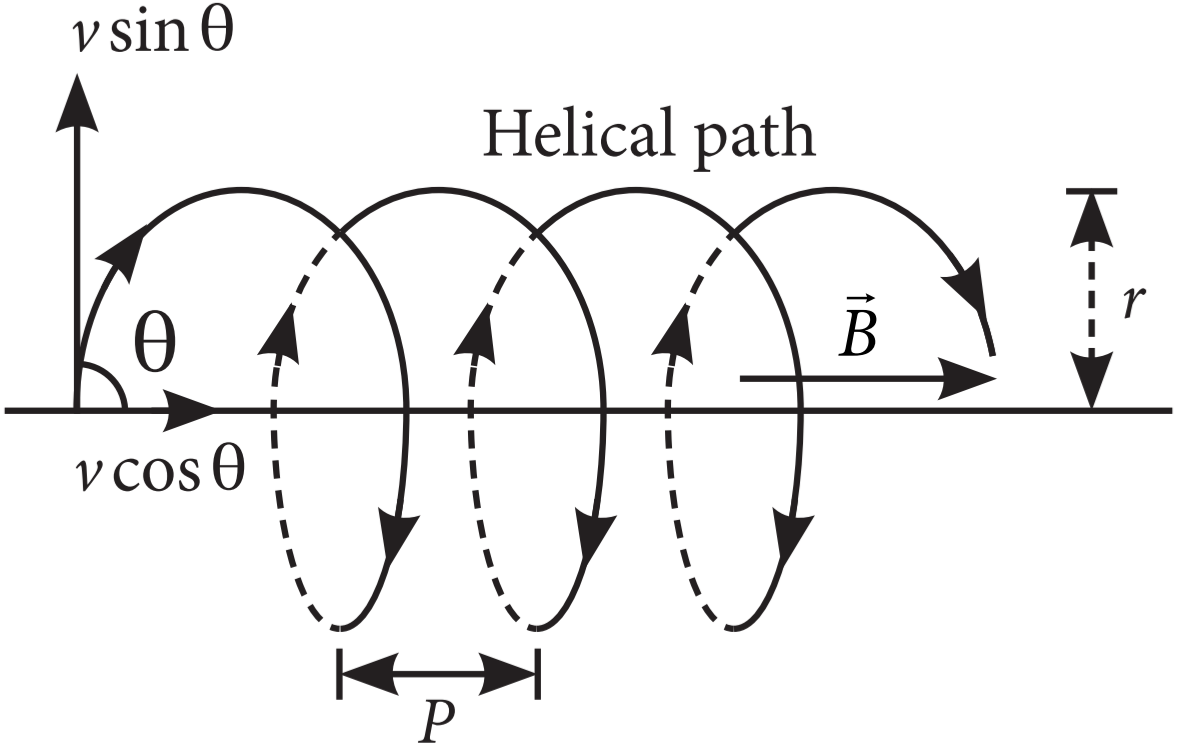
The path of a charged particle in magnetic field depends upon angle between velocity and magnetic field. If velocity $\vec{\text{v}}$ is at angle $\theta$ to $\vec{\text{B}},$ component of velocity parallel to magnetic field $(\text{v}\cos\theta)$ remains constant and component of velocity perpendicular to magnetic field $(\text{v}\sin\theta)$ is responsible for circular motion, thus the charge particle moves in a helical path.
The plane of the circle is perpendicular to the magnetic field and the axis of the helix is parallel to the magnetic field. The charged particle moves along helical path touching the line parallel to the magnetic field passing through the starting point after each rotation. Radius of circular path is $\text{r}=\frac{\text{mv}\sin\theta}{\text{qB}}$ Hence the resultant path of the charged particle will be a helix, with its axis along the direction of $\vec{\text{B}}$ as shown in figure.
  1. When a positively charged particle enters into a uniform magnetic field with uniform velocity, its trajectory can $b$:
  1. A straight line.
  2. A circle.
  3. A helix.
  1. $(i)$ Only
  2. $(i)$ or $(ii)$
  3. $(i)$ or $(iii)$
  4. Any one of $(i), (ii)$ and $(iii)$
  1. Two charged particles $A$ and $B$ having the same charge, mass and speed enter into a magnetic field in such a way that the initial path of $A$ makes an angle of $30^\circ$ and that of $B$ makes an angle of $90^\circ$ with the field. Then the trajectory of:
  1. B will have smaller radius of curvature than that of $A$.
  2. Both will have the same curvature.
  3. A will have smaller radius of curvature than that of $B.$
  4. Both will move along the direction of their original velocities.
  1. An electron having momentum $2.4 \times 10^{-23}kg m/ s$ enters a region of uniform magnetic field of $0.15T.$ The field vector makes an angle of $30^\circ$ with the initial velocity vector of the electron. The radius of the helical path of the electron in the field shall be:
  1. $mm$
  2. $1\ mm$
  3. $\frac{\sqrt{3}}{2}\text{ mm}$
  4. $0.5\ mm$
  1. The magnetic field in a certain region of space is given by $\vec{\text{B}}=8.35\times10^{-2}\hat{\text{i}}\text{T}.$ A proton is shot into the field with velocity $\vec{\text{v}}=(2\times10\hat{\text{i}}+4\times10^5\hat{\text{j}.}$ The proton follows a helical path in the field. The distance moved by proton in the $x-$ direction during the period ofone revolution in the $yz-$ plane will be:
$($Mass of proton $= 1.67 \times 10^{-27}kg)$
  1. $0.053m$
  2. $0.136m$
  3. $0.157m$
  4. $0.236m$
  1. The frequency of revolution of the particle is:
  1. $\frac{\text{m}}{\text{pB}}$
  2. $\frac{\text{qB}}{2\pi\text{m}}$
  3. $\frac{2\pi\text{R}}{\text{v}\cos\theta}$
  4. $\frac{2\pi\text{R}}{\text{v}\sin\theta}$
A hot body is placed in a closed room maintained at a lower temperature. Is the number of photons in the room increasing?
A steel blade placed gently on the surface of water floats on it. If the same blade is kept well inside the water, it sinks. Explain.

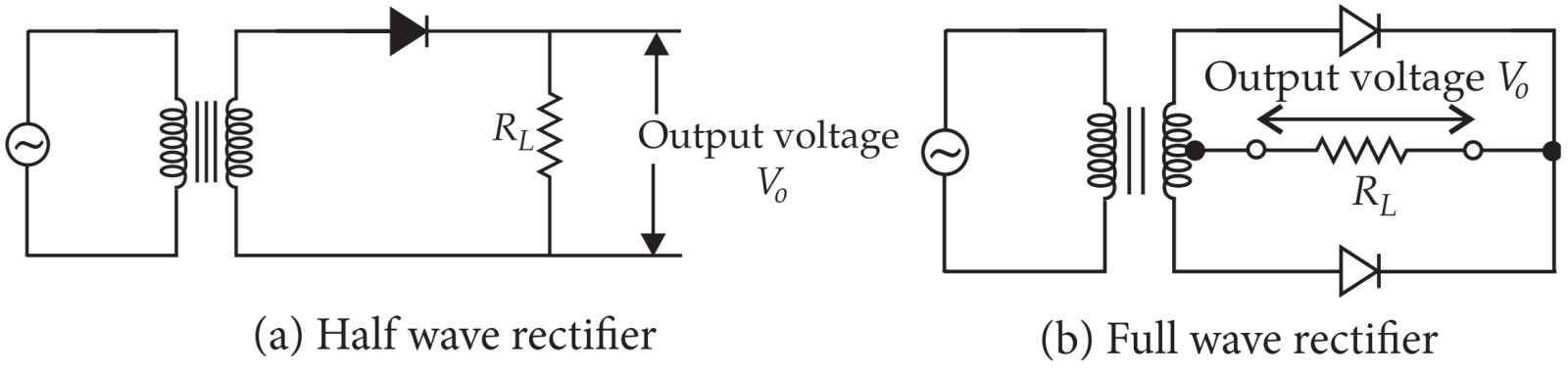
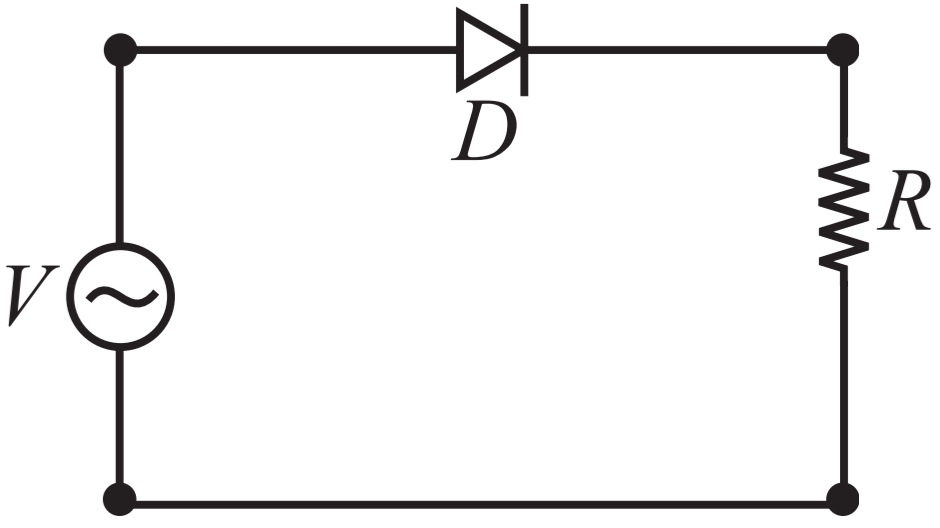
Rectifier is a device which is used for converting alternating current or voltage into direct current or voltage. Its working is based on the fact that the resistance of p-n junction becomes low when forward biased and becomes high when reverse biased. A half-wave rectifier uses only a single diode while a full wave rectifier uses two diodes as shown in figures (a) and (b).
  1. If the rms value of sinusoidal input to a full wave rectifier is $\frac{\text{V}_0}{\sqrt{2}}$ then the rms value of the rectifier's output is:
  1. $\frac{\text{V}_0}{\sqrt{2}}$
  2. $\frac{\text{V}_0^2}{\sqrt{2}}$
  3. $\frac{\text{V}_0^2}{2}$
  4. $\sqrt{2}\text{V}_0^2$
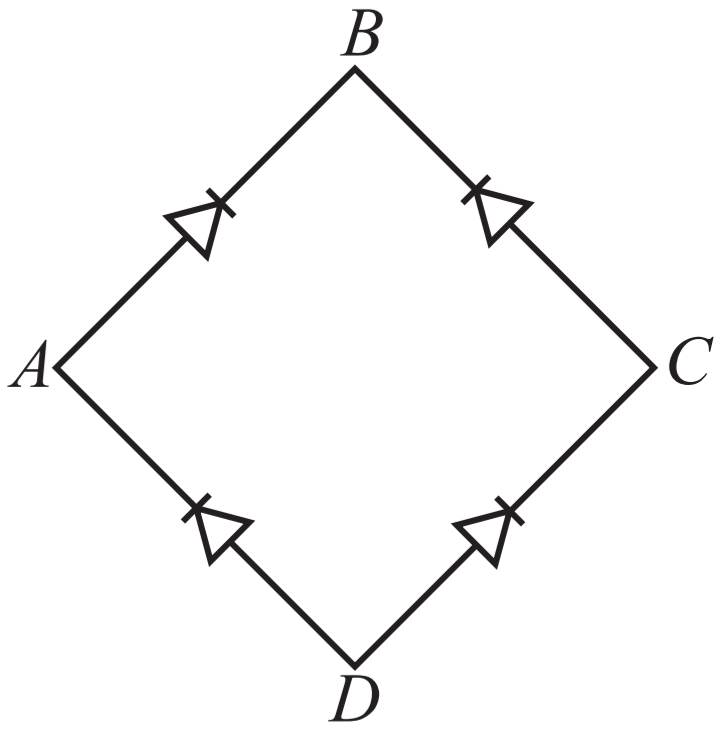
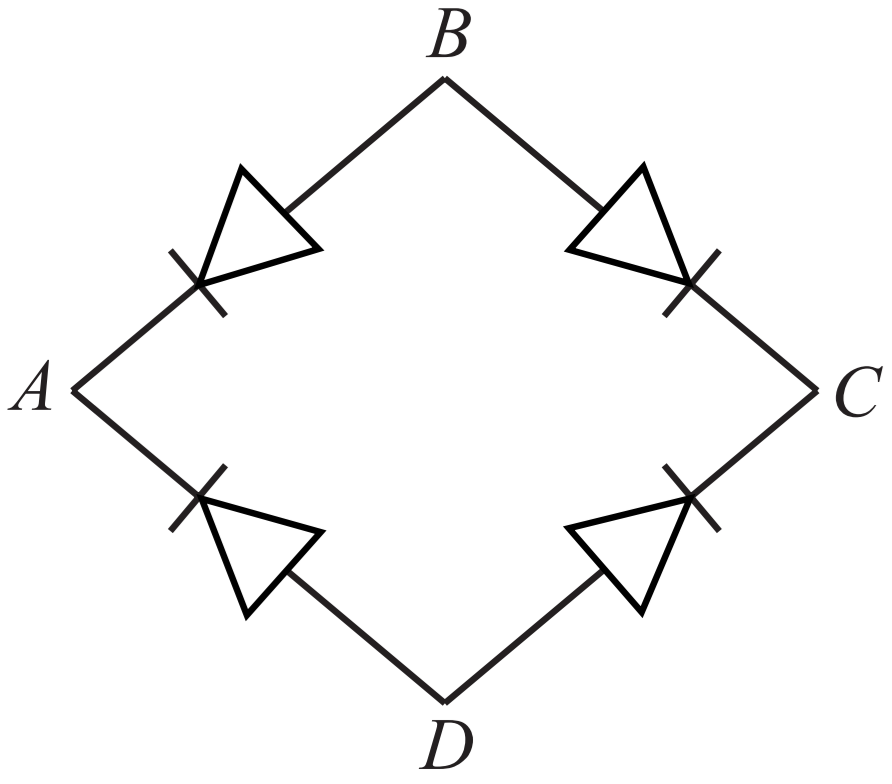
  1. In the diagram, the input ac is across the terminals A and C. The output across B and D is:
  1. Same as the input.
  2. Half wave rectified.
  3. Zero.
  4. Full wave rectified.
  1. A bridge rectifier is shown in figure. Alternating input is given across A and C. If output is taken across BD, then it is:
  1. Zero.
  2. Same as input.
  3. Half wave rectified.
  4. Full wave rectified.
  1. A p-n junction (D) shown in the figure can act as a rectifier. An alternating current source (V) is connected in the circuit. The current (I) in the resistor (R) can be shown by:

  1. With an ac input from 50Hz power line, the ripple frequency is:
  1. 50Hz in the de output of half wave as well as full wave rectifier.
  2. 100Hz in the de output of half wave as well as full wave rectifier.
  3. 50Hz in the de output of half wave and I 00Hz in de output of full wave rectifier.
  4. 100Hz in the de output of half wave and 50Hz in the de output of full wave rectifier.
A thick wire of $15 \Omega$ is stretched to three times its original length. Assuming that the density of the wire remains unchanged, calculate the resistance of the new wire.
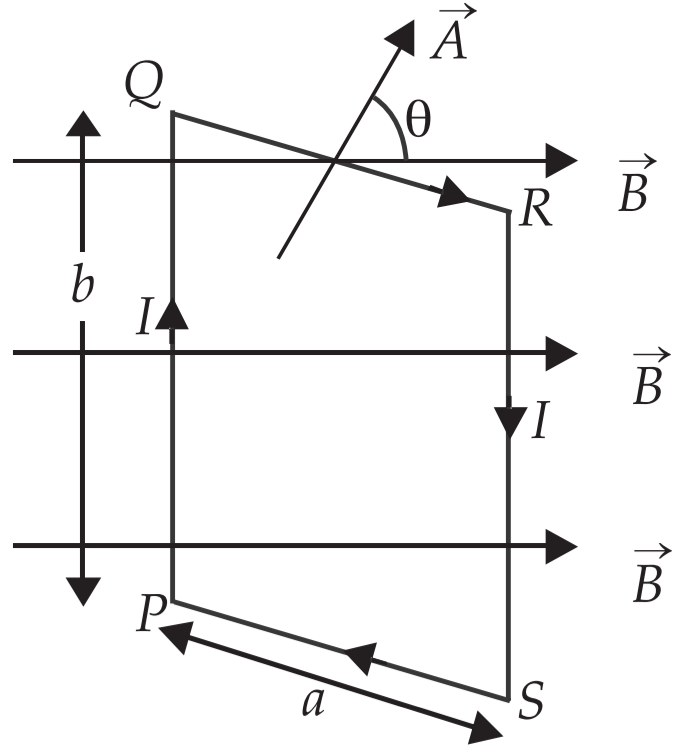
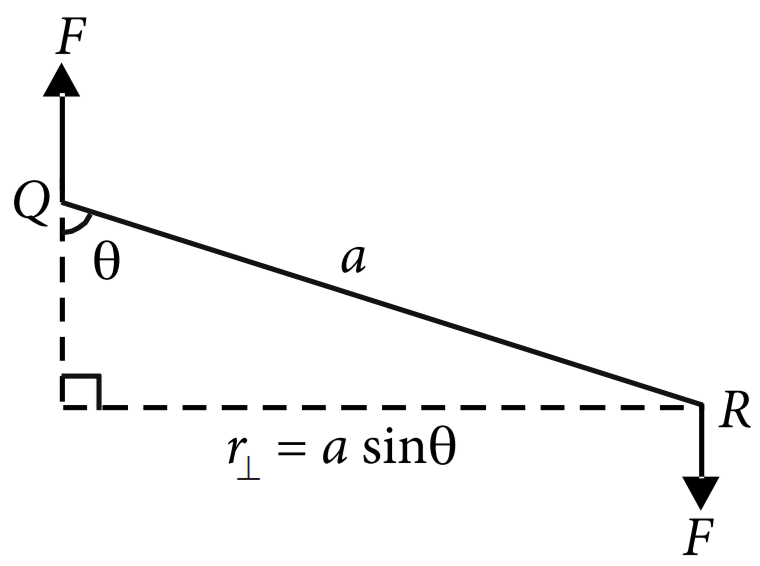
When a rectangular loop $\text{PQRS}$ of sides $' a\ ' $and $' b\ '$ carrying current $I$ is placed in uniform magnetic field $B,$ such that area vector ii makes an angle $8$ with direction of magnetic field, then forces on the arms $QR$ and $SP$ of loop are equal, opposite and collinear, thereby perfectly cancel each other, whereas forces on the arms $PQ$ and $RS$ of loop are equal and opposite but not collinear, so they give rise to torque on the loop.
Force on side $PQ$ or $RS$ of loop is $F = JbB \sin 90^\circ = lb B$ and perpendicular distance between two non-collinear forces is $\text{r}_\bot=\text{a}\sin\theta$
So, torque on the loop. $\tau=\text{IAB}\sin\theta$ In vector form torque, $\vec{\tau}=\vec{\text{M}}\times\vec{\text{B}}$
Where $\vec{\text{M}}=\text{NI}\vec{\text{A}}$ is called magnetic dipole moment of current loop and is directed in direction of area vector $\vec{\text{A}}$ i.e., normal to the plane ofloop.
  1. A circular loop of area $1\ cm^2, $carrying a current of $10A$ is placed in a magnetic field of $0.1T$ perpendicular to the plane of the loop. The torque on the loop due to the magnetic field is:
  1. Zero
  2. $10^{-4}Nm$
  3. $10^{-2}Nm$
  4. $1Nm$
  1. Relation between magnetic moment and angular velocity is:
  1. $\text{m}\propto\omega$
  2. $\text{m}\propto\omega^2$
  3. $\text{m}\propto\sqrt{\omega}$
  4. None of these.
  1. A current loop in a magnetic field:
  1. Can be in equilibrium in two orientations, both the equilibrium states are unstable.
  2. Can be in equilibrium in two orientations, one stable while the other is unstable.
  3. Experiences a torque whether the field is uniform or non uniform in all orientations.
  4. Can be in equilibrium in one orientation.
  1. The magnetic moment of a current $I$ carrying circular coil of radius rand number of turns $N$ varies as:
  1. $\frac{1}{\text{r}^2}$
  2. $\frac{1}{\text{r}}$
  3. $\text{r}$
  4. $\text{r}^2$
  1. A rectangular coil carrying current is placed in a non-uniform magnetic field. On that coil the total:
  1. Force is non$-$zero.
  2. Force is zero.
  3. Torque is zero.
  4. $ZN$one of these.  
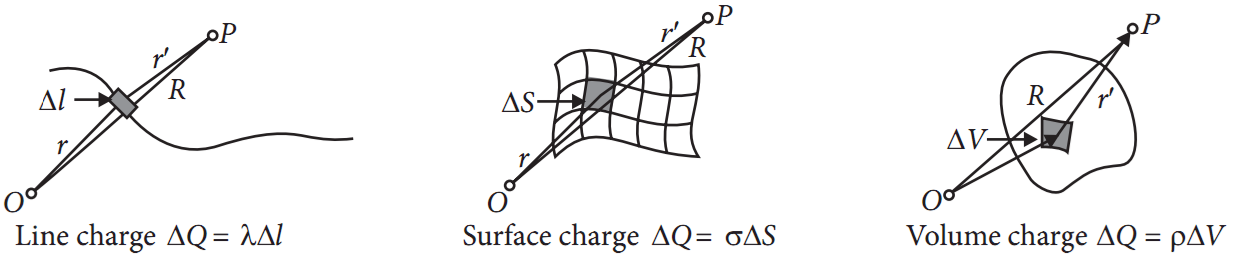
ln practice, we deal with charges much greater in magnitude than the charge on an electron, so we can ignore the quantum nature of charges and imagine that the charge is spread in a region in a continuous manner. Such a charge distribution is known as continuous charge distribution. There are three types of continuous charge distribution : $(i)$ Line charge distribution $(ii)$ Surface charge distribution $(iii)$ Volume charge distribution as shown in figure.
  1. Statement $1$ : Gauss's law can't be used to calculate an electric field near an electric dipole.
Statement $2$ : Electric dipole don't have symmetrical charge distribution.
  1. Statement $1$ and statement $2$ are true.
  2. Statement $1$ is false but statement $2$ is true.
  3. Statement $1$ is true but statement $2$ is false.
  4. Both statements are false.
  1. An electric charge of $8.85 \times 10^{-13}C$ is placed at the centre of a sphere of radius $1m$. The electric flux through the sphere is:
  1. $0.2NC^{-1} m^2$
  2. $0.1NC^{-1} m^2$
  3. $0.3NC^{-1} m^2$
  4. $0.01NC^{-1} m^2$
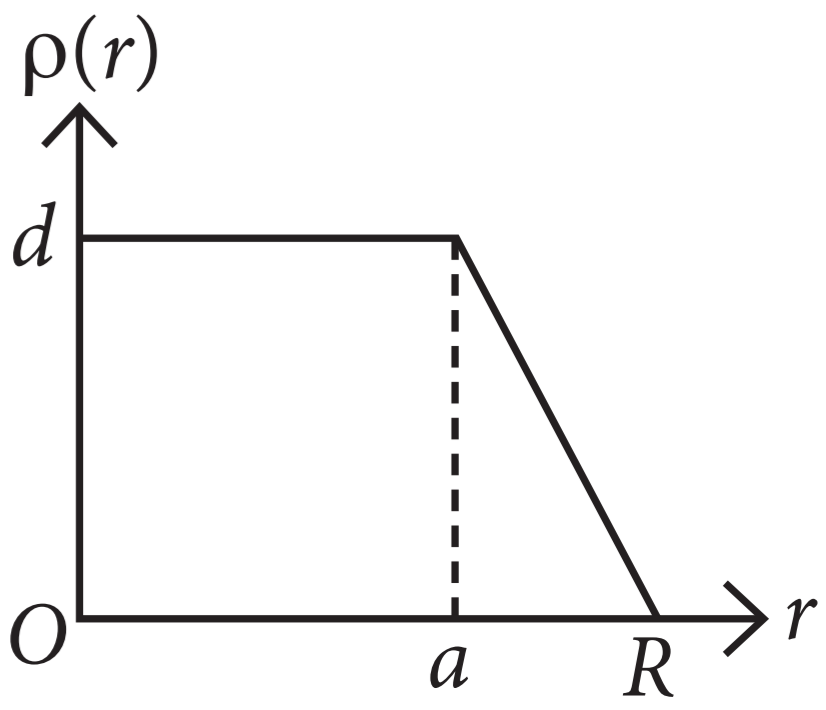
  1. The electric field within the nucleus is generally observed to be linearly dependent on $r$. So,
  1. $a = 0$
  2. $\text{a}=\frac{\text{R}}{2}$
  3. $a = R$
  4. $\text{a}=\frac{\text{2R}}{3}$
  1. What charge would be required to electrify a sphere of radius $25\ cm$ so as to get a surface charge density of $\frac{3}{\pi}\text{Cm}^{-2}?$
  1. $0.75C$
  2. $7.5C$
  3. $75C$
  4. Zero
  1. The $\text{SI}$ unit of linear charge density is :
  1. $Cm$
  2. $Cm^{-1}$
  3. $Cm^{-2}$
  4. $Cm^{-3}$