Equal masses of two liquids are filled in two similar calorimeters. The rate of cooling will
Easy


Download our appand get started for free
Experience the future of education. Simply download our apps or reach out to us for more information. Let's shape the future of learning together!No signup needed.*
Similar Questions
- 1View SolutionA body, which emits radiations of all possible wavelengths, is known as ...........
- 2View SolutionAir is bad conductor of heat or partly conducts heat, still vacuum is to be placed between the walls of the thermos flask because
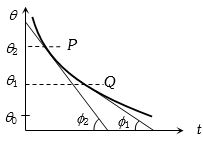
- 3A body cools in a surrounding which is at a constant temperature of ${\theta _0}$. Assume that it obeys Newton's law of cooling. Its temperature $\theta $ is plotted against time $t$ . Tangents are drawn to the curve at the points $P(\theta = {\theta _1})$ and $Q(\theta = {\theta _2})$. These tangents meet the time axis at angles of ${\varphi _2}$and ${\varphi _1}$, as shownView Solution
- 4A solid copper sphere (density $\rho $ and specific heat capacity $c$ ) of radius $r$ at an initial temperature $200K$ is suspended inside a chamber whose walls are at almost $0K$ . The time required (in $\mu s$) for the temperature of the sphere to drop to $100\, K$ isView Solution
- 5A solid cube and a solid sphere of the same material have equal surface area. Both are at the same temperature ${120^o}C$, thenView Solution
- 6An object is at a temperature of ${400^o}C$. At what temperature would it radiate energy twice as fast? The temperature of the surroundings may be assumed to be negligibleView Solution
- 7If a graph is plotted by taking spectral emissive power along $y$-axis and wavelength along $x$-axis then the area below the graph above wavelength axis is ...........View Solution
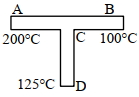
- 8A rod $C D$ of thermal resistance $10.0\; {KW}^{-1}$ is joined at the middle of an identical rod ${AB}$ as shown in figure, The end $A, B$ and $D$ are maintained at $200^{\circ} {C}, 100^{\circ} {C}$ and $125^{\circ} {C}$ respectively. The heat current in ${CD}$ is ${P}$ watt. The value of ${P}$ is ... .View Solution
- 9An object is at a temperature of ${400^o}C$. At what temperature would it radiate energy twice as fast? The temperature of the surroundings may be assumed to be negligibleView Solution
- 10View SolutionThe coefficient of thermal conductivity depends upon