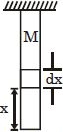
A meter scale of mass $m$ , Young modulus $Y$ and cross section area $A$ is hanged vertically from ceiling at zero mark. Then separation between $30\ cm$ and $70\ cm$ mark will be :-( $\frac{{mg}}{{AY}}$ is dimensionless)
Diffcult


Download our appand get started for free
Experience the future of education. Simply download our apps or reach out to us for more information. Let's shape the future of learning together!No signup needed.*
Similar Questions
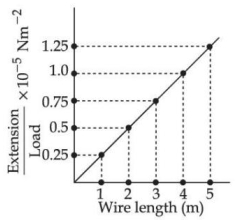
- 1In an experiment to determine the Young's modulus, steel wires of five different lengths $(1,2,3,4$ and $5\,m )$ but of same cross section $\left(2\,mm ^{2}\right)$ were taken and curves between extension and load were obtained. The slope (extension/load) of the curves were plotted with the wire length and the following graph is obtained. If the Young's modulus of given steel wires is $x \times 10^{11}\,Nm ^{-2}$, then the value of $x$ isView Solution
- 2View SolutionThe value of Young's modulus for a perfectly rigid body is ...........
- 3View SolutionWhen compared with solids and liquids, the gases have
- 4$Assertion :$ Stress is the internal force per unitarea of a body.View Solution
$Reason :$ Rubber is more elastic than steel. - 5View SolutionThe bulk modulus of an ideal gas at constant temperature
- 6Two exactly similar wires of steel and copper are stretched by equal forces. If the difference in their elongations is $0.5$ cm, the elongation $(l)$ of each wire is ${Y_s}({\rm{steel}}) = 2.0 \times {10^{11}}\,N/{m^2}$${Y_c}({\rm{copper}}) = 1.2 \times {10^{11}}\,N/{m^2}$View Solution
- 7The bulk modulus of a spherical object is '$B$'. If it is subjected to uniform pressure '$P$', the fractional decrease in radius isView Solution
- 8The length of an iron wire is $L$ and area of cross-section is $A$. The increase in length is $l$ on applying the force $F$ on its two ends. Which of the statement is correctView Solution
- 9A copper wire of length $4.0m$ and area of cross-section $1.2\,c{m^2}$ is stretched with a force of $4.8 \times {10^3}$ $N.$ If Young’s modulus for copper is $1.2 \times {10^{11}}\,N/{m^2},$ the increase in the length of the wire will beView Solution
- 10A body of mass $\mathrm{m}=10\; \mathrm{kg}$ is attached to one end of a wire of length $0.3\; \mathrm{m} .$ The maximum angular speed (in $rad \;s^{-1}$ ) with which it can be rotated about its other end in space station is (Breaking stress of wire $=4.8 \times 10^{7} \;\mathrm{Nm}^{-2}$ and area of cross-section of the wire $=10^{-2}\; \mathrm{cm}^{2}$ ) isView Solution