A milliammeter of range $10\, mA$ has a coil of resistance $1 \,\Omega$. To use it as voltmeter of range $10\, volt$, the resistance that must be connected in series with it, will be ............. $\Omega $
Medium
Download our app for free and get started
(a) $R = \frac{V}{{{i_g}}} - G = \frac{{10}}{{10 \times {{10}^{ - 3}}}} - 1 = 999\,\Omega $.

Download our appand get started for free
Experience the future of education. Simply download our apps or reach out to us for more information. Let's shape the future of learning together!No signup needed.*
Similar Questions
- 1View SolutionAn electron moving towards the east enters a magnetic field directed towards the north. The force on the electron will be directed
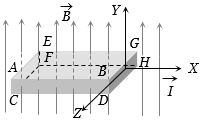
- 2A metallic block carrying current $I$ is subjected to a uniform magnetic induction $\overrightarrow B $ as shown in the figure. The moving charges experience a force $\overrightarrow F $ given by ........... which results in the lowering of the potential of the face ........ Assume the speed of the carriers to be $v$View Solution
- 3The current sensitivity of a moving coil galvanometer increases by $20 \%$ when its resistance is doubled. Calculate, by what factor does the voltage sensitivity change?View Solution
- 4A moving coil galvanometer has resistance $50\,\Omega $ and it indicates full deflection at $4\,mA$ current. A voltmeter is made using this galvanometer and a $5\,k\Omega $ resistance. The maximum voltage, that can be measured using this voltamenter, will be close to ......$V$View Solution
- 5A proton is accelerating in a cyclotron where the applied magnetic field is $2 \,T$. If the potential gap is effectively $100 \,kV$ then how much revolutions the proton has to make between the "dees" to acquire a kinetic energy of $20 \,MeV$ ?View Solution
- 6A wire carrying current $I$ and other carrying $2I$ in the same direction produces a magnetic field $B$ at the mid point. What will be the field when $2I$ wire is switched offView Solution
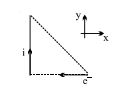
- 7View SolutionThe direction of magnetic force on the electron as shown in the diagram is along
- 8Electron moves at right angles to a magnetic field of $1.5 \times 10^{-2}\,tesla$ with speed of $6 \times 10^7\,m/s$. If the specific charge of the electron is $1.7 \times 10^{11}\,C/kg$. The radius of circular path will be......$cm$View Solution
- 9Two similar coils of radius $R$ are lying concentrically with their planes at right angles to each other. The currents flowing in them are $I$ and $2I$, respectively. The resultant magnetic field induction at the centre will beView Solution
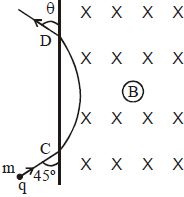
- 10A particle of mass $m = 1.67 \times 10^{-27}\, kg$ and charge $q = 1.6 \times 10^{-19} \, C$ enters a region of uniform magnetic field of strength $1$ $tesla$ along the direction shown in the figure. If the direction of the magnetic field is along the outward normal to the plane of the paper, then the time spent by the particle in the region of the magnetic field after entering it at $C$ is nearly :-......$ns$View Solution