Question
A mixture contains water, kerosene and sand. How will you separate this mixture?

Answer

The mixture of water, kerosene and sand is filtered with the help of filter paper first. Sand remains as residue on the filter paper while mixture of water and kerosene is obtained as filtrate .The mixture of water and kerosene is then put in separating funnel and allowed to stand for some time. The mixture separates into two layers according to the difference in the densities of water and kerosene. Water is heavier than kerosene. So, water forms lower layer while kerosene forms upper layer. On opening the stop clock of separating funnel, the lower layer of water comes out first and collected in beaker leaving behind kerosene in the separating funnel.

Need a full question paper?

Generate a complete, print-ready paper with questions like this in minutes — across 16+ boards, with answer keys.

Start Generating Free

Similar questions

You are provided with a mixture of naphthalene and ammonium chloride by your teacher. Suggest an activity to separate them with well labelled diagram.
Which has more number of atoms, 100grams of sodium or 100grams of iron (given, atomic mass of Na = 23u, Fe = 56u)?
Pragya tested the solubility of three different substances at different temperatures and collected the data as given below (results are given in the following table, as grams of substance dissolved in 100 grams of water to form a saturated solution).
Substance DissolvedTemperature in K
283293313333353
Solubility
Potassium nitrate213262106167
Sodium chloride3636363737
Potassium chloride3535404654
Ammonium chloride24374155
66
  1. What mass of potassium nitrate would be needed to produce a saturated solution of potassium nitrate in 50 grams of water at 313K?
  2. Pragya makes a saturated solution of potassium chloride in water at 353K and leaves the solution to cool at room temperature. What would she observe as the solution cools? Explain.
  3. Find the solubility of each salt at 293K. Which salt has the highest solubility at this temperature?
  4. What is the effect of change of temperature on the solubility of a salt?

In what way is the Rutherford’s atomic model different from that of Thomson’s atomic model?
How is an ion different from an atom? How is cation different from anion?
The atom of an element X contains 17 protons, 17 electrons and 18 neutrons whereas the atom of an element Y contains 11 protons, 11 electrons and 12 neutrons.
  1. What type of ion will be formed by an atom of element X? Write the symbol of ion formed.
  2. What will be the number of (i) protons (ii) electrons, and (iii) neutrons, in the ion formed from X?
  3. What type of ion will be formed by an atom of element Y? Write the symbol of ion formed.
  4. What will be the number of (i) protons (ii) electrons, and (iii) neutrons, in the ion formed from Y?
  5. What is the atomic mas of (i) X, and (ii) Y?
  6. What could the elements X and Y be?
What mass of nitrogen N2, will contain the same number of molecules as 1.8g of water, H2O?
(Atomic masses: N = 14u; H = 1u; O = 16u)
Describe Bohr’s model of the atom.
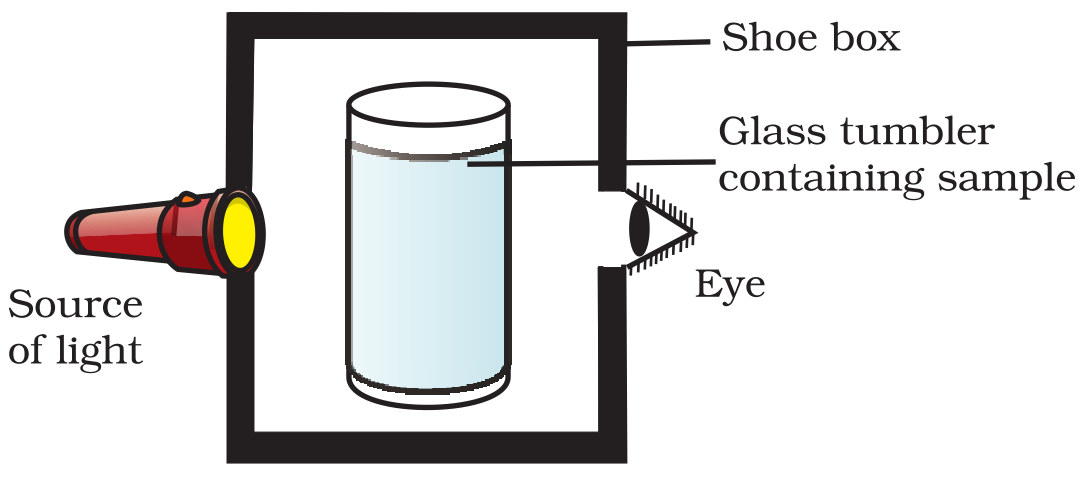
A group of students took an old shoe box and covered it with a black paper from all sides. They fixed a source of light (a torch) at one end of the box by making a hole in it and made another hole on the other side to view the light. They placed a milk sample contained in a beaker/ tumbler in the box as shown in the they were amazed to see that milk taken in the tumbler was illuminated. They tried the same activity by taking a salt solution but found that light simply passed through it?


  1. Explain why the milk sample was illuminated. Name the phenomenon involved.
  2. Same results were not observed with a salt solution. Explain.
  3. Can you suggest two more solutions which would show the same effect as shown by the milk solution?
A mixture contains water, kerosene and sand. How will you separate this mixture?