Question
Describe Bohr’s model of the atom.

Answer

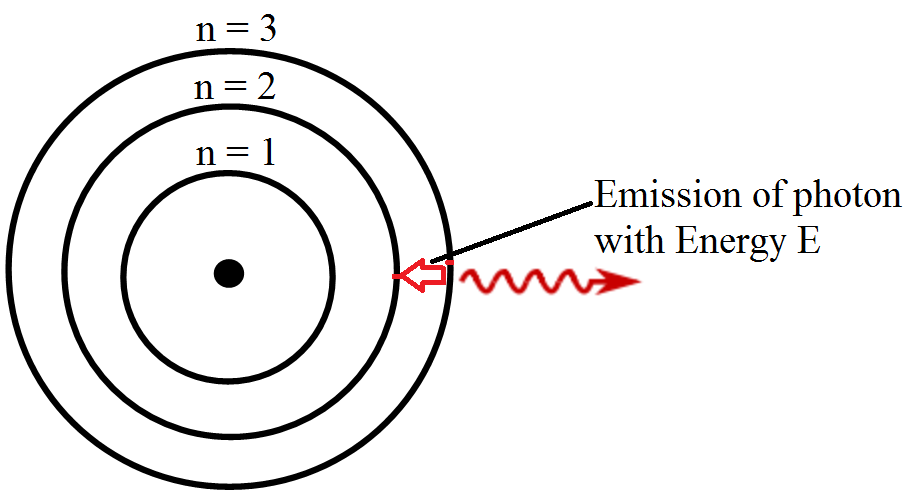
The nucleus of an atom is present in the centre.
Around this nucleus will revolve the negatively charged electrons.
Discrete orbits of electrons are present inside the atom.
While in this orbits, the electrons do not radiate energy.
These discrete orbits are represented as K, L, M, N orbits or denoted with the numbers n = 1, 2, 3, 4
Need a full question paper?

Generate a complete, print-ready paper with questions like this in minutes — across 16+ boards, with answer keys.

Start Generating Free

Similar questions

Write an activity to show that water can be made to boil even at a temperate below its normal boiling point (100°C).
There are three substances X, Y and Z. The substance X does not have a fixed melting point or boiling point and it still shows the individual properties of its constituents. The substance Y is a pure substance which occurs in nature as such. The substance Y has a fixed melting point and boiling point but it cannot be broken down into simpler substances by any chemical means. The substance Z is also a pure substance whose properties are entirely different from those of its constituents. The substance Z can, however, be divided by electrolysis into two substances which belong to the same class of substances as Y.
  1. What type of substance could X be? Name one substance like X.
  2. What type of substance could Y be? Name one substance like Y.
  3. What type of substance could Z be? Name one substance like Z.
  4. Whish process involves absorption or release of an appreciable amount of energy: formation of substance X or formation of substance Z?
  5. Name the three groups into which all the substances like Y are divided on the basis of their properties.
State the various postulates of Dalton’s atomic theory of matter.
Give the chemical formulae for the following compounds and compute the ratio by mass of the combining elements in each one of them.
  1. Ammonia
  2. Carbon monoxide
  3. Hydrogen chloride
  4. Aluminium fluoride
  5. Magnesium sulphide
A liquid compound X of molecular mass 18u can be obtained from a number of natural sources. All the animals and plants need liquid X for their survival. When an electric current is passed through 200 grams of pure liquid X under suitable conditions, then 178 grams of gas Y and 22 grams of gas Z are produced. Gas Y is produced at the positive electrode whereas gas Z is obtained at the negative electrode. Moreover, gas Y supports combustion whereas gas Z burns itself causing explosions.
  1. Name (i) liquid X (ii) gas Y, and (iii) gas Z
  2. What is the ratio to the mass of element Z to the mass of element Y in the liquid X?
  3. Which law of chemical combination is illustrated by this example?
  4. Name two sources of liquid X.
  5. Gate an important use of Y in our life.
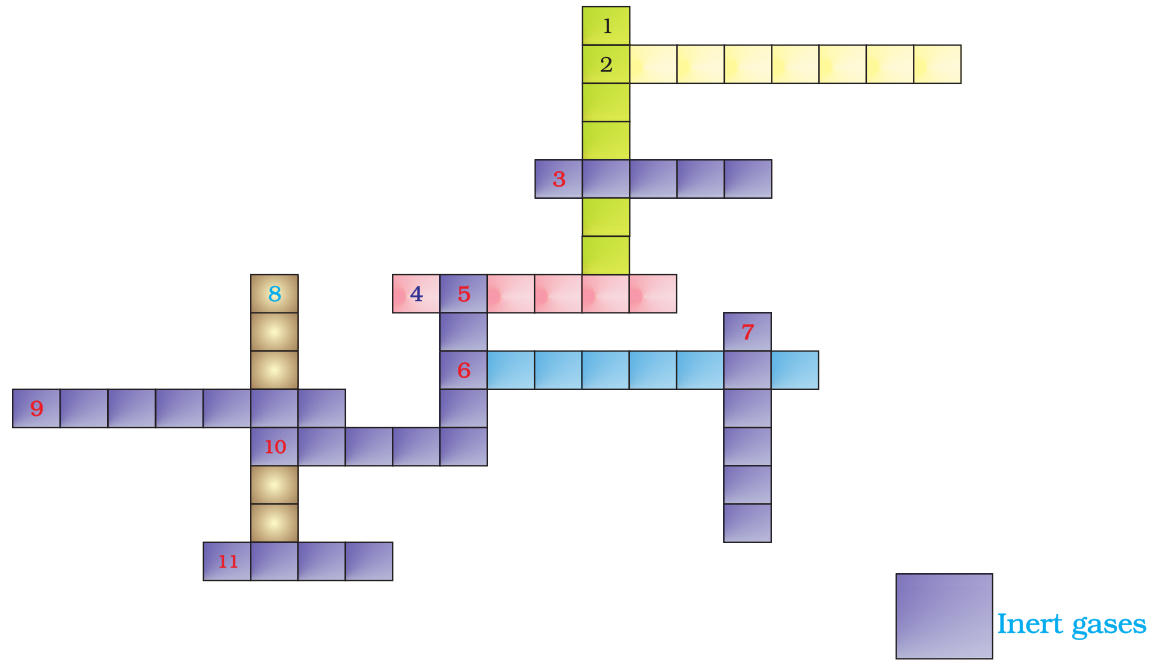
In this crossword puzzle (Figure), names of 11 elements are hidden. Symbols of these are given below. Complete the puzzle.
  1. Cl
  2. H
  3. Ar
  4. O
  5. Xe
  6. N
  7. He
  8. F
  9. Kr
  10. Rn
  11. Ne


The electronic configuration of an element Z is 2, 8, 8.
  1. What is the atomic number of the element?
  2. State whether element Z is a metal or a non-metal.
  3. What type of ion (if any) will be formed by an atom of element Z? Why?
  4. What is special about the outermost electron shell or the atom of this element?
  5. Give the name and symbol of element Z.
  6. Name the group of elements to which Z belongs.
An element is sonorous and highly ductile. Under which category would you classify this element? What other characteristics do you expect the element to possess?
One of the forms of a naturally occurring solid compound P is usually used for making the floors of houses. On adding a few drops of dilute hydrochloric acid to P, brisk effervescence are produced. When 50g of reactant P was heated strongly, than 22g of a gas Q and 28g of a solid R were produced as products. Gas Q is the same which produced brisk effervescence on adding dilute HCl to P. Gas Q is said to cause global warming whereas solid R is used for white-washing.
  1. What is (i) solid P (ii) gas Q, and (iii) solid R.
  2. What is the total mass of Q and R obtained from 50g of P?
  3. How does the total mass of Q and R formed compare with the mass of P taken?
  4. What conclusion do you get from the comparison of masses of products and reactant?
  5. Which law of chemical combination is illustrated by the example given in this problem?
Why are we able to sip hot tea or milk faster from a saucer rather than from a cup?