A modern grand-prix racing car of mass $m$ is travelling on a flat track in a circular arc of radius $R$ with a speed $v$. If the coefficient of static friction between the tyres and the track is $\mu_{s},$ then the magnitude of negative lift $F_{L}$ acting downwards on the car is
(Assume forces on the four tyres are identical and $g =$ acceleration due to gravity)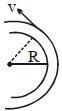
JEE MAIN 2021, Difficult
Download our app for free and get started
$\mu_{ s } N =\frac{ mv ^{2}}{ R }$
$N =\frac{ mv ^{2}}{\mu_{ s } R }= mg + F _{ L }$
$F _{ L }=\frac{ mv ^{2}}{\mu_{ s } R }- mg$

Download our appand get started for free
Experience the future of education. Simply download our apps or reach out to us for more information. Let's shape the future of learning together!No signup needed.*
Similar Questions
- 1View SolutionA motor cycle driver doubles its velocity when he is having a turn. The force exerted outwardly will be
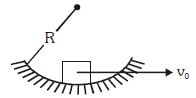
- 2A particle is projected with a speed ${v_0} = \sqrt {gR} $ . The coefficient of friction between the particle and the hemispherical plane is $\mu = 0.5$ . Then, the initial acceleration of the particle isView Solution
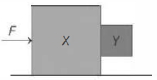
- 3Consider the system shown below. A horizontal force $F$ is applied to a block $X$ of mass $8 \,kg$, such that the block $Y$ of mass $2 \,kg$ adjacent to it does not slip downwards under gravity. There is no friction between the horizontal plane and the base of the block $X$. The coefficient of friction between the surfaces of blocks $X$ and $Y$ is $0.5$. The minimum value of $F$ is ............ $N$ (take, acceleration due to gravity to be $10 \,ms ^{-2}$ )View Solution
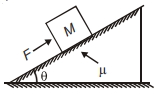
- 4A block (mass $=M kg$ ) is placed on a rough inclined plane. A force $F$ is applied parallel to the inclined (as shown in figure) such that it just starts moving upward. The value of $F$ isView Solution
- 5A block of mass $m$ is stationary on a rough plane of mass $M$ inclined at an angle $\theta$ to the horizontal, while the whole set up is accelerating upwards at an acceleration $\alpha$. If the coefficient of friction between the block and the plane is $\mu$, then the force that the plane exerts on the block isView Solution
- 6A stone weighing $1$ kg and sliding on ice with a velocity of $2$ m/s is stopped by friction in $10$ sec. The force of friction (assuming it to be constant) will be ......... $N$View Solution
- 7A block of mass $10\, kg$ is placed on a rough horizontal surface having coefficient of friction $\,\mu = 0.5$. If a horizontal force of $100\, N$ is acting on it, then acceleration of the block will be ....... $m/s^2$View Solution
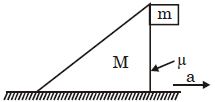
- 8As shown in the figure, block m and wedge $M$ move together with a horizontal acceleration of $20\, m/s^2$. Given $m = 1\, kg$, $\mu = 0.6$ (between $m$ and $M$) and $g = 10\, m/s^2$. Choose the $CORRECT$ alternative :-View Solution
- 9A $2 \mathrm{~kg}$ brick begins to slide over a surface which is inclined at an angle of $45^{\circ}$ with respect to horizontal axis. The co-efficient of static friction between their surfaces is:View Solution
- 10A cylinder of mass $10\,kg$ is sliding on a plane with an initial velocity of $10\,m/s$. If coefficient of friction between surface and cylinder is $ 0.5$, then before stopping it will describe ............. $\mathrm{m}$View Solution