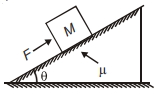
A block (mass $=M kg$ ) is placed on a rough inclined plane. A force $F$ is applied parallel to the inclined (as shown in figure) such that it just starts moving upward. The value of $F$ is
Easy
Download our app for free and get started
(b)
$F$ will oppose friction force and gravitation force
$F=m g \sin \theta+\mu m g \cos \theta$

Download our appand get started for free
Experience the future of education. Simply download our apps or reach out to us for more information. Let's shape the future of learning together!No signup needed.*
Similar Questions
- 1A block of mass $10\; \mathrm{kg}$ is in contact against the inner wall of a hollow cylindow cylindrical drum of radius $1 \;\mathrm{m}$. The coeffident of friction between the block and the inner wall of the cylinder is $0.1$. The minimum angular velocity needed for the cylinder to keep the block stationary when the cylinder is vertical and rotating about its axis, will be: ......$rad/s$ $\left(g-10 m / s^{2}\right)$View Solution
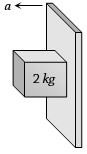
- 2A rough vertical board has an acceleration $‘a’$ so that a $2$ kg block pressing against it does not fall. The coefficient of friction between the block and the board should beView Solution
- 3A block of mass $4\,kg$ is placed on a rough horizontal plane A time dependent force $F = kt^2$ acts on the block, where $k = 2\,N/s^2$. Coefficient of friction $\mu = 0.8$. Force of friction between block and the plane at $t = 2\,s$ is ....... $N$View Solution
- 4A circular road of radius $1000 \,m$ has banking angle ${45^o}$. The maximum safe speed of a car having mass $2000 \,kg$ will be, if the coefficient of friction between tyre and road is $0.5$ ....... $m/s$View Solution
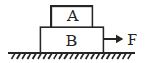
- 5In figure, the coefficient of friction between the floor and the block $B$ is $0.1$. The coefficient of friction between the blocks $B$ and $A$ is $0.2$. The mass of $A$ is $\frac{m}{2}$ and of $B$ is $m$. ........ $mg$ is the maximum horizontal force $F$ can be applied to the block $B$ so that two blocks move together ?View Solution
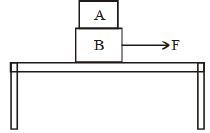
- 6Two blocks $A$ and $B$ of masses $m_A = 1\,kg$ and $m_B = 3\,kg$ are kept on the table as shown in figure. The coefficient of friction between $A$ and $B$ is $0.2$ and between $B$ and the surface of the table is also $0.2.$ The maximum force $F$ that can be applied on $B$ horizontal, so that the block $A$ does not slide over the block $B$ is ........ $N$. [Take $g = 10\,m/s^2$ ]View Solution
- 7A $2\,kg$ block slides on a horizontal floor with a speed of $4\, m/s$. It strikes a uncompressed spring, and compresses it till the block is motionless. The kinetic friction force is $110\,N$ and spring constant is $1000\, N/m$. The spring compresses by ........ $cm$View Solution
- 8View SolutionA cube is resting on an inclined plane. What must be the value of coefficient of friction between cube and plane so that cube topples before sliding
- 9In the given arrangement of a doubly inclined plane two blocks of masses $\mathrm{M}$ and $\mathrm{m}$ are placed. The blocks are connected by a light string passing over an ideal pulley as shown. The coefficient of friction between the surface of the plane and the blocks is $0.25$ . The value of $\mathrm{m}$, for which $\mathrm{M}=10$ $\mathrm{kg}$ will move down with an acceleration of $2 \mathrm{~m} / \mathrm{s}^2$, is : (take $\mathrm{g}=10 \mathrm{~m} / \mathrm{s}^2$ and $\left.\tan 37^{\circ}=3 / 4\right)$View Solution
- 10A sphere of mass $m$ is set in motion with initial velocity $v_o$ on a surface on which $kx^n$ is the frictional force with $k$ and $n$ as the constants and $x$ as the distance from the point of start. Find the distance in which sphere will stopView Solution