A block of mass $10\, kg$ is placed on a rough horizontal surface having coefficient of friction $\,\mu = 0.5$. If a horizontal force of $100\, N$ is acting on it, then acceleration of the block will be ....... $m/s^2$
AIPMT 2002, Medium


Download our appand get started for free
Experience the future of education. Simply download our apps or reach out to us for more information. Let's shape the future of learning together!No signup needed.*
Similar Questions
- 1View SolutionIn a tonga, horse pulls a wagon. Which is the correct analysis of the situation?
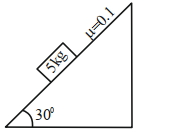
- 2A block slides down on incline of angle $30^o$ with an acceleration $\frac{g}{4}$. Find the coefficient of kinetic frictionView Solution
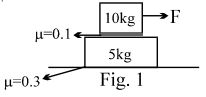
- 3When $F = 2N$, the frictional force between $10 kg$ block and $5 kg$ block is ...... $N$View Solution
- 4View SolutionA car travels north with a uniform velocity. It goes over a piece of mud which sticks to the tyre. The particles of the mud, as it leaves the ground are thrown
- 5View SolutionStatic friction between two surfaces
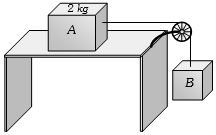
- 6The coefficient of static friction, ${\mu _s},$ between block $A$ of mass $2\, kg$ and the table as shown in the figure is $0.2$. ........ $kg$ would be the maximum mass value of block $B$ so that the two blocks do not move. The string and the pulley are assumed to be smooth and massless. $(g = 10\,m/{s^2})$View Solution
- 7Consider a car moving along a straight horizontal road with a speed of $72\, km/h$. If the coefficient of kinetic friction between the tyres and the road is $0.5,$ the shortest distance in which the car can be stopped is ........ $m$ .$[g = 10\,m{s^{ - 2}}]$View Solution
- 8Two stones of masses $m$ and $2\,m$ are whirled in horizontal circles, the heavier one in a radius $\frac{r}{2}$ and the lighter one in radius $r.$ The tangential speed of lighter stone is $n$ times that of the value of heavier stone when they experience same centripetal forces. The value of $n$ isView Solution
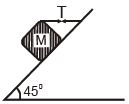
- 9A block of mass $15 \,kg $ is resting on a rough inclined plane as shown in figure. The block is tied up by a horizontal string which has tension of $50\,N$. The minimum coefficient of friction between the surfaces of contact is $(g = 10\,m/s^2)$View Solution
- 10A block of mass $5 \mathrm{~kg}$ is placed on a rough inclined surface as shown in the figure.If $\vec{F}_1$ is the force required to just move the block up the inclined plane and $\vec{F}_2$ is the force required to just prevent the block from sliding down, then the value of $\left|\vec{F}_1\right|-\left|\vec{F}_2\right|$ is : [Use $g=10 \mathrm{~m} / \mathrm{s}^2$ ]View Solution