Question
A molecule. of hydrogen contains two protons and two electrons. The nuclear force between these two protons is always neglected while discussing the behaviour of a hydrogen molecule. Why?

Answer

Inside the nucleus, two protons exert nuclear force on each other. These forces are short-ranged (a few fm), strong and attractive forces. They also exert electrostatic repulsive force (long-ranged). While discussing the behaviour of a hydrogen molecule, the nuclear force between the two protons is always neglected. This is because the separation between the two protons in the molecule is ~70pm which is much greater than the range of the nuclear force.

Need a full question paper?

Generate a complete, print-ready paper with questions like this in minutes — across 16+ boards, with answer keys.
Start Generating Free

Similar questions

At $t=0$, a particle is at rest at origin. Its acceleration is $2 m / s ^2$ for the first 3 s and $-2 m / s ^2$ for next 3 s . Plot the acceleration versus time and velocity versus time graph.
An adult weighing 600N raises the centre of gravity of his body by 0.25m while taking each step of 1m length in jogging. If he jogs for 6km, calculate the energy utilised by him in jogging assuming that there is no energy loss due to friction of ground and air. Assuming that the body of the adult is capable of converting 10% of energy intake in the form of food, calculate the energy equivalents of food that would be required to compensate energy utilised for jogging.
Distinguish between a cyclic process and a non-cyclic process.
A car moves with a speed of $54\ km/h$ towards a cliff. The horn of the car emits sound of frequency $400Hz$ at a speed of $3.35m/s.$
  1. Find the wavelength of the sound emitted by the horn in front of the car.
  2. Find the wavelength of the wave reflected from the cliff.
  3. What frequency does a person sitting in the car hear for the reflected sound wave?
  4. How many beats does he hear in $10$ seconds between the sound coming directly from the horn and that coming after the reflection?
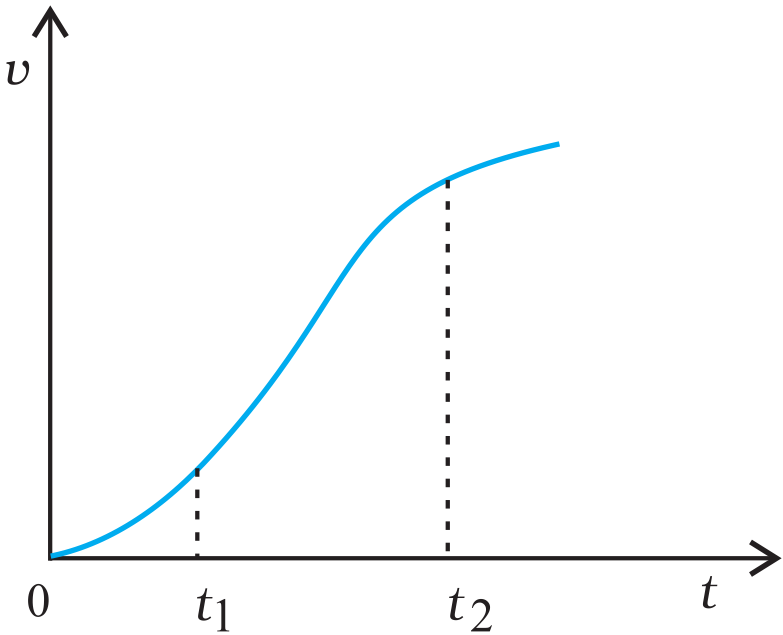
The velocity-time graph of a particle in one-dimensional motion is shown in:

Which of the following formulae are correct for describing the motion of the particle over the time-interval $t_1$ to $t_2$:
a. $x\left(t_2\right)=x\left(t_1\right)+v\left(t_1\right)\left(t_2-t_1\right)+(1 / 2) a\left(t_2-t_1\right)^2$
b. $v\left(t_2\right)=v\left(t_1\right)+a\left(t_2-t_1\right)$
c. $v_{\text {average }}=\left(x\left(t_2\right)-x\left(t_1\right)\right) /\left(t_2-t_1\right)$
d. $\mathrm{a}_{\text {average }}=\left(\mathrm{v}\left(\mathrm{t}_2\right)-\mathrm{v}\left(\mathrm{t}_1\right)\right) /\left(\mathrm{t}_2-\mathrm{t}_1\right)$
e. $x\left(t_2\right)=x\left(t_1\right)+v_{\text {average }}\left(t_2-t_1\right)+(1 / 2) a_{\text {average }}\left(t_2-t_1\right)^2$
f. $x\left(t_2\right)-x\left(t_1\right)=$ area under the v-t curve bounded by the $t$-axis and the dotted line shown.
Define moment of inertia and find the moment of inertia of a uniform rod of mass M, length l about an axis perpendicular to it through one end.
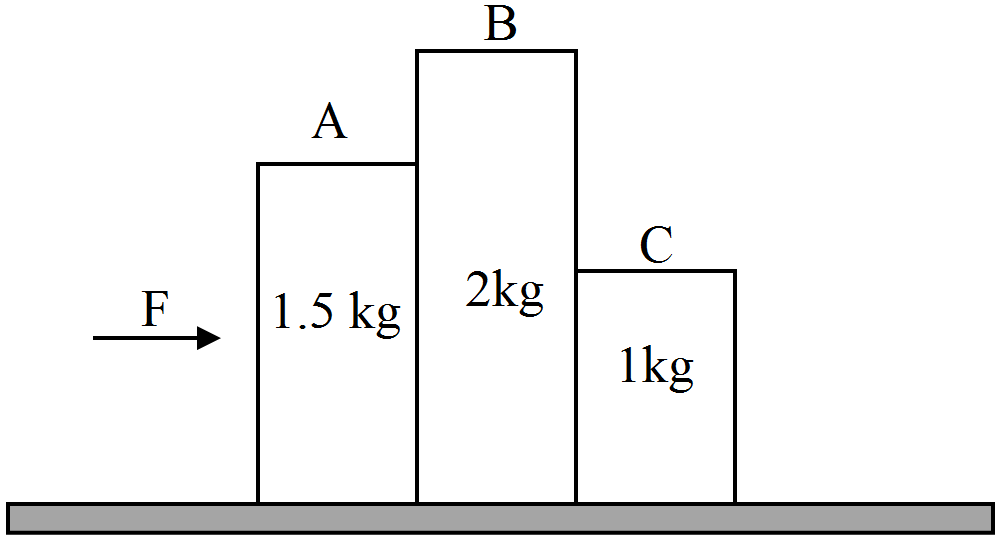
In the system of three blocks $A , B$ and C shown in figure,
(i) how large a force $F$ is needed to give the blocks an acceleration of $3 m / s ^2$, if the coefficient of friction between blocks and table is $0.27$
(ii) how large a force does the block $A$ exert on the block $B$ ?
A trolley of mass $300kg$ carrying a sandbag of $25kg$ is moving uniformly with a speed of $27km/h$ on a frictionless track. After a while, sand starts leaking out of a hole on the floor of the trolley at the rate of $0.05 kgs^{-1}$. What is the speed of the trolley after the entire sand bag is empty?
Plot the corresponding reference circle for each of the following simple harmonic motions. Indicate the initial (t = 0) position of the particle, the radius of the circle, and the angular speed of the rotating particle. For simplicity, the sense of rotation may be fixed to be anticlockwise in every case: (x is in cm and t is in s).$\text{x}=-2\sin\Big(3\text{t}+\frac{\pi}{3}\Big)$
Find the value of $60W$ on a system having $100g, 20cm$ and $1$ minute as the fundamental units.