Question
A monkey climbs up a slippery pole for 3 seconds and subsequently slips for 3 seconds. Its velocity at time t is given by v(t) = 2t(3 - t); 0 < t < 3 and v(t) = -(t - 3)(6 - t) for 3 < t < 6s in m/s. It repeats this cycle till it reaches the height of 20m. How many cycles (counting fractions) are required to reach the top?
Answer

Given velocity $\text{v}(\text{t})=2\text{t}(3-\text{t})=6\text{t}-2\text{t}^2$ Distance covered in 0 to 3s = 9m Distance covered in 3 to 6s $=\int_3^6(18-9\text{t}+\text{t}^2)\text{dt}=\Big(18\text{t}-\frac{9\text{t}^2}{2}+\frac{\text{t}^3}{3}\Big)^6$ $=18\times6-\frac{9}{2}\times6^2+\frac{6^3}{3}-\Big(18\times3-\frac{9\times3^2}{2}+\frac{3^3}{3}\Big)$ $=108-9\times18+\frac{6^3}{3}-18\times3+\frac{9}{2}\times9-\frac{27}{3}$ $=-4.5\text{m}$ $\therefore$ Total distance travelled in one cycle $=\text{s}_1+\text{s}_2=9-4.5=4.5\text{m}$ Number of cycles to be covered in total distance $=\frac{20}{4.5}\approx4.44\approx5$

Need a full question paper?

Generate a complete, print-ready paper with questions like this in minutes — across 16+ boards, with answer keys.

Start Generating Free

Similar questions

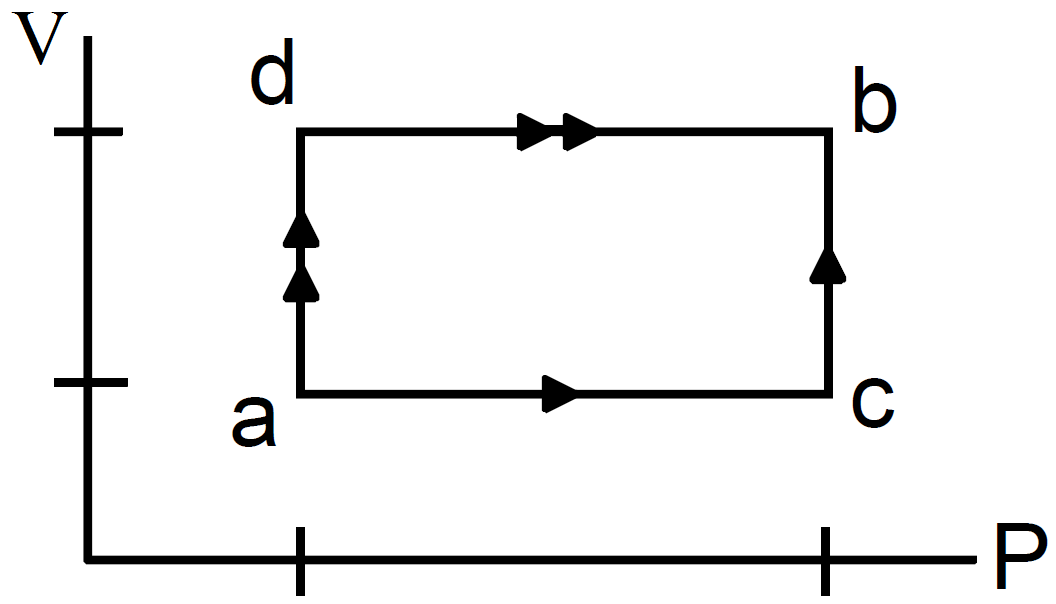
When a system is taken through the process abc shown in figure. 80J of heat is absorbed by the system and 30J of work is done by it. If the system does 10J of work during the process adc, how much heat flows into it during the process?
One mole of an ideal gas is taken in a Carnot engine working between $27°C$ and $227°C$. The useful work done in one cycle is $600J$. Calculate the ratio of the volume of the gas at the end and beginning of the isothermal expansion. Given $R = 8.31J mole^{-1} K^{-1}$.
A steel wire of length 4.7 m and cross-sectional area $3.0 \times 10^{-5} m^2$ stretches by the same amount as a copper wire of length 3.5 m and cross-sectional area of $4.0 \times 10^{-5} m^2$ under a given load. What is the ratio of the Young's modulus of steel to that of copper?
Light in certain cases may be considered as a stream of particles called photons. Each photon has a linear momentum $\frac{\text{h}}{\lambda}$ where h is the Planck's constant and $\lambda$ is the wavelength of the light. A beam of light of wavelength $\lambda$ is incident on a plane mirror at an angle of incidence $\theta.$ Calculate the change in the linear momentum of a photon as the beam is reflected by the mirror.
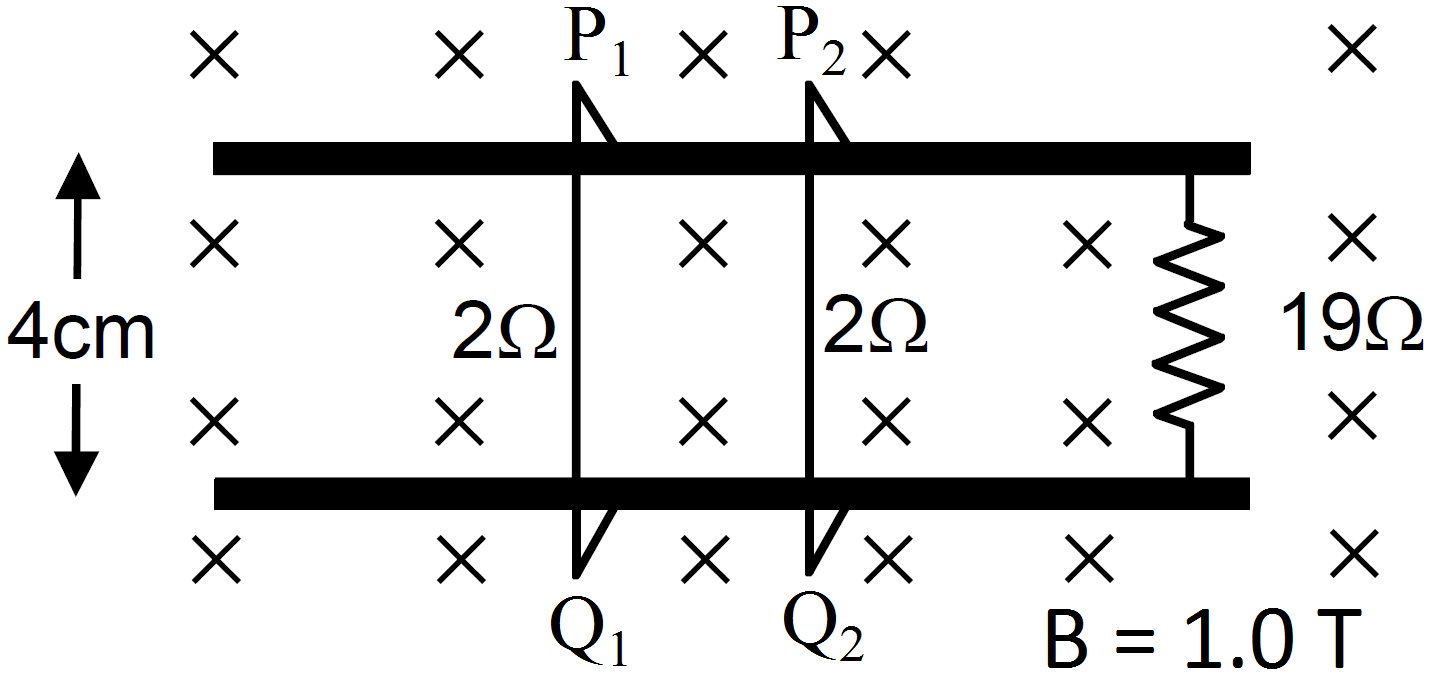
Consider the situation shown in figure. The wires $P_1Q_1$ and $P_2Q_2$ are made to slide on the rails with the same speed $5\ cm/s$. Find the electric current in the $19\Omega$ resistor if:
  1. Both the wires move towards right.
  2. If $P_1Q_1$ moves towards left but $P_2Q_2$ moves towards right.
Two bodies A and B having masses me and my respectively have equal kinetic energies. If $p_A$ and $P_B$ are their respective momentaa, then prove that the ratio of momenta is equal to the square root of ratio of respective masses.
Find the value of $60W$ on a system having $100g, 20cm$ and $1$ min as the fundamental units.
Derive an expression for the excess of pressure inside a liquid drop.
A wheel starting from rest is uniformly accelerated at $4 rad/-s^2$ for $10$ seconds.It is allowed to rotate uniformly for the next $10$ seconds and is finally brought to rest in the next 10 seconds. Find the total angle rotated by the wheel.
Derive an expression for moment of inertia of a thin circular ring passing through the centre and perpendicular to the plane of the ring.