Question
Derive an expression for the excess of pressure inside a liquid drop.

Answer

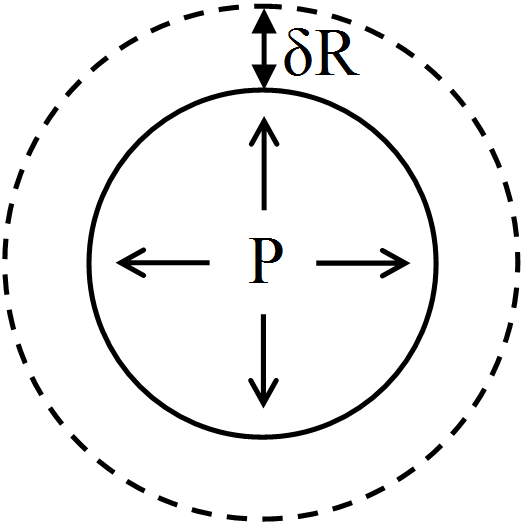
Consider a liquid drop of radius R and $\sigma$ the surface tension of liquid.

Excess pressure inside the liquid drop, $P = P_i - P_0$ ($\therefore$ liquid drop has only one free surface)$\delta\text{R}=$ Small increase in radius of liquid drop due to excess pressure
$\therefore$ W = Force × Displacement.
W = (Excess pressure × Area) × Increase in radius$\text{W}=\text{P}\times4\pi\text{R}^2\times\delta\text{R}$
Increase in surface area of liquid drop = Final surface area - Initail surface area$=4\pi(\text{R}+\delta\text{R})^2-4\pi\text{R}^2$
$=8\pi\text{R}(\delta\text{R})(\text{Neglecting }\delta\text{R}^2)$
Increase P.E. = Increase in surface area × Surface tension$=8\pi\text{R}(\delta\text{R})\times\sigma$
Since the drop is in equilibrium.$\therefore\text{P}\times4\pi\text{R}^2\times\delta\text{R}=8\pi\text{R}(\delta\text{R})\times\sigma$
$\Rightarrow\text{P}=\frac{2\sigma}{\text{R}}$
$\Rightarrow\text{P}_\text{i}-\text{P}_\text{o}=\frac{2\sigma}{\text{R}}[\because\text{P}=\text{P}_\text{i}-\text{P}_\text{o}]$

Need a full question paper?

Generate a complete, print-ready paper with questions like this in minutes — across 16+ boards, with answer keys.
Start Generating Free

Similar questions

A cylinder containing a gas is lifted from the first floor to the second floor. What is the amount of work done on the gas? What is the amount of work done by the gas? Is the internal energy of the gas increased? Is the temperature of the gas increased?
A traffic policeman sounds a whistle to stop a car-driver approaching towards him. The car-driver does not stop and takes the plea in court that because of the Doppler shift, the frequency of the whistle reaching him might have gone beyond the audible limit of 20kHz and he did not hear it. Experiments showed that the whistle emits a sound with frequency close to 16kHz. Assuming that the claim of the driver is true, how fast was he driving the car? Take the speed of sound in air to be 330m/s. Is this speed practical with today's technology?
A liquid-nitrogen container is made of a 1cm thick styrofoam sheet having thermal conductivity $0.025\text{Js}^{-1}\text{m}^{-1}{^\circ}\text{C}^{-1}.$ Liquid nitrogen at 80K is kept in it. A total area of $0.80m^2$ is in contact with the liquid nitrogen. The atmospheric temperature is 300K. Calculate the rate of heat flow from the atmosphere to the liquid nitrogen.
A molecule in a gas container hits a horizontal wall with speed $200ms^{-1}$ and angle $30°$ with the normal, and rebounds with the same speed. Is momentum conserved in the collision? Is the collision elastic or inelastic?
What is a black body? How was such a body designed by Fery?
The condition of air in a cloeed room is described as follows. Temperature $=25^{\circ} \mathrm{C}$, relative humidity $=60 \%$, pressure $=104 \mathrm{kPa}$. If all the water vapour is removed from the room without changing the temperature, what will be the new pressure? The saturation vapour pressure at $25^{\circ} \mathrm{C}=3.2 \mathrm{kPa}$.
Distinguish clearly between the three modes of heat transmission.
Two loudspeakers have been installed in an open space to listen to a speech. When both the loudspeakers are in operation, a listener sitting at a particular place receives a very feeble sound. Why? What will happen if one loudspeaker is kept off?
$i.$ Explain clearly with examples the distinction between magnitude of displacement over an interval of time and the total length of the path covered by a particle over the same interval.
$ii.$ A body starting from rest accelerates uniformly along a straight line at the rate of $10\  ms^{-2}$ for $5 s$ . It moves for $2 s$ with uniform velocity of $50\  ms^{-1}$. Then it retards uniformly and comes to rest in $3 s$ . Draw velocity$-$time graph of the body and find the total distance travelled by it.