Question
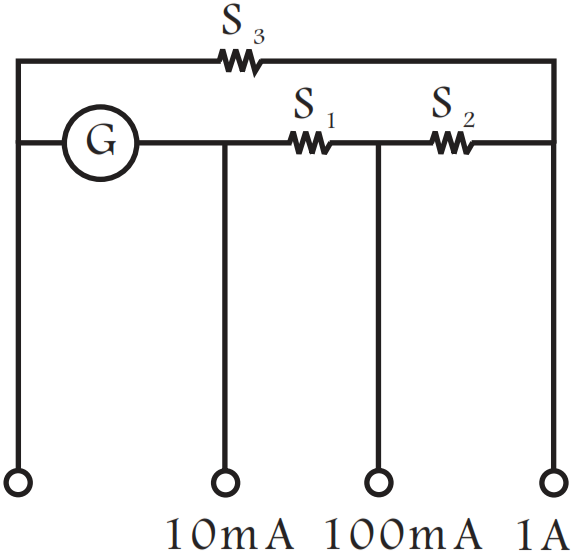
A multirange current meter can be constructed by using a galvanometer circuit as shown in Fig. We want a current meter that can measure $10mA,$ $100mA$ and $1A$ using a galvanometer of resistance $10\Omega$ and that prduces maximum deflection for current of $1mA.$ Find $S_1, S_2$ and $S_3$ that have to be used.
Answer

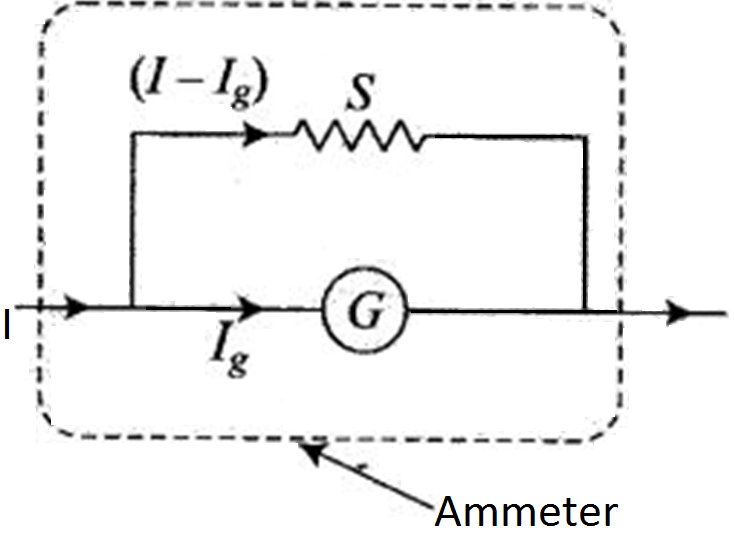
Key concept: A galvanometer can be converted into ammeter by connecting a very low resistance wire (shunt S) connected in parallel with galvanometer. The relationship is given by $I_gG = (l - I_g) S,$ where $I_g$ is
the range of galvanometer, G is the resistance of galvanometer.

For measuring $I_1 = 10mA : IG.G = (I_1 - IG)(S_1 + S_2 + S_3)$
For measuring $I_2 = 100mA : IG(G + S_1) = (I_2 - IG)(S_2 - S_3)$
For measuring $I_3 = 1A : IG(G + S_1 + S_2) =(I_3 - IG)(S_3)$
Gives $S_1 = 1\Omega , S_2 = 0.1\Omega$ and $S_3 = 0.01\Omega .$

Need a full question paper?

Generate a complete, print-ready paper with questions like this in minutes — across 16+ boards, with answer keys.

Start Generating Free

Similar questions

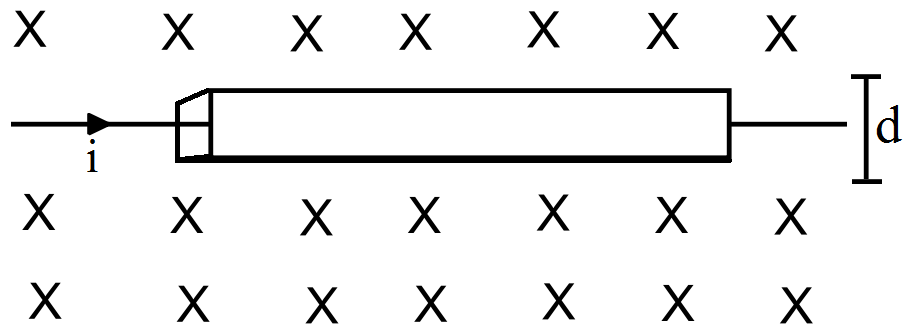
A current i is passed through a silver strip of width d and area of cross-section A. The number of free electrons per unit volume is n.
  1. Find the drift velocity v of the electrons.
  2. If a magnetic field B exists in the region, as shown in the figure, what is the average magnetic force on the free electrons?
  3. Due to the magnetic force, the free electrons get accumulated on one side of the conductor along its length. This produces a transverse electric field in the conductor, which opposes the magnetic force on the electrons. Find the magnitude of the electric field which will stop further accumulation of electrons.
  4. What will be the potential difference developed across the width of the conductor due to the electron-accumulation? The appearance of a transverse emf, when a current-carrying wire is placed in a magnetic field, is called Hall effect.
A circuit containing a $80\ mH$ inductor and a $60 \mu\  F$ capacitor in series is connected to a $230\ V, 50 \ Hz$ supply. The resistance of the circuit is negligible.
$a.$ Obtain the current amplitude and rms values.
$b.$ Obtain the rms values of potential drops across each element.
$c.$ What is the average power transferred to the inductor?
$d.$ What is the average power transferred to the capacitor?
$e.$ What is the total average power absorbed by the circuit? $[$‘Average’ implies ‘averaged over one cycle’.$]$
Explain the Function of a $n-p-n$ transistor as a switch with necessary circuit diagram.
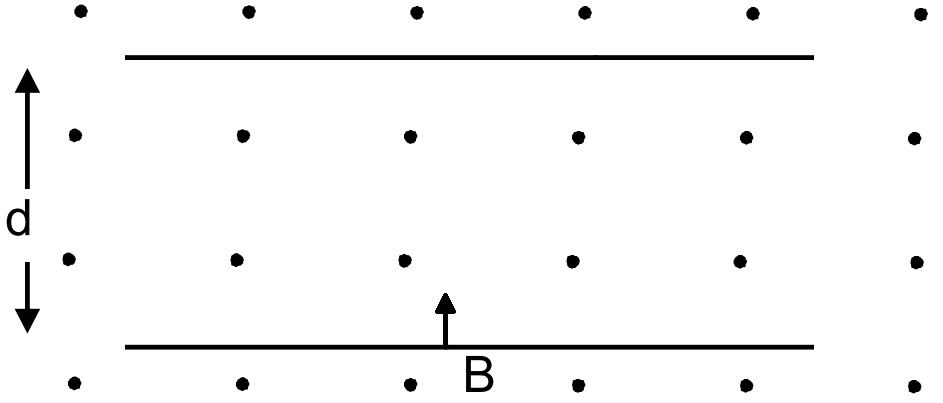
An electron is emitted with negligible speed from the negative plate of a parallel$-$plate capacitor charged to a potential difference $V$. The separation between the plates is $d$ and $a$ magnetic field Bexists in the space, as shown in the figure. Show that the electron will fail to strike the upper plates if $\text{d} > \Big(\frac{2\text{m}_\text{e}\text{v}}{\text{eB}^2}\Big)^{\frac{1}{2}}.$
A battery of emf 100V and a resistor of resistance $10\text{k}\Omega$ are joined in series. This system is used as a source to supply current to an external resistance R. If R is not greater than $100\Omega,$ the current through it is constant up to two significant digits. Find its value. This is the basic principle of a constant-current source.
The electric field associated with a light wave is given by $\text{E}=\text{E}_0\sin[(1.57\times10^7\text{m}^{-1})(\text{x}-{\text{ct}})].$ Find the stopping potential when this light is used in an experiment on photoelectric effect with the emitter having work function $1.9eV.$ 
In a Young's double slit interference experiment the fringe pattern is observed on a screen placed at a distance D from the slits. The slits are separated by a distance d and are illuminated by monochromatic light of wavelength $\lambda$. Find the distance from the central point where the intensity falls to,
  1. Half the maximum.
  2. One fourth of the maximum.
$\text{ }^{212}_{33}\text{Bi}$ can disintegrate either by emitting an $\alpha-$ particle of by emitting a $\beta^-$ particle.
  1. Write the two equations showing the products of the decays.
  2. The probabilities of disintegration $\alpha$ and $\beta -$ decays are in the ratio $\frac{7}{13}.$ The overall half $-$ life of $^{212}Bi$ is one hour. If $1g$ of pure $^{212}Bi$ is taken at $12.00$ noon, what will be the composition of this sample at $1P.m$. the same day?
A thin paper of thickness $0.02\ mm$ having a refractive index $1.45$ is pasted across one of the slits in a Young's double slit experiment. The paper transmits $\frac{4}{9}$ of the light energy falling on it.
  1. Find the ratio of the maximum intensity to the minimum intensity in the fringe pattern.
  2. How many fringes will cross through the centre if an identical paper piece is pasted on the other slit also? The wavelength of the light used is 600nm.
Suppose that the electric field amplitude of an electromagnetic wave is $E_0 = 120 N/C$ and that its frequency is $ν = 50.0 MHz. (a)$ Determine $, B_0, ω, k,$ and $\lambda . (b)$ Find expressions for $E$ and $B$.