Question
Explain the Function of a $n-p-n$ transistor as a switch with necessary circuit diagram.
Answer

Any device which can turn ON and OFF current in an electrical circuits in known as a switch. Generally, mechanical switches are used to resume and break connection in electrical circuits. Digital devices like computers perform a very large number of switching operations every day. In computer circuits an electronic device like junction diode and junction transistor can be used to turn rapidly on or off the current.
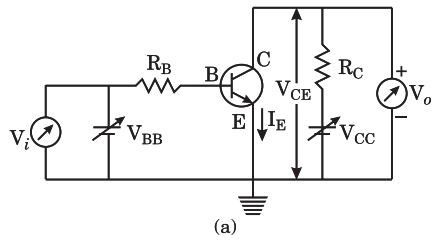
Junction Transistor as a Switch : In order to understood the switching action of a junction transistor we should be familiar with three states of working of a transistor. In Fig. (a), circuit diagram of an $n-p-n$ transistor in common-emitter configuration is shown. In this circuit a battery of variable voltage VBB IS connected to input circuit i.e., base-emitter circuit and another battery of variable voltage Vcc is connected to the output circuit i.e., emitter-collector circuit, RB and Re are the resistances in the input and output circuits, respectively.
Image
Now applying Kirchhoff's voltage rule in the closed loop of input side and output side, we get respectively as :
$V_{BB}=I_{B} R_{B}+V_{BE} \text { and } V_{CE}=V_{CC}-I_{C} R_{C}$ ... (1)
But the voltage $V_{B B}$ can be regarded as d.c. input voltage Vi and VCE as the d.c. output voltage VO Hence the above equation can be written as :
$V _i= I _{ B } R _{ B }+ V _{ BE }$ and $V _o= V _{ CC }- I _{ C } R _{ C }$ ...(2)
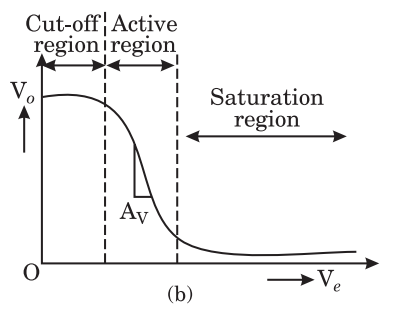
With the help of series (2) of the equation, a graph between $V _o$ and $V _i$ is drawn, which is called transfer characteristic of the junction transistor Fig. (b). This typical characteristic curve has three well defined regions as follows :
(i) Cut-off region : In Si transistor, as long as input Vi is less than 0.6 V the transistor remains in cut off state and current Ic remains zero.
$\therefore \quad V _o= V _{ CC }$
This region is called cut-off region.
(ii) Active region : When Vi becomes greater then 0.6 V tansistor is in active region with some current Ic in the output path and the output Vo decreases as the current $I _{ C }$ increases ( $V _o= V _{ CC }- I _{ C } R _{ C }$ ). With increase in $V _i, I _{ C }$ increases almost linearly and so $V _o$ decreases linearly till its value becomes less than about 1.0 V .
Image
(iii) Saturation Region : When Vi is further increased to a high value, the large collector current flows which produces such a large potential drop across the load Rc that the emitter-collector junction gets also forward biased. The output voltage Vo decreases to almost zero. Since it cannot pass any more collector currect IC, hence this situation is called saturation state and the transistor is said to be in saturation region.
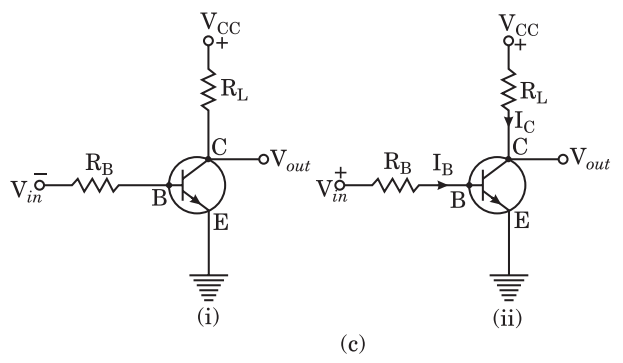
A transistor can be used as a switch only if it is operated in its cut-off and saturation states. The electric circuit required to explain the switching action of a junction transistor is shown in Fig. (c) (i) in which common emitter $n-p-n$ transistor is used.
Image
When the base input voltage Vin is negative or zero as shown in Fig. (c) (ii), the transistor is cut-off (i.e., base current IB is zero) and no collector current flows in the load resistance RL connected to the collector circuit. As such, there is no voltage drop across RL. Hence the output voltage is equal to the collector supply voltage,
i.e. $V _{\text {out }}= V _{ CC }$
Strictly speaking, the collector current is not zero since a small collector-to-emitter leakage current always flows when the base input voltage is negative or zero.
When the base input voltage is positive [Fig. (c) (ii)], a base current IB flows and an amplified collector-current Ic flows through the load RL. Clearly, the output voltage is now given as follows :
$V _{\text {out }}= V _{ CC }- I _{ C } R _{ L }$
Thus, the transistor turns the current ON or OFF in the load RL depending upon whether the input base voltage is positive or negative (or zero). In other words, it acts like a switch.
An compared to other types of switches, the transistor switch is compact, noiseless, trouble-free and has a very fast speed of operation.

Need a full question paper?

Generate a complete, print-ready paper with questions like this in minutes — across 16+ boards, with answer keys.

Start Generating Free

Similar questions

A $5\ mm$ high pin is placed at a distance of $15\ cm$ from a convex lens of focal length $10\ cm$. A second lens of focal length $5\ cm$ is placed $40\ cm$ from the first lens and $55\ cm$ from the pin. Find
  1. The position of the final image.
  2. Its nature.
  3. Its size.
How long can an electric lamp of 100 W be kept glowing by fusion of 2.0 kg of deuterium? Take the fusion reaction as :
${ }_1^2 H +{ }_1^2 H \rightarrow{ }_2^3 He +n+3.27 MeV$
Find the change in the internal energy of $2\ kg$ of water as it is heated from $0^\circ C$ to $4^\circ C$. The specific heat capacity of water is $4200Jkg^{-1} K^{-1}$ and its densities at $0^\circ C $and $4^\circ C$ are $999.9\ kgm^{-3}$ and $1000\ kgm^{-3}$ respectively. Atmospheric pressure $= 10^{-6}Pa.$
A horizontal cesium plate ($\phi$ = l.9 eV) is moved vertically downward at a constant speed u in a room full of radiation of wavelength 250 run and above. What should be the minimum value of u so that the vertically upward component of velocity is nonpositive for each photoelectron?
A metre scale is made up of steel and measures correct length at $16^\circ C$. What will be the percentage error if this scale is used:
  1. On a summer day when the temperature is $46^\circ C$.
  2. On a winter day when the temperature is $6^\circ C$? Coefficient of linear expansion of steel $= 11 \times 10^{-6^\circ} C^{-1}.$
Consider the situation shown in figure $(17-E6).$ The two slits $S_1$ and $S_2$ p laced symmetrically around the central line are illuminated by a monochromatic light of wavelength $\lambda.$ The separation between the slits is $d.$ The light transmitted by the slits falls on a screen $E_1$ placed at a distance $D$ from the slits. The slit $S_3$ is at the central line and the slit $S_4$ is at a distance $z$ from $S_3.$ Another screen $\sum_2$ is placed a further distance $D$ away from $\sum_1$. Find the ratio of the maximum to minimum intensity observed on $\sum_2$, if z is equal to,
  1. $\text{z}=\frac{\lambda\text{D}}{2\text{d}}$
  2. $\frac{\lambda\text{D}}{\text{d}}$
  3. $\frac{\lambda\text{D}}{4\text{d}}$
Consider the situation of the previous problem. Suppose the block of mass $m_1$ is pulled by a constant force $F_1$ and the other block is pulled by a constant force $F_2.$ Find the maximum elongation that the spring will suffer.
When a light ray passes from the atmosphere (a) through the combination of two mediums water (b) and glass (c), then find the relationship between the refractive indices of the three mediums.
Two particles $A$ and $B$, having opposite charges $2.0 \times 10^{-6}C$ and $2.0 \times 10^{-6}C$, are placed at a separation of $1.0\ cm.$
  1. Write down the electric dipole moment of this pair.
  2. Calculate the electric field at a point on the axis of the dipole $1.0m$ awa.y from the centre.
  3. Calculate the electric field at a point on the perpendicular bisector of the dipole and $1.0m$ away from the centre.
Explain the resolving power of an optical instrument. Write the formula for resolving power of telescope and microscope. Why is the resolving power of electron microscope more than that of optical microscope ?