A musician using an open flute of length $50\,cm$ produces second harmonic sound waves. A person runs towards the musician from another end of a hall at a speed of $10 \,km/h.$ If the wave speed is $330\,m/s,$ the frequency heard by the running person shall be close to...... $Hz$
JEE MAIN 2019, Medium
Download our app for free and get started
$f=\frac{2}{2 \ell} V_{s}=\frac{330}{0.5}=660 \mathrm{Hz}$
$ \therefore \quad f^{\prime}=f\left(\frac{v_{s}+v}{v_{s}}\right)=(660)\left(\frac{330+\frac{50}{18}}{330}\right)=660\left(1+\frac{50}{18 \times 330}\right)$
$=666 \mathrm{Hz}$

Download our appand get started for free
Experience the future of education. Simply download our apps or reach out to us for more information. Let's shape the future of learning together!No signup needed.*
Similar Questions
- 1Frequency of tuning fork $A$ is $256\,Hz$ . It produces four $beats/sec$ . with tuning fork $B$ . When wax is applied at tuning fork $B$ then $6\,beats/sec$ . are heard. By reducing little amount of wax $4\,beats/sec$ . are heard. Frequency of $B$ is .... $Hz$View Solution
- 2A resonance tube is old and has jagged end. It is still used in the laboratory to determine velocity of sound in air. A tuning fork of frequency $512\,Hz$ produces first resonance when the tube is filled with water to a mark $11\,cm$ below a reference mark, near the open end of the tube. The experiment is repeated with another fork of frequency $256\,Hz$ which produces first resonance when water reaches a mark $27\,cm$ below the reference mark. The velocity of sound in air, obtained in the experiment, is close to .... $ms^{-1}$View Solution
- 3The equation of a wave disturbance is given as : $y = 0.02 cos \left( {\frac{\pi }{2} + 50\pi t} \right) cos (10 x),$ where $x$ and $y$ are in meters and $t$ in seconds. Choose the wrong statement:View Solution
- 4Wave has simple harmonic motion whose period is $4\; sec$ while another wave which also possesses simple harmonic motion has its period $3\; sec$. If both are combined, then the resultant wave will have the period equal to ....... $sec$View Solution
- 5The wave described by $y=0.25 \,sin\left[ {10\pi x - 2\pi t} \right]$, where $x$ and $y$ are in meters and $t$ in seconds, is a wave travelling along theView Solution
- 6A uniform wire of length $L$ and mass $M$ is stretched between two fixed points, keeping tension $F$. A sound of frequency $m$ is impressed on it. Then the maximum vibrational energy is existing in the wire when $\mu $ =View Solution
- 7When two tuning forks (fork $1$ and fork $2$ ) are sounded together, $4$ beats per second are heard. Now some tape is attached on the prong of the fork $2$. When the tuning forks are sounded again, $6$ beats per second are heard. If the frequency of fork $1$ is $200 \,Hz$, then the original frequency of fork $2$ is ........... $Hz$View Solution
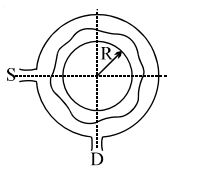
- 8A narrow tube is bent in the form of a circle of radius $R,$ as shown in the figure. Two small holes $S$ and $D$ are made in the tube at the positions right angle to each other. A source placed at $S$ generated a wave of intensity $I_0$ which is equally divided into two parts : One part travels along the longer path, while the other travels along the shorter path. Both the part waves meet at the point $D$ where a detector is placed If a maxima is formed at the detector then, the magnitude of wavelength $\lambda$ of the wave produced is given by $\pi R$View Solution
- 9View Solutionstationary source is emitting sound at a fixed frequency $f_0$, which is reflected by two cars approaching the source. The difference between the frequencies of sound reflected from the cars is $1.2\%$ of $f_0$. What is the difference in the speeds of the cars (in $km$ per hour) to the nearest integer ..... $km/hr$ ? The cars are moving at constant speeds much smaller than the speed of sound which is $330$ $ms^{-1}$.
- 10The fundamental frequency of a closed organ pipe of length $20\; cm$ is equal to the second overtone of an organ pipe open at both the ends. The length of organ pipe open at both the ends is ...... $cm$View Solution