A resonance tube is old and has jagged end. It is still used in the laboratory to determine velocity of sound in air. A tuning fork of frequency $512\,Hz$ produces first resonance when the tube is filled with water to a mark $11\,cm$ below a reference mark, near the open end of the tube. The experiment is repeated with another fork of frequency $256\,Hz$ which produces first resonance when water reaches a mark $27\,cm$ below the reference mark. The velocity of sound in air, obtained in the experiment, is close to .... $ms^{-1}$
JEE MAIN 2019, Diffcult


Download our appand get started for free
Experience the future of education. Simply download our apps or reach out to us for more information. Let's shape the future of learning together!No signup needed.*
Similar Questions
- 1An open pipe of length $33\, cm$ resonates to a frequency of $1000\,Hz$. The mode of vibration is: (velocity of sound $= 330\, m/s$)View Solution
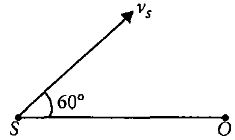
- 2A source of sound $S$ emitting waves of frequency $100\,\, Hz$ and an observer $O$ are ocated at some distance from each other. The source is moving with a speed of $19 .4\,\, m s^{-1}$ at an angle of $60^o $ with the source observer line as shown in the figure. The observer is at rest. The apparent frequency observed by the observer .... $Hz$ (velocity of sound in air $330 \,\, m s^{-1}$), isView Solution
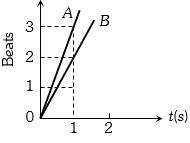
- 3Two tuning forks $P$ and $Q$ are vibrated together. The number of beats produced are represented by the straight line $OA$ in the following graph. After loading $Q$ with wax again these are vibrated together and the beats produced are represented by the line $OB.$ If the frequency of $P$ is $341Hz,$ the frequency of $Q$ will be ... $ Hz$View Solution
- 4For a solid rod, the Young's modulus of elasticity is $3.2 \times 10^{11}\,Nm ^{-2}$ and density is $8 \times 10^3\,kg\,m ^{-3}$. The velocity of longitudinal wave in the rod will be $......... \times 10^{3}\,ms^{-1}$View Solution
- 5If in an experiment for determination of velocity of sound by resonance tube method using a tuning fork of $512 Hz$, first resonance was observed at $30.7 cm$ and second was obtained at $63.2 cm$, then maximum possible error in velocity of sound is .....$cm/sec$ (consider actual speed of sound in air is $332 m/s$)View Solution
- 6One end of a taut string of length $3 \ m$ along the $x$-axis is fixed at $x=0$. The speed of the waves in the string is $100 \ m / s$. The other end of the string is vibrating in the $y$-direction so that stationary waves are set up in the string. The possible waveform$(s)$ of these stationary waves is (are)View Solution
$(A)$ $y(t)=A \sin \frac{\pi x}{6} \cos \frac{50 \pi t}{3}$
$(B)$ $y(t)=A \sin \frac{\pi x}{3} \cos \frac{100 \pi t}{3}$
$(C)$ $y(t)=A \sin \frac{5 \pi x}{6} \cos \frac{250 \pi t}{3}$
$(D)$ $y(t)=A \sin \frac{5 \pi x}{2} \cos 250 \pi t$
- 7A train blowing its whistle moves with constant speed on a straight track towards observer and then crosses him. If the ratio of difference between the actual and apparent frequencies be $3: 2$ in the two cases, then the speed of train is [ $v$ is speed of sound]View Solution
- 8The percentage increase in the speed of transverse waves produced in a stretched string if the tension is increased by $4\, \%$, will be ......... $\%$View Solution
- 9The intensity of sound wave while passing through an elastic medium falls down by $10\%$ as it covers one metre distance through the medium. If the initial intensity of the sound wave was $100$ decibels, its value after it has passed through $3$ metre thickness of the medium will be .... $decibel$View Solution
- 10$5\, beats/ second$ are heard when a turning fork is sounded with a sonometer wire under tension, when the length of the sonometer wire is either $0.95\,m$ or $1\,m$ . The frequency of the fork will be ... $Hz$View Solution