Question
A narrow slit S transmitting light of wavelength $\lambda$ is placed a distance d above a large plane mirror as shown in figure (17-E1). The light coming directly from the slit and that coming after the reflection interfere at a screen $\sum$ placed at a distance D from the slit.
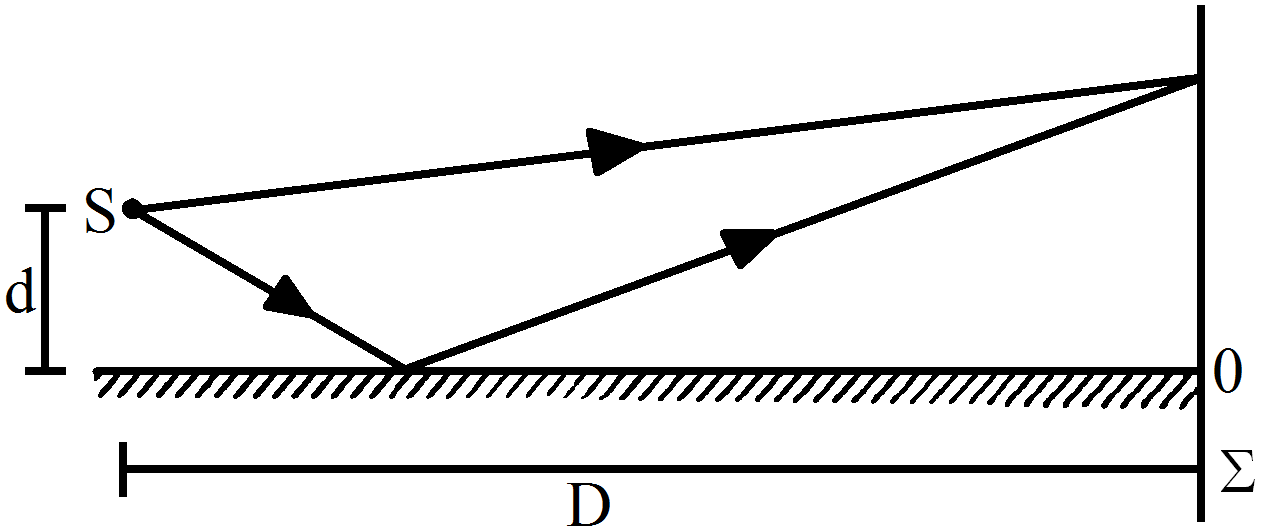
  1. What will be the intensity at a point just above the mirror, i.e., just above O?
  2. At what distance from 0 does the first maximum occur?
Answer

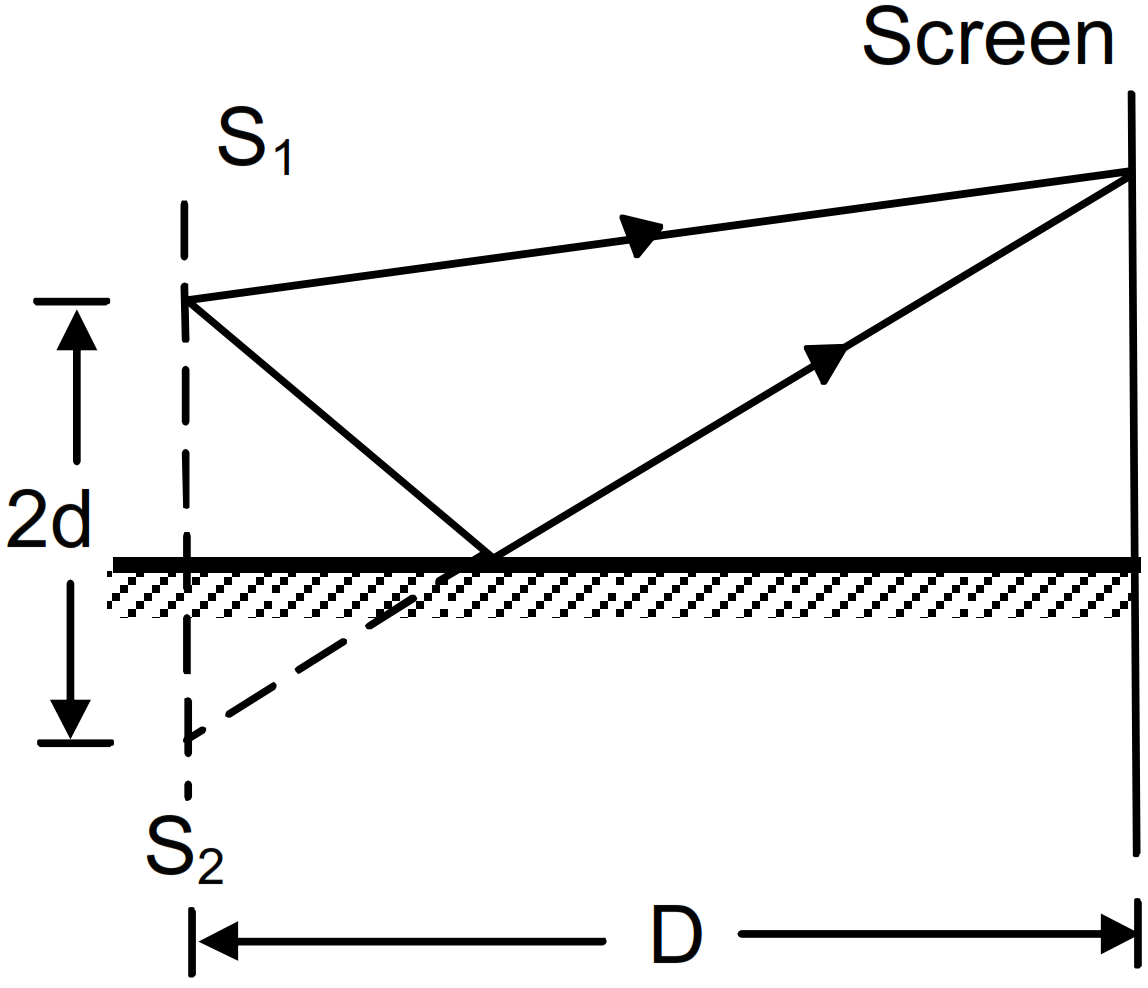
  1. Since, there is a phase difference of $\pi$ between direct light and reflecting light, the intensity just above the mirror will be zero.
  2. Here, 2d = equivalent slit separation

D = Distance between slit and screen.
We know for bright fringe, $\Delta\text{x}=\frac{\text{y}\times2\text{d}}{\text{D}}=\text{n}\lambda$
But as there is a phase reversal of $\frac{\lambda}{2}.$
$\Rightarrow\frac{\text{y}\times2\text{d}}{\text{D}}+\frac{\lambda}{2}=\text{n}\lambda$
$\Rightarrow\frac{\text{y}\times2\text{d}}{\text{D}}=\text{n}\lambda-\frac{\lambda}{2}\Rightarrow\text{y}=\frac{\lambda\text{D}}{4\text{d}}$

Need a full question paper?

Generate a complete, print-ready paper with questions like this in minutes — across 16+ boards, with answer keys.

Start Generating Free

Similar questions

Explain how radioactive nuclei can emit $\beta-$particles even though atomic nuclei do not contain these particles? Hence explain why the mass number of radioactive nuclide does not change during $\beta-$decay?
A $2.00m$ long rope, having a mass of $80g,$ is fixed at one end and is tied to a light string at the other end. The tension in the string is $256N.$
  1. Find the frequencies of the fundamental and the first two overtones.
  2. Find the wavelength in the fundamental and the first two overtones.
The work function of caesium is $2.14 eV$. Find (a) the threshold frequency for caesium, and (b) the wavelength of the incident light if the photocurrent is brought to zero by a stopping potential of $0.60 V$.
You are given a low resistance $R_1$ a high resistance $R_2$ and a moving coil galvanometer. Suggest how would you use these to have an instrument that will be able to measure?
  1. Current.
  2. Potential difference.
It is said that any charge given to a conductor comes to its surface. Should all the protons come to the surface? Should all the electrons come to the surface? Should all the free electrons come to the surface?
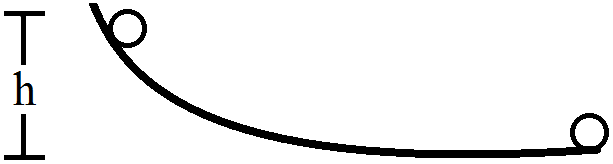
A small spherical ball is released from a point at a height h on a rough track shown in figure. Assuming that it does not slip anywhere, find its linear speed when it rolls on the horizontal part of the track.
Suppose the bob of the previous problem has a speed of 1.4m/ s when the string makes an angle of 0.20 radian with the vertical. Find the tension at this instant. You can use $\cos\theta\approx1-\frac{\theta^2}{2}$ and $\sin\theta\approx\theta$ for small $\theta.$
You have learnt that plane and convex mirrors produce virtual images of objects. Can they produce real images under some circumstances? Explain.
Define mutual inductance between a pair of coils. Derive an expression for the mutual inductance of two long coaxial solenoids of the same length wound one over the other.
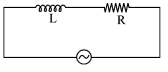
In the given figure, voltage across the ends of inductor ( L ) and resistor ( R ) is 120 V and 90 V respectively. The root mean square value of the current is 3 A. Calculate :
(i) impedance of the circuit and (ii) phase difference between voltage and current.
Image