Question
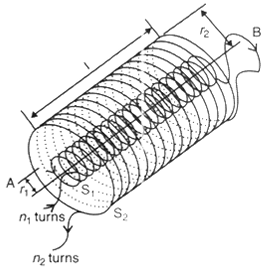
Define mutual inductance between a pair of coils. Derive an expression for the mutual inductance of two long coaxial solenoids of the same length wound one over the other.
Answer

$i$. Mutual inductance is numerically equal to the induced emf in the secondary coil when the current in the primary coil changes by unity.
$ii$. in the question mutual inductance of two long coaxial solenoids of same length l wound one over the other is given by: $-$

Image

Let a current $l_2$ flow in the secondary coil
$\therefore B_2=\frac{\mu_0 N_2 i_2}{l}$
$\therefore $  Flux linked with the primary coil $=\frac{\mu_0 N_2 N_1 A_1 i_2}{l}$
$= M _{12} i _2$
Hence $,  M _{12}=\frac{\mu_0 N_2 N_1 A_1}{l}$
$\mu_0 n_2 n_1 A_1 l\left(n_1=\frac{N_1}{l} ; n_2=\frac{N_2}{l}\right)$

Need a full question paper?

Generate a complete, print-ready paper with questions like this in minutes — across 16+ boards, with answer keys.
Start Generating Free

Similar questions

The rest distance between Patna and Delhi is 1000km. A nonstop train travels at 360km/h:
  1. What is the distance between Patna and Delhi in the train frame?
  2. How much time elapses in the train frame between Patna and Delhi?
A light ray falling at an angle of $45^\circ$ with the surface of a clean slab of ice of thickness $1m$ is refracted into it at an angle of $30^\circ$ . Calculate the time taken by the light rays, to cross the slab. Speed of light in vacuum $= 3 \times 10^8\ m/s$
Write the truth table of NAND gate and NOR gate.
The drift current in a reverse-biased p-n junction increases in magnitude if the temperatu,re of the junction is increased. Explain this on the basis of creation of hole-electron pairs.
The wavelength of a probe is roughly a measure of the size of a structure that it can probe in some detail. The quark structure of protons and neutrons appears at the minute length$-$scale of $10^{–15} m$ or less. This structure was first probed in early $1970’s$ using high energy electron beams produced by a linear accelerator at Stanford, $\text{USA.}$ Guess what might have been the order of energy of these electron beams. $($Rest mass energy of electron $= 0.511\ MeV.)$
The spring shown in figure is unstretched when a man starts pulling on the cord. The mass of the block is M. If the man exerts a constant force F, find
  1. The amplitude and the time period of the motion of the block,
  2. The energy stored in the spring when the block passes through the equilibrium position and,
  3. The kinetic energy of the block at this position.
  1. Draw the equipotential surfaces corresponding to a uniform electric field in the z-direction.
  2. Derive an expression for the electric potential at any point along the axial line of an electric dipole.
A small block of mass 100g is pressed against a horizontal spring fixed at one end to compress the spring through 5.0cm (figure). The spring constant is 100N/m. When released, the block moves horizontally till it leaves the spring. Where will it hit the ground 2m below the spring?
Calculate the minimum and maximum wavelength of hydrogen spectrum emitted in the Balmer series. $(R_{H}=1.1\times10^{7}m^{-1})$
A metal wire PQ of mass 10g lies at rest on two horizontal metal rails separated by 4.90cm A vertically-downward magnetic field of magnitude 0.800T exists in the space. The resistance of the circuit is slowly decreased and it is found that when the resistance goes below 20.0Ω, the wire PQ starts sliding on the rails. Find the coefficient of friction.