A negative charge is coming towards the observer. The direction of the magnetic field produced by it will be (as seen by observer)
Easy
Download our app for free and get started
(a)
$\vec{B}$ will be clockwise as seen by observer.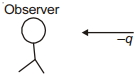

Download our appand get started for free
Experience the future of education. Simply download our apps or reach out to us for more information. Let's shape the future of learning together!No signup needed.*
Similar Questions
- 1A moving coil galvanometer is converted into an ammeter reading upto $0.03\,A$ by connecting a shunt of resistance $4r$ across it and into an ammeter reading upto $0.06\,A$ when a shunt of resistance $r$ is connected across it. What is the maximum current which can be sent through this galvanometer if no shunt is used ............... $A$View Solution
- 2A particle with charge to mass ratio, $\frac{q}{m} = \alpha $ is shot with a speed $v$ towards a wall at a distance $d$ perpendicular to the wall. The minimum value of $\vec B$ that exist in this region perpendicular to the projection of velocity for the particle not to hit the wall isView Solution
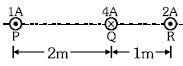
- 3Three long current carrying wires $P, Q$ and $R$ placed perpendicular to plane of the paper. Magnetic force per unit length on wire $'R'$ isView Solution
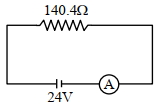
- 4In the given figure an ammeter $A$ consists of a $240 \Omega$ coil connected in parallel to a $10 \Omega$ shunt. The reading of the ammeter is . . . . . . $\mathrm{mA}$.View Solution
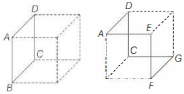
- 5The current in flowing along the path $A B C D$ of a cube (shown in the left figure) produces a magnetic field at the centre of cube of magnitude $B$. Dashed line depicts the non-conducting part of the cube. Consider a cubical shape shown to the right which is identical in size and shape to the left. If the same current now flows in along the path $D A E F G C D$, then the magnitude of magnetic field at the centre will beView Solution
- 6A current of $I$ $ampere$ is passed through a straight wire of length $2.0$ $metres$. The magnetic field at a point in air at a distance of $3$ $metres$ from either end of wire and lying on the axis of wire will beView Solution
- 7View SolutionIf the direction of the initial velocity of the charged particle is perpendicular to the magnetic field, then the orbit will be or The path executed by a charged particle whose motion is perpendicular to magnetic field is
- 8An electron is revolving round a proton, producing a magnetic field of $16\, weber/m^2$ in a circular orbit of radius $1\,\mathop A\limits^o $. It’s angular velocity will beView Solution
- 9An electron with kinetic energy $5 \mathrm{eV}$ enters a region of uniform magnetic field of $3 \mu \mathrm{T}$ perpendicular to its direction. An electric field $\mathrm{E}$ is applied perpendicular to the direction of velocity and magnetic field. The value of $\mathrm{E}$, so that electron moves along the same path, is . . . . . $\mathrm{NC}^{-1}$.View Solution
(Given, mass of electron $=9 \times 10^{-31} \mathrm{~kg}$, electric charge $=1.6 \times 10^{-19} \mathrm{C}$ )
- 10A particle of charge $q$ and mass $m$ is moving along the $x$ -axis with a velocity $v$ and enters a region of electric field $E$ and magnetic field $B$ as shown in figure below for which figure the net force on the charge may be zeroView Solution