An electron is revolving round a proton, producing a magnetic field of $16\, weber/m^2$ in a circular orbit of radius $1\,\mathop A\limits^o $. It’s angular velocity will be
Medium


Download our appand get started for free
Experience the future of education. Simply download our apps or reach out to us for more information. Let's shape the future of learning together!No signup needed.*
Similar Questions
- 1Two coaxial solenoids of different radii carry current $I$ in the same direction. Let $\;{\overrightarrow {\;F} _1}$ be the magnetic force on the inner solenoid due to the outer one and $\;{\overrightarrow {\;F} _2}$ be the magnetic force on the outer solenoid due to the inner one. ThenView Solution
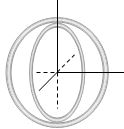
- 2View SolutionTwo insulated rings, one of slightly smaller diameter than the other are suspended along their common diameter as shown. Initially the planes of the rings are mutually perpendicular. When a steady current is set up in each of them
- 3In hydrogen atom, an electron is revolving in the orbit of radius $0.53\,{\mathop A\limits^o }$ with $6.6 \times {10^{15}}$ $rotations/second$. Magnetic field produced at the centre of the orbit is.......$wb/{m^2}$View Solution
- 4A current carrying wire of length $L$ is transformed into a coil of $N$ turns. To achieve maximum magnetic moment, the coilView Solution
- 5Electron moves at right angles to a magnetic field of $1.5 \times 10^{-2}\,tesla$ with speed of $6 \times 10^7\,m/s$. If the specific charge of the electron is $1.7 \times 10^{11}\,C/kg$. The radius of circular path will be......$cm$View Solution
- 6A particle of specific charge $(q/m)$ is projected from the origin of coordinates with initial velocity $[ui - vj]$. Uniform electric magnetic fields exist in the region along the $+y$ direction, of magnitude $E$ and $B.$ The particle will definitely return to the origin once ifView Solution
- 7A particle carrying a charge equal to $100$ times the charge on an electron is rotating per second in a circular path of radius $0.8$ $metre$. The value of the magnetic field produced at the centre will be $({\mu _0} = $ permeability for vacuum)View Solution
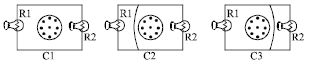
- 8A solenoid is oriented end-on so that its opening is perpendicular to the circuit containing the two light bulbs as drawn in figure $C_1.$ For figure $C_2$ and $C_3,$ a shorting wire of negligible resistance is added as shown. Assume that the magnetic field from the solenoid, shown coming out of the plane of the page, decreases uniformly with time at the same rate for each circuit. Rank the circuits for the brightness of the bulb labeled $R_1$ from brightest to dimmest.View Solution
- 9A straight section $PQ$ of a circuit lies along the $X$-axis from $x = - \frac{a}{2}$ to $x = \frac{a}{2}$ and carries a steady current $i$. The magnetic field due to the section $PQ$ at a point $X = + a$ will beView Solution
- 10View SolutionMagnetic effect of current was discovered by