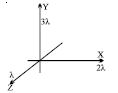
The diagram shows three infinitely long uniform line charges placed on the $X, Y $ and $Z$ axis. The work done in moving a unit positive charge from $(1, 1, 1) $ to $(0, 1, 1) $ is equal to
Advanced
Download our app for free and get started
$d w=\frac{\lambda q}{2 \pi \epsilon_{0} r} d z$
$w=\frac{\lambda q}{2 \pi \epsilon_{0}} \int_{r_{1}}^{r_{2}} \frac{d r}{r}$
$=\frac{\lambda q}{2 \pi \epsilon_{0}} \ln \left(\frac{r_{2}}{r_{1}}\right)$
Now, lets us it as formula $W N=W x+W y+W z$
$\left[W_{i}: \text { Work done by wire in } i \text { direction }\right]$
$=\frac{2 \lambda_{1}(1)}{2 \pi \epsilon_{0}} \ln \left(\frac{\sqrt{2}}{\sqrt{2}}\right)+\frac{3 \lambda(1)}{2 \pi \epsilon_{0}} \ln \left(\frac{1}{\sqrt{2}}\right)+\frac{\lambda}{2 \pi \epsilon_{0}} \ln \left(\frac{1}{\sqrt{2}}\right)$
$=0+\frac{\lambda}{2 \pi \epsilon_{0}}\left[\frac{-3}{2} \ln 2-\frac{1}{2} \ln 2\right]$
$=-\frac{2 \lambda \ln 2}{2 \pi \epsilon_{0}}=\frac{-\lambda \ln 2}{\pi \epsilon_{0}}$
$W_{e x t}=-W N=\frac{\lambda \ln 2}{\pi \epsilon_{0}}$

Download our appand get started for free
Experience the future of education. Simply download our apps or reach out to us for more information. Let's shape the future of learning together!No signup needed.*
Similar Questions
- 1Potential at a point $x$-distance from the centre inside the conducting sphere of radius $R$ and charged with charge $Q$ isView Solution
- 2A parallel plate capacitor filled with a medium of dielectric constant $10$ , is connected across a battery and is charged. The dielectric slab is replaced by another slab of dielectric constant $15$ . Then the energy of capacitor will ......................View Solution
- 3Eight drops of mercury of equal radii possessing equal charges combine to form a big drop. Then the capacitance of bigger drop compared to each individual small drop is........$times$View Solution
- 4The capacity of a condenser is $4 \times {10^{ - 6}}$ farad and its potential is $100\,\,volts$. The energy released on discharging it fully will be.......$Joule$View Solution
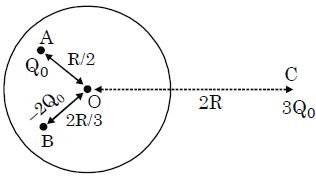
- 5A thin conducting spherical shell (center at $O$ ) having charge $Q_0$ , radius $R$ and three point charges $Q_0$ , $-2Q_0$ , $3Q_0$ are also kept at point $A$ , $B$ and $C$ respectively as shown. Find the potential at any point on the conducting shell. (Potential at infinity is assumed to be zero)View Solution
- 6Two metal spheres $A$ and $B$ of radii $a$ and $b(a < b)$ respectively are at a large distance apart. Each sphere carries a charge of $100 \mu C$. The spheres are connected by a conducting wire, thenView Solution
- 7A capacitor having capacitance $C$ is charged to a voltage $V$. It is then removed and connected in parallel with another identical capacitor which is uncharged. The new charge on each capacitor is nowView Solution
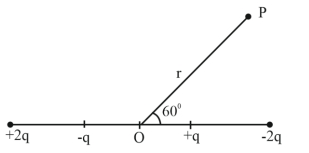
- 8The distance between charges $+\mathrm{q}$ and $-\mathrm{q}$ is $2 l$ and between $+2 \mathrm{q}$ and $-2 \mathrm{q}$ is $4 l$. The electrostatic potential at point $P$ at a distance $r$ from centre $O$ is $-\alpha\left[\frac{q l}{r^2}\right] \times 10^9 \mathrm{~V}$, where the value of $\alpha$ is____. (Use $\left.\frac{1}{4 \pi \varepsilon_0}=9 \times 10^9 \mathrm{Nm}^2 \mathrm{C}^{-2}\right)$View Solution
- 9Two capacitors connected in parallel having the capacities ${C_1}$ and ${C_2}$ are given $'q'$ charge, which is distributed among them. The ratio of the charge on ${C_1}$ and ${C_2}$ will beView Solution
- 10The respective radii of the two spheres of a spherical condenser are $12\;cm$ and $9\;cm$. The dielectric constant of the medium between them is $ 6$. The capacity of the condenser will beView Solution