A neutral spherical copper particle has a radius of $10 \,nm \left(1 \,nm =10^{-9} \,m \right)$. It gets charged by applying the voltage slowly adding one electron at a time. Then, the graph of the total charge on the particle versus the applied voltage would look like
KVPY 2019, Advanced
Download our app for free and get started
$(a)$ From $V=\frac{k q}{r}$,
$q=\frac{V \cdot r}{k}=C \cdot V$
As, $q=n e$, hence graph of quersus $V$ is a step function.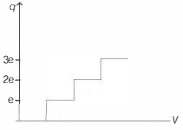

Download our appand get started for free
Experience the future of education. Simply download our apps or reach out to us for more information. Let's shape the future of learning together!No signup needed.*
Similar Questions
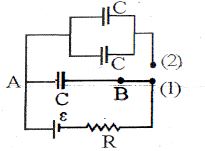
- 1If capacitor connected across $AB$ is charged to $Q$ and then switch is shifted to $2$ . The heat released after thatView Solution
- 2There are four concentric shells $A, B, C $ and $D $ of radii $ a, 2a, 3a$ and $4a$ respectively. Shells $B$ and $D$ are given charges $+q$ and $-q$ respectively. Shell $C$ is now earthed. The potential difference $V_A - V_C $ is :View Solution
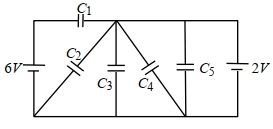
- 3In the following circuit $C_1=12 \mu F, C_2=C_3=4 \mu F$ and $C_4=C_5=2 \mu F$. The Charge stored in $C_3$ is. . . . . $\mu C$.View Solution
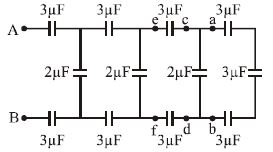
- 4The resultant capacitance between $A$ and $B$ in the fig. is......$\mu F$View Solution
- 5A $4\,\mu F$ condenser is connected in parallel to another condenser of $8\,\mu F$. Both the condensers are then connected in series with a $12\,\mu F$ condenser and charged to $20\;volts$. The charge on the plate of $4\,\mu F$ condenser is......$\mu C$View Solution
- 6View SolutionAssertion : The electrostatic force between the plates of a charged isolated capacitor decreases when dielectric fills whole space between plates.
Reason : The electric field between the plates of a charged isolated capacitance increases when dielectric fills whole space between plates.
- 7View SolutionThe value of electric potential at any point due to any electric dipole is
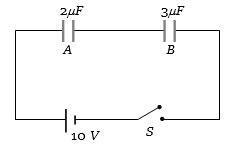
- 8Two capacitors $A$ and $B$ are connected in series with a battery as shown in the figure. When the switch $S$ is closed and the two capacitors get charged fully, thenView Solution
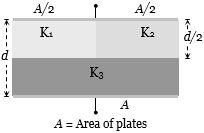
- 9View SolutionIn the figure a capacitor is filled with dielectrics. The resultant capacitance is
- 10To obtain $3\,\mu F$ capacity from three capacitors of $2\,\mu F$ each, they will be arrangedView Solution