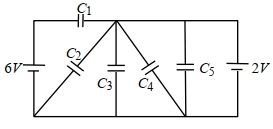
In the following circuit $C_1=12 \mu F, C_2=C_3=4 \mu F$ and $C_4=C_5=2 \mu F$. The Charge stored in $C_3$ is. . . . . $\mu C$.
IIT 2022, Medium


Download our appand get started for free
Experience the future of education. Simply download our apps or reach out to us for more information. Let's shape the future of learning together!No signup needed.*
Similar Questions
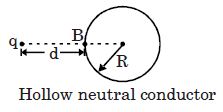
- 1View SolutionFor the situation shown in the figure below, mark out the correct statement
- 2Two identical parallel plate capacitors are connected in series to a battery of $100\,V$. A dielectric slab of dielectric constant $4.0$ is inserted between the plates of second capacitor. The potential difference across the capacitors will now be respectivelyView Solution
- 3The capacity of a parallel plate condenser is $C$. Its capacity when the separation between the plates is halved will beView Solution
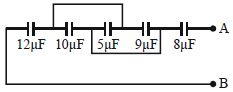
- 4Five capacitors together with their capacitances are shown in the adjoining figure. The potential difference between the points $A$ and $B$ is $60\, volt$. The equivalent capacitance between the point $A$ and $B$ and charge on capacitor $5 \mu F$ will be respectively:-View Solution
- 5View SolutionForce of attraction between the plates of a parallel plate capacitor is
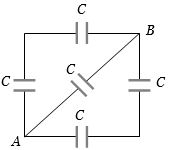
- 6In the figure shown, the effective capacitance between the points $A$ and $B$, if each has capacitance $C$, isView Solution
- 7There is $10$ units of charge at the centre of a circle of radius $10\,m$. The work done in moving $1\, unit$ of charge around the circle once is...........$units$View Solution
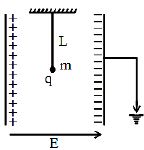
- 8A simple pendulum of length $L$ is placed between the plates of a parallel plate capacitor having electric field $E,$ as shown in figure. Its bob has mass $m$ and charge $q.$ the time period of the pendulum is given byView Solution
- 9View SolutionIf a solid and a hollow conducting sphere have same radius then
- 10A parallel plate capacitor has a uniform electric field $E$ in the space between the plates. If the distance between the plates is $d$ and area of each plate is $A,$ the energy stored in the capacitor isView Solution