Question
In a Young's double slit experiment using monochromatic light, the fringe pattern shifts by a certain distance on the screen when a mica sheet of refractive index 1.6 and thickness 1.964 micron (1 micron = 10-6m) is introduced in the path of one of the interfering waves. The mica sheet is then removed and the distance between the screen and the slits is doubled. It is found that the distance between the successive maxima now is the same as the observed fringe-shift upon the introduction of the mica sheet. Calculate the wavelength of the monochromatic light used in the experiment.
Answer

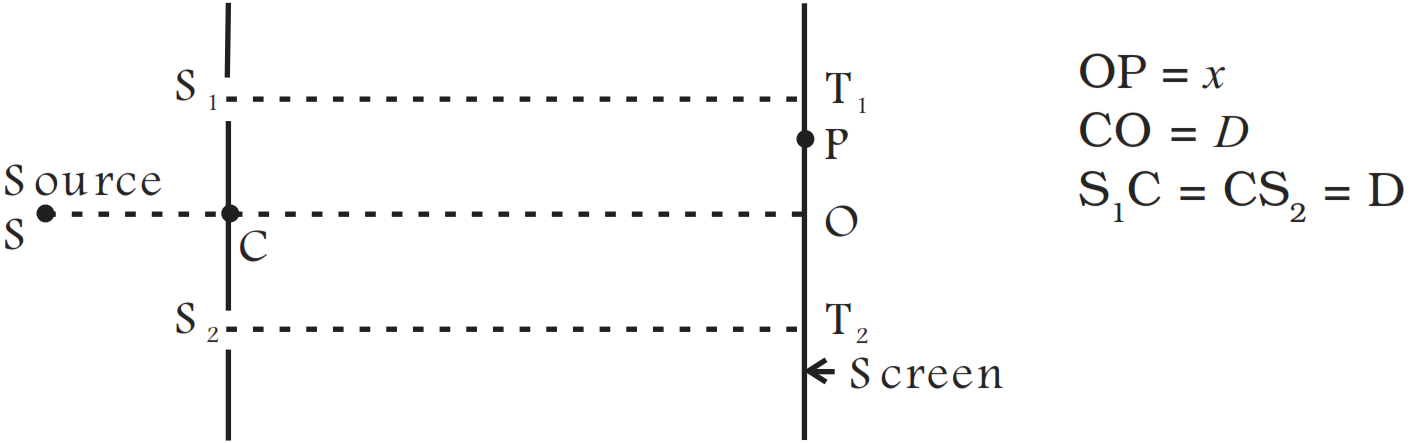
In the given Young’s double slit experiment,

$\mu=1.6,$ t = 1.964 micron = 1.964 × 10⁻⁶m

We know, number of fringes shifted $=\frac{(\mu-1)\text{t}}{\lambda}$

So, the corresponding shift = No.of fringes shifted × fringe width

$=\frac{(\mu-1)\text{t}}{\lambda}\times\frac{\lambda\text{D}}{\text{d}}=\frac{(\mu-1)\text{tD}}{\text{d}}\ ...(1)$

Again, when the distance between the screen and the slits is doubled,

Fringe width $=\frac{\lambda(2\text{D})}{\text{d}}\ ...(2)$

From (1) and (2), $\frac{(\mu-1)\text{tD}}{\text{d}}=\frac{\lambda(2\text{D})}{\text{d}}$

$\Rightarrow\lambda=\frac{(\mu-1)\text{t}}{\lambda}$

$=\frac{(1.6-1)\times(1.964)\times10^{-6}}{2}=589.2\times10^{-9}=589.2\text{nm}.$

Need a full question paper?

Generate a complete, print-ready paper with questions like this in minutes — across 16+ boards, with answer keys.

Start Generating Free

Similar questions

Explain ac voltage applied on a series LCR circuit and give its analytical solution.
Obtain expression for root mean square value of alternating emf. Draw graph between $E$ and t and $E ^2$ and $t$ and prove that average rate of heat produced for alternating current in one complete cycle is $H = I _{\text {max }}^2 R$.
By explaining magnetic field lines, write their characteristics.
An air bubble of radius 2.0mm is formed at the bottom of a 3.3m deep river. Calculate the radius of the bubble as it comes to the surface. Atmospheric pressure = 1.0 × 10⁵ Pa and density of water = 1000kg/m-3.
  1. Describe briefly, with the help of a diagram, the role of the two important processes involved in the formation of a p-n junction.
  2. Name the device which is used as a voltage regulator. Draw the necessary circuit diagram and explain its working.
Two long wires carrying current I1 and I2 are arranged as shown in Fig. The one carrying current I1 is along is the x-axis. The other carrying current I2 is along a line parallel to the y-axis given by x = 0 and z = d. Find the force exerted at O2 because of the wire along the x-axis.

  1. Explain, giving reasons, the basic difference in converting a galvanometer into (i) a voltmeter and (ii) an ammeter.
  2. Two long straight parallel conductors carrying steady currents I1 and I2 are separated by a distance 'd'. Explain briefly, with the help of a suitable diagram, how the magnetic field due to one conductor acts on the other. Hence deduce the expression for the force acting between the two conductors. Mention the nature of this force.
A ball of mass 50g moving at a speed of 2.0m/s strikes a plane surface at an angle of incidence 45°. The ball is reflected by the plane at equal angle of reflection with the same speed. Calculate
  1. The magnitude of the change in momentum of the ball.
  2. The change in the magnitude of the momentum of the ball.
Consider a two slit interference arrangements (Fig.) such that the distance of the screen from the slits is half the distance between the slits. Obtain the value of D in terms of λ such that the first minima on the screen falls at a distance D from the centre O.

The time constant of an LR circuit is 40ms. The circuit is connected at t = 10 and the steady-state current is found to be 2.0A. Find the current at:
  1. t = 10ms
  2. t = 20ms
  3. t = 100ms
  4. t = 1s.