A non-conducting ring of radius $0.5\,m$ carries a total charge of $1.11 \times {10^{ - 10}}\,C$ distributed non-uniformly on its circumference producing an electric field $\vec E$ everywhere in space. The value of the line integral $\int_{l = \infty }^{l = 0} {\, - \overrightarrow E .\overrightarrow {dl} } \,(l = 0$ being centre of the ring) in volt is
IIT 1997, Medium


Download our appand get started for free
Experience the future of education. Simply download our apps or reach out to us for more information. Let's shape the future of learning together!No signup needed.*
Similar Questions
- 1A parallel plate condenser has a capacitance $50\,\mu F$ in air and $110\,\mu F$ when immersed in an oil. The dielectric constant $'k'$ of the oil isView Solution
- 2Capacitance (in $F$) of a spherical conductor with radius $1\, m$ isView Solution
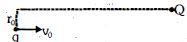
- 3A point chargr $Q$ is fixed A small charge $q$ and mass $m$ is given a velocity $v_0$ from infinity & perpendicular distance $r_0$ as shown. If distance of closest approach is $r_0/2$. The value of $q$ is [Given $mv_0^2 = \frac{{{Q^2}}}{{4\pi { \in _0}\,{r_0}}}$]View Solution
- 4The energy of a charged capacitor is given by the expression ($q$= charge on the conductor and $C$ = its capacity)View Solution
- 5Three capacitors, each of $3\,\mu F$, are provided. These cannot be combined to provide the resultant capacitance of.........$\mu F$View Solution
- 6The energy and capacity of a charged parallel plate capacitor are $U$ and $C$ respectively. Now a dielectric slab of $\in _r = 6$ is inserted in it then energy and capacity becomes (Assume charge on plates remains constant)View Solution
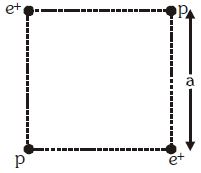
- 7Two positrons $(e^+)$ and two protons $(p)$ are kept on four corners of a square of side $a$ as shown in figure. The mass of proton is much larger than the mass of positron. Let $q$ denotes the charge on the proton as well as the positron then the kinetic energies of one of the positrons and one of the protons respectively after a very long time will be-View Solution
- 8A capacitor of capacitance $C_1 = 1\ \mu F$ can with stand maximum voltage $V_1= 6\ kV$ (kilo-volt) and another capacitor of capacitance $ C_2 = 3\ \mu F$ can withstand maximum voltage $V_2 = 4\ kV$. When the two capacitors are connected in series, the combined system can withstand a maximum voltage of......$kV$View Solution
- 9View SolutionConsider a neutral conducting sphere. A positive point charge is placed outside the sphere. The net charge on the sphere is then,
- 10This question contains Statement$-1$ and Statement$-2$. Of the four choices given after the statements, choose the one that best describes the two statements.View Solution
Statement$-1$ : For a charged particle moving from point $P$ to point $Q$, the net work done by an electrostatic field on the particle is independent of the path connecting point $P$ to point $Q$.
Statement$-2$ : The net work done by a conservative force on an object moving along a closed loop is zero.