The energy of a charged capacitor is given by the expression ($q$= charge on the conductor and $C$ = its capacity)
Easy
Download our app for free and get started
$q = CV$ and $U = \frac{1}{2}C{V^2} = \frac{{{q^2}}}{{2C}}$

Download our appand get started for free
Experience the future of education. Simply download our apps or reach out to us for more information. Let's shape the future of learning together!No signup needed.*
Similar Questions
- 1View SolutionIf a charge is shifted from a low potential region to high potential region, the electric potential energy
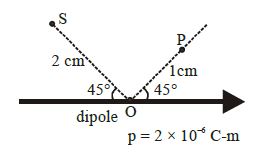
- 2If $OP = 1\,\,cm$ and $OS = 2\,\, cm$, work done by electric field in shifting a point charge $\frac {4\sqrt 2}{27}\,\, μC$ from point $P$ to $S$ in given figure isView Solution
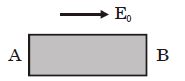
- 3View SolutionA metallic rod is placed in a uniform electric field. Select the correct option.
- 4Within a spherical charge distribution of charge density $\rho \left( r \right)$, $N$ equipotential surfaces of potential ${V_0},{V_0} + \Delta V,{V_0} + 2\Delta V,$$.....{V_0} + N\Delta V\left( {\Delta V > 0} \right),$ are drawn and have increasing radii $r_0, r_1, r_2,......r_N$, respectively. If the difference in the radii of the surfaces is constant for all values of $V_0$ and $\Delta V$ thenView Solution
- 5A parallel plate capacitor of capacitance $90\ pF$ is connected to a battery of $emf$ $20\ V$. If a dielectric material of dielectric constant $K = \frac{5}{3}$ is inserted between the plates, the magnitude of the induced charge will be.......$n $ $C$View Solution
- 6A sphere of $4\, cm$ radius is suspended within a hollow sphere of $6\, cm$ radius. The inner sphere is charged to potential $3\, e.s.u.$ and the outer sphere is earthed. The charge on the inner sphere is.....$e.s.u.$View Solution
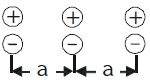
- 7Three identical small electric dipoles are arranged parallel to each other at equal separation a as shown in the figure. Their total interaction energy is $U$. Now one of the end dipole is gradually reversed, how much work is done by the electric forces.View Solution
- 8A capacitor of capacity $C$ is connected with a battery of potential $V$ in parallel. The distance between its plates is reduced to half at once, assuming that the charge remains the same. Then to charge the capacitance upto the potential $V$ again, the energy given by the battery will beView Solution
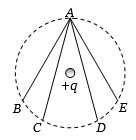
- 9In the electric field of a point charge $q$, a certain charge is carried from point $A$ to $B$, $C$, $D$ and $E$. Then the work doneView Solution
- 10Three capacitors of capacity ${C_1},\;{C_2}\;{C_3}$ are connected in series. Their total capacity will beView Solution