A parallel plate capacitor has plates of area $A$ separated by distance $d$ between them. It is filled with a dielectric which has a dielectric constant that varies as $\mathrm{k}(\mathrm{x})=\mathrm{K}(1+\alpha \mathrm{x})$ where $\mathrm{x}$ is the distance measured from one of the plates. If $(\alpha \text {d)}<<1,$ the total capacitance of the system is best given by the expression
JEE MAIN 2020, Advanced
Download our app for free and get started
As $\mathrm{K}$ is variable we take a plate element of Area $A$ and thickness $dx$ at distance $\mathrm{x}$
Capacitance of element
$\mathrm{d} \mathrm{C}=\frac{(\mathrm{A}) \mathrm{K}(1+\alpha \mathrm{x}) \varepsilon_{0}}{\mathrm{dx}}$
Now all such elements are is series so
equivalent capacitance
$\frac{1}{\mathrm{C}}=\int \frac{1}{\mathrm{d} \mathrm{C}}=\int_{0}^{\mathrm{d}} \frac{\mathrm{dx}}{\mathrm{AK} \varepsilon_{0}(1+\alpha \mathrm{x})}$
$\frac{1}{\mathrm{C}}=\frac{1}{\alpha \mathrm{AK} \varepsilon_{0}} \ln \left(\frac{1+\alpha \mathrm{d}}{1}\right)$
$=\frac{1}{\mathrm{C}}=\frac{1}{\alpha \mathrm{AK} \varepsilon_{0}}\left(\alpha \mathrm{d}-\frac{(\alpha \mathrm{d})^{2}}{2}+\frac{(\alpha \mathrm{d})^{3}}{3}+\ldots .\right)$
$\Rightarrow \frac{1}{\mathrm{C}}=\frac{\alpha \mathrm{d}}{\alpha \mathrm{AK} \varepsilon_{0}}\left(1-\frac{\alpha \mathrm{d}}{2}+\frac{(\alpha \mathrm{d})^{2}}{3}+\ldots .\right)$
$\frac{1}{\mathrm{C}}=\frac{\mathrm{d}}{\mathrm{AK} \varepsilon_{0}}\left(1-\frac{\alpha \mathrm{d}}{2}\right)$
$C=\frac{A K \varepsilon_{0}}{d}\left(1+\frac{\alpha d}{2}\right)$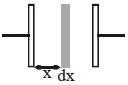

Download our appand get started for free
Experience the future of education. Simply download our apps or reach out to us for more information. Let's shape the future of learning together!No signup needed.*
Similar Questions
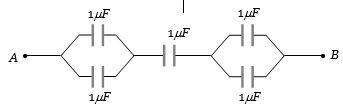
- 1The equivalent capacitance between $A$ and $B$ is.......$\mu \,F$View Solution
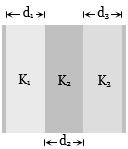
- 2The expression for the capacity of the capacitor formed by compound dielectric placed between the plates of a parallel plate capacitor as shown in figure, will be (area of plate $ = A$)View Solution
- 3If the dielectric constant and dielectric strength be denoted by $k$ and $x$ respectively, then a material suitable for use as a dielectric in a capacitor must haveView Solution
- 4$STATEMENT-1$ For practical purposes, the earth is used as a reference at zero potential in electrical circuits.andView Solution
$STATEMENT-2$ The electrical potential of a sphere of radius $R$ with charge $\mathrm{Q}$ uniformly distributed on the surface is given by $\frac{\mathrm{Q}}{4 \pi \varepsilon_0 R}$.
- 5Two capacitors $C_1$ and $C_2$ are charged to $120\ V$ and $200\ V$ respectively. It is found that connecting them together the potential on each one can be made zero. ThenView Solution
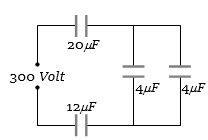
- 6In the adjoining figure, four capacitors are shown with their respective capacities and the $P.D.$ applied. The charge and the $P.D.$ across the $4\,\mu F$ capacitor will beView Solution
- 7There is a uniform electrostatic field in a region. The potential at various points on a small sphere centred at $P$, in the region, is found to vary between in the limits $589.0\,V$ to $589.8\, V$. What is the potential at a point on the sphere whose radius vector makes an angle of $60^o$ with the direction of the field ?........$V$View Solution
- 8At a certain distance from a point charge the electric field is $500\,V/m$ and the potential is $3000\,V$. What is this distance......$m$View Solution
- 9View SolutionConsider a neutral conducting sphere. A positive point charge is placed outside the sphere. The net charge on the sphere is then,
- 10An electric dipole has the magnitude of its charge as $q$ and its dipole moment is $p$. It is placed in a uniform electric field $E$. If its dipole moment is along the direction of the field, the force on it and its potential energy are respectivelyView Solution