An electric dipole has the magnitude of its charge as $q$ and its dipole moment is $p$. It is placed in a uniform electric field $E$. If its dipole moment is along the direction of the field, the force on it and its potential energy are respectively
AIPMT 2004, Easy
Download our app for free and get started
(c) In the given condition angle between $\vec p$ and $\vec E$ is zero. Hence potential energy $U = - \,pE\cos 0 = - \,pE\, = \min .$
Also in uniform electric field $F_{net} = 0$.
Also in uniform electric field $F_{net} = 0$.

Download our appand get started for free
Experience the future of education. Simply download our apps or reach out to us for more information. Let's shape the future of learning together!No signup needed.*
Similar Questions
- 1The capacity of a parallel plate capacitor with no dielectric substance but with a separation of $0.4 \,cm$ is $2\,\mu \,F$. The separation is reduced to half and it is filled with a dielectric substance of value $2.8$. The final capacity of the capacitor is.......$\mu \,F$View Solution
- 2View SolutionInside a hollow charged spherical conductor, the potential
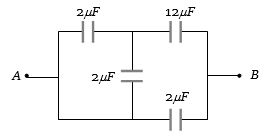
- 3Four capacitors are connected in a circuit as shown in the figure. The effective capacitance in $\mu F$ between points $A$ and $B$ will beView Solution
- 4Equipotential surfaces associated with an electric field which is increasing in magnitude along the $x$-direction areView Solution
- 5This question has Statement $-1$ and Statement $-2$ Of the four choices given after the Statements, choose the one that best describes the two StatementsView Solution
Statement $1$ : No work is required to be done to move a test charge between any two points on an equipotential surface
Statement $2$ : Electric lines of force at the equipotential surfaces are mutually perpendicular to each other
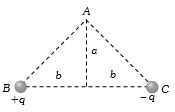
- 6As shown in the figure, charges $ + q$ and $ - q$ are placed at the vertices $B$ and $C$ of an isosceles triangle. The potential at the vertex $A$ isView Solution
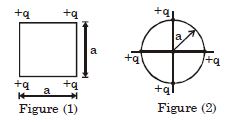
- 7Consider the configuration of a system of four charges each of value $+q$ . The work done by external agent in changing the configuration of the system from figure $(1)$ to figure $(2)$ isView Solution
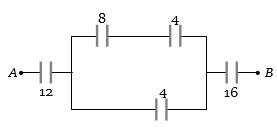
- 8What is the equivalent capacitance between $A$ and $B$ in the given figure (all are in farad)View Solution
- 9A parallel plate condenser with oil between the plates (dielectric constant of oil $K = 2$) has a capacitance $C$. If the oil is removed, then capacitance of the capacitor becomesView Solution
- 10A capacitor $C$ is fully charged with voltage $V _{0}$ After disconnecting the voltage source, it is connected in parallel with another uncharged capacitor of capacitance $\frac{ C }{2} .$ The energy loss in the process after the charge is distributed between the two capacitors is$.........$$CV _{0}^{2}$View Solution