Question
A parallel-plate capacitor having plate area 20cm2 and separation between the plates 1.00mm is connected to a battery of 12.0V. The plates are pulled apart to increase the separation to 2.0mm.
  1. Calculate the charge flown through the circuit during the process.
  2. How much energy is absorbed by the battery during the process?
  3. Calculate the stored energy in the electric field before and after the process.
  4. Using the expression for the force between the plates, find the work done by the person pulling the plates apart.
  5. Show and justify that no heat is produced during this transfer of charge as the separation is increased.
Answer

Area = a = 20cm2 = 2 × 10⁻²m2

d = Separation = 1mm = 10-3m

$\text{C}_{\text{i}}=\frac{\in_0\times2\times10^{-3}}{10^{-3}}=2\in_0$

$\text{C}_{\text{f}}=\frac{\in_0\times2\times10^{-3}}{2\times10^{-3}}=\in_0$

$\text{q}_{\text{i}}=24\in_0$

$\text{q}_{\text{f}}=12\in_0$

  1. So, q flown out $12\in_0.$ i.e., qi - qf

So, q = 12 × 8.85 × 10-12 = 106.2 × 10⁻¹²C = 1.06 × 10⁻¹⁰C

  1. Energy absorbed by battery during the process

= q × v = 1.06 × 10-10C × 12

= 12.7 × 10⁻¹⁰J

  1. Before the process

$\text{E}_{\text{i}}=\Big(\frac{1}{2}\Big)\times\text{C}_{\text{i}}\times\text{V}^2$

$=\Big(\frac{1}{2}\Big)\times2\times8.85\times10^{-12}\times144$

$=12.7\times10^{-10}\text{J}$

After the force

$\text{E}_{\text{f}}=\Big(\frac{1}{2}\Big)\times\text{C}_{\text{f}}\times\text{V}^2$

$=\Big(\frac{1}{2}\Big)\times8.85\times10^{-12}\times144$

$=6.35\times10^{-10}\text{J}$

  1. Workdone = Force × Distance

$=\frac{1}{2}\frac{\text{q}^2}{\in_0\text{A}}=1\times10^{3}$

$=\frac{1}{2}\times\frac{12\times12\times\in_0\times\in_0\times10^{-3}}{\in_0\times2\times10^{-3}}$

  1. From (c) and (d) we have calculated, the energy loss by the separation of plates is equal to the work done by the man on plate. Hence no heat is produced in transformer.

Need a full question paper?

Generate a complete, print-ready paper with questions like this in minutes — across 16+ boards, with answer keys.

Start Generating Free

Similar questions

A concave mirror forms an image of 20cm high object on a screen placed 5.0m away from the mirror. The height of the image is 50cm. Find the focal length of the mirror and the distance between the mirror and the object.
A smooth sphere of radius R is made to translate in a straight line with a constant acceleration a. A particle kept on the top of the sphere is released from there at zero velocity with respect to the sphere. Find the speed of the particle with respect to the sphere as a function of the angle $\theta$ it slides.
A double convex lens has focal length 25cm. The radius of curvature of one of the surfaces is double of the other. Find the radii, if the refractive index of the material of the lens is 1.5.
The bob of a pendulum at rest is given a sharp hit to impart a horizontal velocity $\sqrt{10\text{gl}},$ where l is the length of the pendulum. Find the tension in the string when,
  1. The string is horizontal.
  2. The bob is at its highest point.
  3. The string makes an angle of 60° with the upward vertical.
One end of a 10cm long silk thread is fixed to a large vertical surface of a charged nonconducting plate and the other end is fastened to a small ball having a mass of 10g and a charge of 4.0 × 10⁻⁵C. In equilibrium, the thread makes an angle of 60° with the vertical. Find the surface charge density on the plate.
For the same objective, find the ratio of the least separation between two points to be distinguished by a microscope for light of 5000A and electrons accelerated through 100V used as the illuminating substance.
A bulb with rating 250V, 100W is connected to a power supply of 220V situated 10m away using a copper wire of area of cross-section 5mm2. How much power will be consumed by the connecting wires? Resistivity of copper $1.7\times10^{-8}\Omega-\text{m}$.
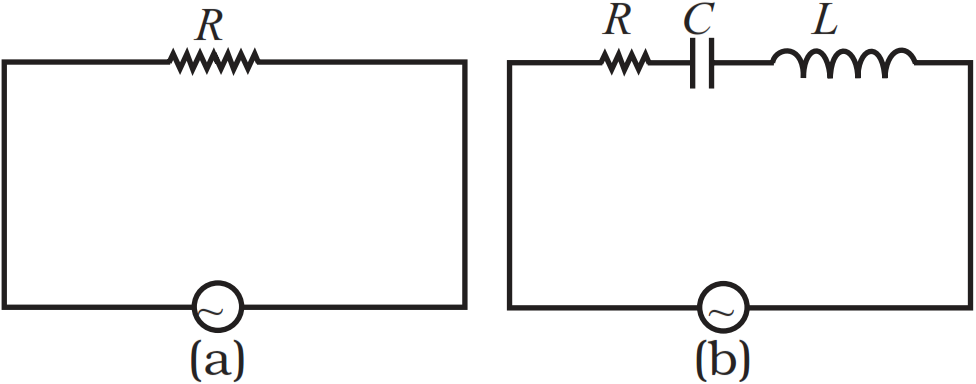
Study the circuits (a) and (b) shown in Fig. and answer the following questions.

  1. Under which conditions would the rms currents in the two circuits be the same?
  2. Can the rms current in circuit (b) be larger than that in (a)?
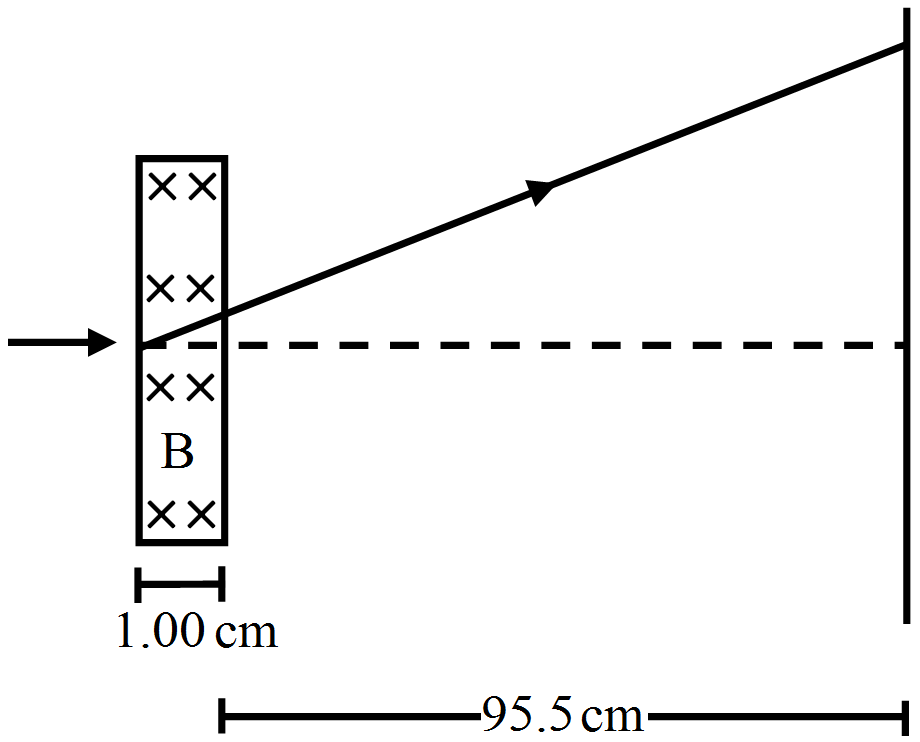
A narrow beam of singly charged potassium ions of kinetic energy 32keV is injected into a region of width 1.00cm with a magnetic field of strength 0.500T, as shown in the figure. The ions are collected at a screen 95.5cm away from the field region. If the beam contains isotopes of atomic weights 39 and 41, find the separation between the points where these isotopes strike the screen. Take the mass of a potassium ion = A (1.6 × 10⁻²⁷)kg, where A is the mass number.

  1. Show that the normal component of electrostatic field has a discontinuity from one side of a charged surface to another given by

$(\text{E}_2-\text{E}_1).\hat{\text{n}}=\frac{\sigma}{\in_0}$

where $\hat{\text{n}}$ is a unit vector normal to the surface at a point and σ is the surface charge density at that point. (The direction of $\hat{\text{n}}$ is from side 1 to side 2.) Hence show that just outside a conductor, the electric field is σ $\hat{\text{n}}$0.

  1. Show that the tangential component of electrostatic field is continuous from one side of a charged surface to another.

[Hint: For (a), use Gauss’s law. For, (b) use the fact that work done by electrostatic field on a closed loop is zero.]