Question
A parallel-plate capacitor having plate area 20cm2 and separation between the plates 1.00mm is connected to a battery of 12.0V. The plates are pulled apart to increase the separation to 2.0mm.
  1. Calculate the charge flown through the circuit during the process.
  2. How much energy is absorbed by the battery during the process?
  3. Calculate the stored energy in the electric field before and after the process.
  4. Using the expression for the force between the plates, find the work done by the person pulling the plates apart.
  5. Show and justify that no heat is produced during this transfer of charge as the separation is increased.
Answer

Area = a = 20cm2 = 2 × 10⁻²m2

d = Separation = 1mm = 10-3m

$\text{C}_{\text{i}}=\frac{\in_0\times2\times10^{-3}}{10^{-3}}=2\in_0$

$\text{C}_{\text{f}}=\frac{\in_0\times2\times10^{-3}}{2\times10^{-3}}=\in_0$

$\text{q}_{\text{i}}=24\in_0$

$\text{q}_{\text{f}}=12\in_0$

  1. So, q flown out $12\in_0.$ i.e., qi - qf

So, q = 12 × 8.85 × 10-12 = 106.2 × 10⁻¹²C = 1.06 × 10⁻¹⁰C

  1. Energy absorbed by battery during the process

= q × v = 1.06 × 10-10C × 12

= 12.7 × 10⁻¹⁰J

  1. Before the process

$\text{E}_{\text{i}}=\Big(\frac{1}{2}\Big)\times\text{C}_{\text{i}}\times\text{V}^2$

$=\Big(\frac{1}{2}\Big)\times2\times8.85\times10^{-12}\times144$

$=12.7\times10^{-10}\text{J}$

After the force

$\text{E}_{\text{f}}=\Big(\frac{1}{2}\Big)\times\text{C}_{\text{f}}\times\text{V}^2$

$=\Big(\frac{1}{2}\Big)\times8.85\times10^{-12}\times144$

$=6.35\times10^{-10}\text{J}$

  1. Workdone = Force × Distance

$=\frac{1}{2}\frac{\text{q}^2}{\in_0\text{A}}=1\times10^{3}$

$=\frac{1}{2}\times\frac{12\times12\times\in_0\times\in_0\times10^{-3}}{\in_0\times2\times10^{-3}}$

  1. From (c) and (d) we have calculated, the energy loss by the separation of plates is equal to the work done by the man on plate. Hence no heat is produced in transformer.

Need a full question paper?

Generate a complete, print-ready paper with questions like this in minutes — across 16+ boards, with answer keys.

Start Generating Free

Similar questions

Answer the following:

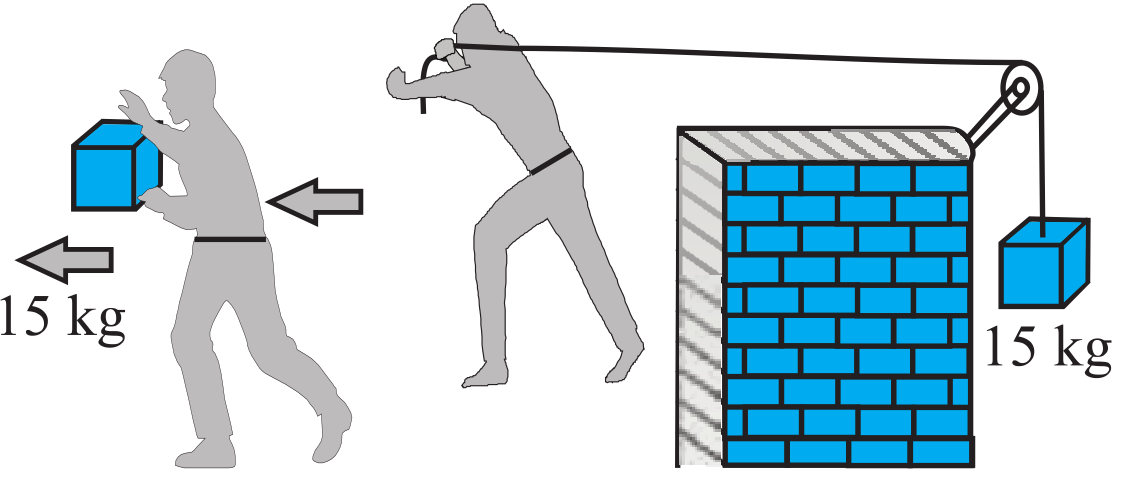
In the man walks 2m carrying a mass of 15kg on his hands. In he walks the same distance pulling the rope behind him. The rope goes over a pulley, and a mass of 15kg hangs at its other end. In which case is the work done greater?

Two mercury droplets of radii 0.1cm. and 0.2cm. collapse into one single drop. What amount of energy is released? The surface tension of mercury T = 435.5 × 10-3N m-1
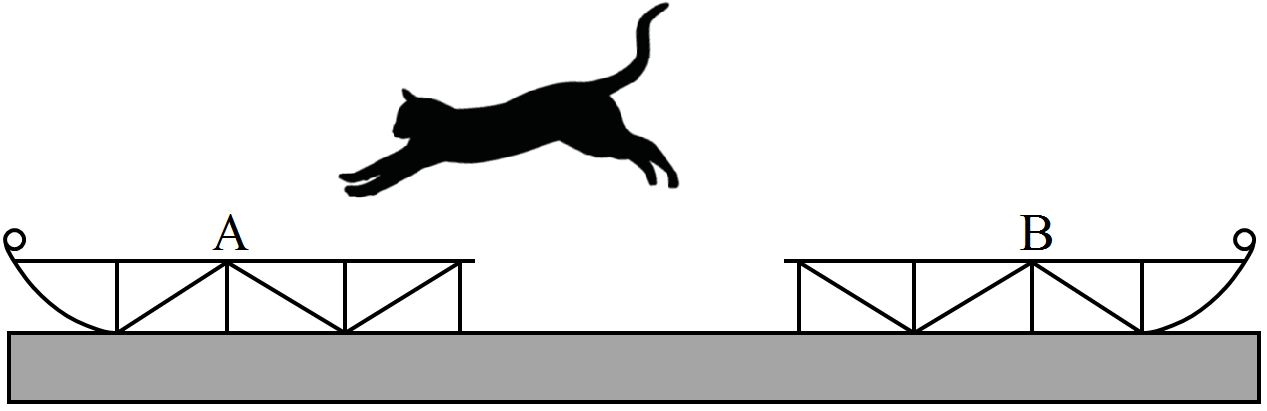
Two 22.7kg ice sleds A and B are placed a short distance apart, one directly behind the other, as shown in Fig. A 3.63kg cat, standing on one sled, jumps across to the other and immediately back to the first. Both jumps are made at a speed of 3.05ms-1 relative to the ice. Find the final speeds of the two sleds.

Draw velocity-time graph of uniformly accelerated motion in one dimension. From the velocity time graph of uniform accelerated motion, deduce the equations of motion in distance and time.
We would like to prepare a scale whose length does not change with temperature. It is proposed to prepare a unit scale of this type whose length remains, say 10cm. We can use a bimetallic strip made of brass and iron each of different length whose length (both components) would change in such a way that difference between their lengths remain constant. If airon = 1.2 × 10-5/ K and abrass = 1.8 × 10-5/ K, what should we take as length of each strip?
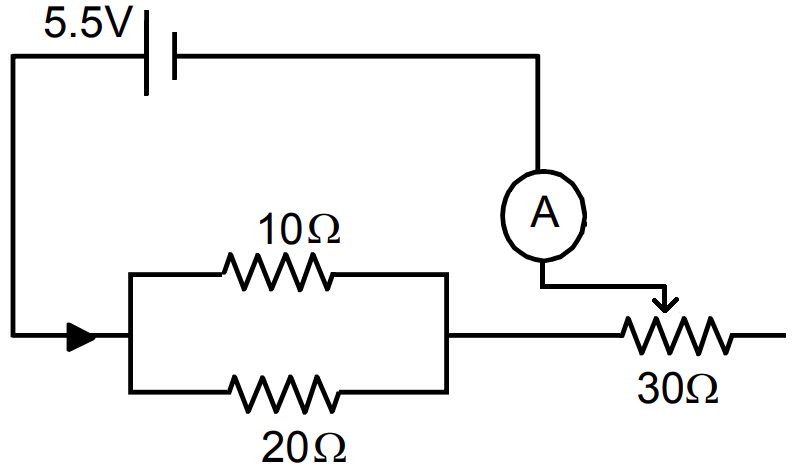
The resistance of the rheostat shown in the figure. is $30\Omega.$ Neglecting the meter resistance, find the minimum and maximum currents through the ammeter as the rheostat is varied.

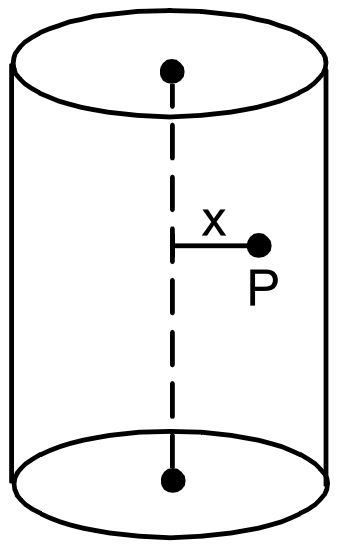
A long cylindrical volume contains a uniformly distributed charge of density $\rho.$ Find the electric field at a point P inside the cylindrical volume at a distance x from its axis (figure).

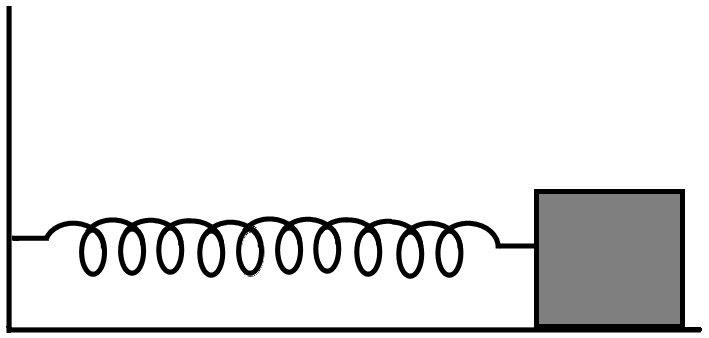
For three situations, the initial and final positions respectively, along x-axis for the block in Fig are (a) - 3cm, 2cm. (b) 2cm, 3 cm and (c) -2cm, 2cm. In each situation, is the work done by the spring force on the block positive, negative or zero?

Two cylindrical hollow drums of radii R and 2R, and of a common height h, are rotating with angular velocities $\omega$ (anti-clockwise) and $\omega$ (clockwise), respectively. Their axes, fixed are parallel and in a horizontal plane separated by $(3\text{R}+\delta).$ They are now brought in contact $(\delta\rightarrow0){:}$
  1. Show the frictional forces just after contact.
  2. Identify forces and torques external to the system just after contact.
  3. What would be the ratio of final angular velocities when friction ceases?
A particle of mass 0.1kg has an initial speed of 4ms-1 at a point A on a rough horizontal road. The coefficient of friction, between the object and the road is 0.15. The particle moves to a point B at a distance of 2m from A. What is the speed of the particle B? (Take g = 10ms-2)