Question
We would like to prepare a scale whose length does not change with temperature. It is proposed to prepare a unit scale of this type whose length remains, say 10cm. We can use a bimetallic strip made of brass and iron each of different length whose length (both components) would change in such a way that difference between their lengths remain constant. If airon = 1.2 × 10-5/ K and abrass = 1.8 × 10-5/ K, what should we take as length of each strip?
Answer

According to the problem, L- Lb = 10cm where,

L1 = length of iron scale

Lb = Length of brass scale

This condition is possible if change in length both the rods is remain same at all temperatures.

Change in length of iron rod,

$\Delta\text{L}=\alpha_{\text{I}}\text{L}_{\text{I}}\Delta\text{T}$

Change in length of brass rod,

$\Delta\text{L}=\alpha_\text{B}\text{L}_\text{B}\Delta\text{T}$

As the cahange will equal in both the rods, so

$\alpha_1\text{L}_1\Delta\text{T}=\alpha_\text{B}\text{L}_\text{B}\Delta\text{T}$

$\Rightarrow\alpha_1\text{L}_1=\alpha_\beta\text{L}_\beta$

$\Rightarrow\frac{\text{L}_1}{\text{L}_\text{B}}=\frac{\alpha_\text{B}}{\alpha_\text{I}}$

Here, $\alpha_\beta=1.8\times10^{-5}\text{K}^{-1},\alpha_\text{I}=1.2\times10^{-5}\text{K}^{-1}$

$\therefore\ \frac{\text{L}_\text{I}}{\text{L}_\text{B}}=\frac{1.8\times10^{-5}}{1.2\times10^{-5}}=\frac{3}{2}$

$\text{L}_1=\frac{3}{2}\text{L}_\text{B}$

As, $\text{L}_\text{I}-\text{L}_\text{B}=10\text{cm}$

$\therefore\ \frac{3}{2}\text{L}_\text{B}-\text{L}_\text{B}=10$

$\Rightarrow\frac{1}{2}\text{L}_\text{B}=10$

$\Rightarrow \text{L}_\text{B}=20{\text{cm}}$

Need a full question paper?

Generate a complete, print-ready paper with questions like this in minutes — across 16+ boards, with answer keys.

Start Generating Free

Similar questions

Two vector forces 5 N and 3 N are acting on a particle. Find the magnitude and direction of resultant force.(a) When both the forces are in same direction.(b) When both the forces are at right angles.(c) When both the forces are inclined at angle $60^{\circ}$.
A bullet of mass m moving with a velocity v is embedded into a block of mass M suspended by a thread. As a result of this collision, the block along with the bullet rises to a height h. Prove that velocity of bullet was $\big(\frac{\text{m}+\text{M}}{\text{m}}\big)\sqrt{2\text{gh}}$.
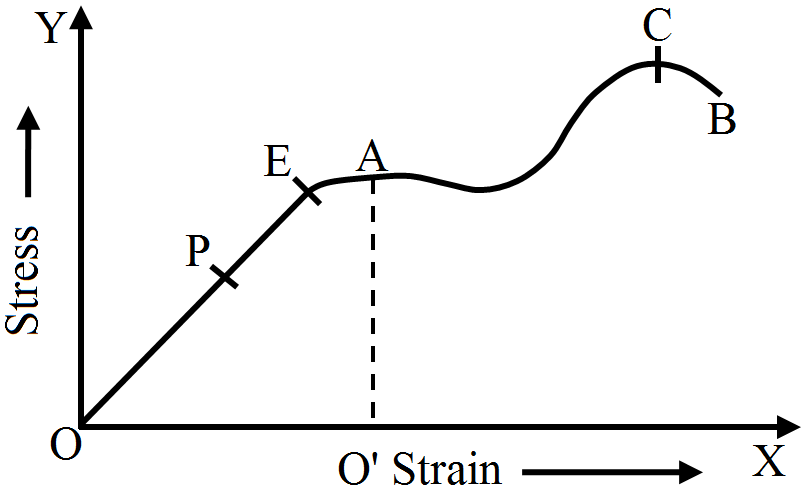
The Stress-Strain graph for a metal wire is shown in the figure upto the point E. The wire returns to its original state O along the curve EPO when it is gradually unloaded. Point B corresponds to the fracture of the wire:

  1. Upto what point of the curve is Hooke's law obeyed?
  2. Which point on the curve corresponds to the elastic limit or yield point of the wire?
  3. Indicate the elastic and plastic regions of the Stress-Strain graph.
  4. Describe what happens when the wire is loaded upto a stress corresponding to the point A on the graph, and then unloaded gradually. In particular, explain, the dotted curve.
  5. What is peculiar about the portion of the Stress-Strain graph from C to B? Upto what stress can the wire be subjected without causing fracture?
A gaseous mixture contains 16g of helium and 16g of oxygen, then calculate the ratio of $\frac{\text{C}_{\text{p}}}{\text{C}_{\text{V}}}$ of the mixture.
A copper calorimeter of mass 100g contains 200g of a mixture of ice and water. Steam at 100°C under normal pressure is passed into the calorimeter and the temperature of the mixture is allowed to rise to 50°C. If the mass of the calorimeter and its contents is now 330g, what was the ratio of ice and water in the beginning? Neglect heat losses. Given.
Specific heat capacity of copper 0.42 × 103J/ kg-1K-1
Specific heat capacity of water = 4.2 × 103J/ kg-1K-1
Latent heat of fusion of ice = 3.36 × 105J/ kg-1
Latent heat of condensation of steam = 22.5 × 105J/ kg-1
Two absolute scales A and B have triple points of water defined to be 200A and 350B. What is the relation between TA and TB?
A rectangular box lies on a rough inclined surface. The coefficient of friction between the surface and the box is $\mu$. Let the mass of the box be m.
  1. At what angle of inclination $\theta$ of the plane to the horizontal will the box just start to slide down the plane?
  2. What is the force acting on the box down the plane, if the angle of inclination of the plane is increased to a $\theta>$?
  3. What is the force needed to be applied upwards along the plane to make the box either remain stationary or just move up with uniform speed?
  4. What is the force needed to be applied upwards along the plane to make the box move up the plane with acceleration a?
The earth has a radius of 6400km. The inner core of 1000km radius is solid. Outside it, there is a region from 1000km to a radius of 3500km which is in molten state. Then again from 3500km to 6400km the earth is solid. Only longitudinal (P) waves can travel inside a liquid. Assume that the P wave has a speed of 8km s–1 in solid parts and of 5km s–1 in liquid parts of the earth. An earthquake occurs at some place close to the surface of the earth. Calculate the time after which it will be recorded in a seismometer at a diametrically opposite point on the earth if wave travels along diameter?
A ball is whirled in a circle by attaching it to a fixed point with a string. Is there an angular rotation of the ball about its centre? If yes, is this angular velocity equal to the angular velocity of the ball about the fixed point?
Air is pumped into an automobile tyre's tube up to a pressure of 200kPa in the morning when the air temperature is 20°C. During the day the temperature rises to 40°C and the tube expands by 2%. Calculate the pressure of the air in the tube at this temperature.