Question
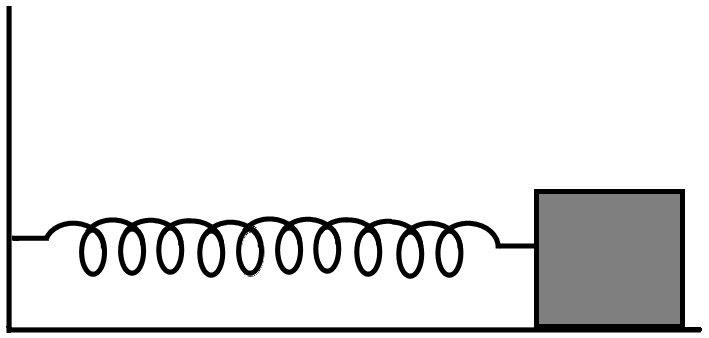
For three situations, the initial and final positions respectively, along x-axis for the block in Fig are (a) - 3cm, 2cm. (b) 2cm, 3 cm and (c) -2cm, 2cm. In each situation, is the work done by the spring force on the block positive, negative or zero?
Answer

  1. Since $\text{U}=\frac{1}{2}\text{k}\Big(\text{x}_2^2-\text{x}_2^1\Big),$ energy decreases, so work done by external force is negative. Therefore, work done by spring force is positive.

  2. Since, $\text{U}=\frac{1}{2}\text{k}\Big(\text{x}_2^2-\text{x}_1^2\Big)$ energy increases, so work done by external force is positive. Therefore, work done by spring force is negative.

  3. Since, $\text{U}=\frac{1}{2}\text{k}\Big(\text{x}_2^2-\text{x}_1^2\Big),$ there is no change in K.E., so work done is zero.

Need a full question paper?

Generate a complete, print-ready paper with questions like this in minutes — across 16+ boards, with answer keys.

Start Generating Free

Similar questions

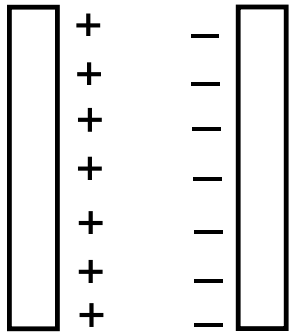
Two large conducting plates are placed parallel to each other and they carry equal and opposite charges with surface density $\sigma$ as shown in figure. Find the electric field:
  1. At the left of the plates.
  2. In between the plates.
  3. At the right of the plates.

Explain why,
  1. A horse cannot pull a cart and run in empty space.
  2. Passengers are thrown forward from their seats when a speeding bus stops suddenly.
  3. It is easier to pull a lawn mower than to push it.
  4. A cricketer moves his hands backwards while holding a catch.
We have carefully distinguished between average speed and magnitude of average velocity. No such distinction is necessary when we consider instantaneous speed and magnitude of velocity. The instantaneous speed is always equal to the magnitude of instantaneous velocity. Why?
A geyser heats water flowing at the rate of 3.0 litres per minute from 27°C to 77°C. If the geyser operates on a gas burner, what is the rate of consumption of the fuel if its heat of combustion is 4.0 × 10⁴J/g?
The mass of the planet Jupiter is 1.9 × 1027kg and that of the Sun is 1.99 1030kg. The mean distance of the Jupiter from the Sun is 7.8 × 10¹¹m. Calculate the gravitational force which the Sun exerts on Jupiter, assuming that Jupiter moves in circular orbit around the Sun. Calculate the speed of the Jupiter.
G = 6.67 10-11 Nm2kg-2
Two identical balls, each having a charge of 2.00 × 10-7C and a mass of 100g, are suspended from a common point by two insulating strings each 50cm long. The balls are held at a separation 5.0cm apart and then released. Find,
  1. The electric force on one of the charged balls.
  2. The components of the resultant force on it along and perpendicular to the string.
  3. The tension in the string.
  4. The acceleration of one of the balls. Answers are to be obtained only for the instant just after the release.
Two satellites S1 and S2 revolve round a planet in coplanar circular orbit in the same sense. Their periods of revolution are one hour and 8 hours respectively. The radius of the orbit of S1 is 104km. When S2 is close to S1 find:
  1. The speed of S2 relative to S1.
  2. The angular speed of S2 as actually observed by an astronaut in S1.

Two ideal gases have the same value of $\frac{\text{C}_\text{P}}{\text{C}_\text{V}}=\gamma.$ What will be the value of this ratio for a mixture of the two gases in the ratio 1 : 2?
Find the expression of the position of the center of mass of a system of n-particles.
The ratio of the molar heat capacities of an ideal gas is $\frac{\text{C}_\text{p}}{\text{C}_\text{V}}=\frac{7}{6}.$ Calculate the change in internal energy of 1.0 mole of the gas when its temperature is raised by 50K.
  1. Keeping the pressure constant.
  2. Keeping the volume constant.
  3. Adiabatically.