Question
A parallel$-$plate capacitor having plate area $400\ cm^2$ and separation between the plates $1.0\ mm$ is connected to a power supply of $100V$. A dielectric slab of thickness $1.0\ mm$ and dielectric constant $5.0$ is inserted into the gap:
  1. Find the increase in electrostatic energy.
  2. If the power supply is now disconnected and the dielectric slab is taken out, find the further increase in energy.
  3. Why does the energy increase in inserting the slab as well as in taking it out?
Answer

$A = 400\ cm^2 = 4 \times 10^{-2}m^2$
$d = 1\ cm = 1 \times 10^{-3}m$
$V = 160V$
$t = 0.5 = 5 \times 10^{-4}m$
$k = 5$
$\text{C}=\frac{\epsilon_0\text{A}}{\text{d}-\text{t}+\frac{\text{t}}{\text{k}}}$
$=\frac{8.85\times10^{-12}\times4\times10^{-2}}{10^{-3}-5\times10^{-4}+\frac{5\times10^{-4}}{5}}$
$=\frac{35.4\times10^{-4}}{10^{-3}-0.5}$

Need a full question paper?

Generate a complete, print-ready paper with questions like this in minutes — across 16+ boards, with answer keys.

Start Generating Free

Similar questions


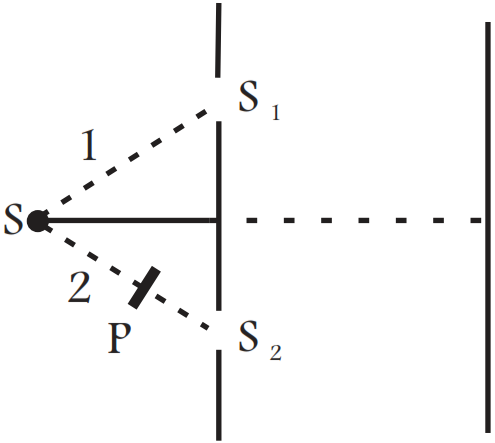
Figure shown a two slit arrangement with a source which emits unpolarised light. $P$ is a polariser with axis whose direction is not given. If $I_0$ is the intensity of the principal maxima when no polariser is present, calculate in the present case, the intensity of the principal maxima as well as of the first minima.
What is Zener diode? Give its symbolic diagram. Draw its (I-V) characteristic curve. Explain its use as a voltage regulator ?
A wire of length $10\ cm$ translates in a direction making an angle of $60^\circ$ with its length. The plane of motion is perpendicular to a uniform magnetic field of $1.0T$ that exists in the space. Find the emf induced between the ends of the rod if the speed of translation is $20\ cm/s^{-1}.$
A resistor of $400 \Omega$, an inductor of $\frac{5}{\pi} H$ and a capacitor of $\frac{50}{\pi} \mu F$ are connected in series across a source of alternating voltage of $140 \sin 100 \pi t V$. Find the voltage $($rms$)$ across the resistor, the inductor and the capacitor. Is the algebraic sum of these voltages more than the source voltage? If yes, resolve the paradox. (Given, $\sqrt{2}=1.414 ).$
Assume the dipole model for earth's magnetic field $B$ which is given by $B_V =$ vertical component of magnetic field $=\frac{\mu_0}{4\pi}\frac{2\text{m}\cos\theta}{\text{r}^3}$
$B_H =$ Horizontal component of magnetic field $=\frac{\mu_0}{4\pi}\frac{\sin\theta\text{m}}{\text{r}^3}
\theta = 90^\circ - $ lattitude as measured from magnetic equator. Find loci of points for which,
  1. $|B|$ is minimum,
  2. Dip angle is zero,
  3. Dip angle is $± 45^\circ $.
Derive a mathematical expression for the force per unit length experienced by each of the two long current carrying conductors placed parallel to each other in air. Hence define one ampere of current.Explain why two parallel straight conductors carrying current in the opposite direction kept near each other in air repel?
Find the change in the internal energy of $2\ kg$ of water as it is heated from $0^\circ C$ to $4^\circ C$. The specific heat capacity of water is $4200Jkg^{-1} K^{-1}$ and its densities at $0^\circ C $and $4^\circ C$ are $999.9\ kgm^{-3}$ and $1000\ kgm^{-3}$ respectively. Atmospheric pressure $= 10^{-6}Pa.$
The heavier block in an Atwood machine has a mass twice that of the lighter one. The tension in the string is 16.0N when the system is set into motion. Find the decrease in the gravitational potential energy during the first second after the system is released from rest.
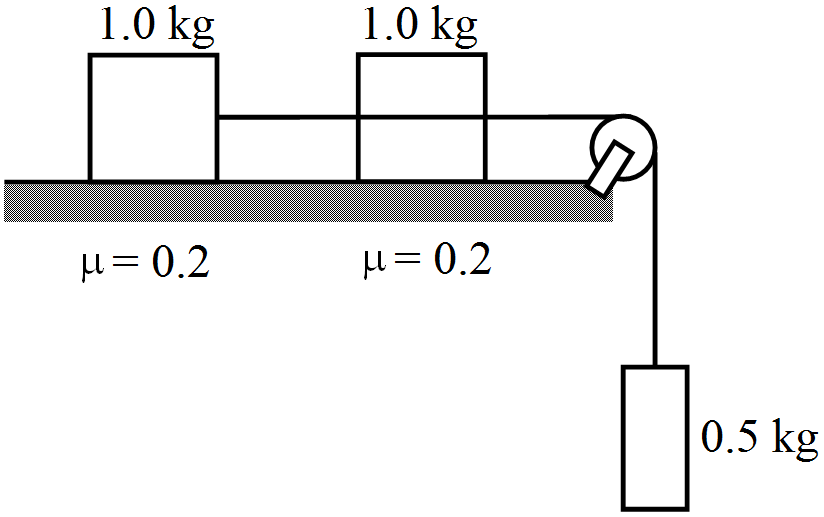
Consider the situation shown in figure. Calculate:
  1. The acceleration of the $1.0\ kg$ blocks.
  2. The tension in the string connecting the $1.0\ kg$ blocks.
  3. The tension in the string attached to $0.50\ kg.$
A convex lens of focal length 20cm and a concave lens of focal length 10cm are placed 10cm apart with their principal axes coinciding. A beam of light travelling parallel to the principal axis and having a beam diameter 5.0mm, is incident on the combination. Show that the emergent beam is parallel to the incident one. Find the beam diameter of the emergent beam.