Question


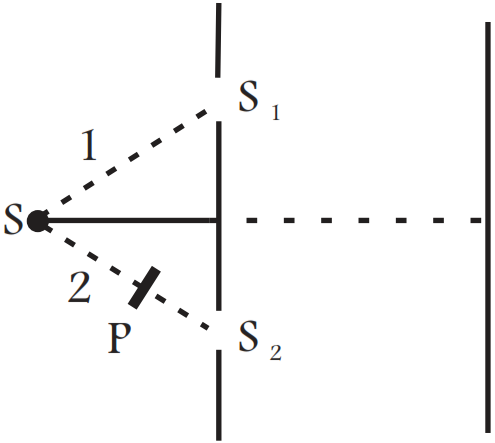
Figure shown a two slit arrangement with a source which emits unpolarised light. $P$ is a polariser with axis whose direction is not given. If $I_0$ is the intensity of the principal maxima when no polariser is present, calculate in the present case, the intensity of the principal maxima as well as of the first minima.

Answer

The resultant amplitude of wave reaching on screen will be the sum of amplitude of either wave in perpendicular and parallel polarisation.
Amplitude of the wave in perpendicular polarisation
$\text{A}_\bot=\text{A}_\bot^1+\text{A}_\bot^2=\text{A}_\bot^0\sin(\text{kx}-\omega\text{t})+\text{A}_\bot^2\sin(\text{kx}-\omega\text{t}+\phi)$
$\Rightarrow\ \text{A}_\bot=\text{A}_\bot^0(\sin(\text{kx}-\omega\text{t})+\sin(\text{kx}-\omega\text{t}+\phi))$
Amplitude of the wave in parallel polarisation
$\text{A}_{||}=\text{A}_{||}^{(1)}+\text{A}_{||}^{(2)}$
$\Rightarrow\ \text{A}_\bot=\text{A}_\bot^0[\sin(\text{kx}-\omega\text{t})+\sin(\text{kx}-\omega\text{t}+\phi)]$
$\therefore$ Average Intensity on the screen
$\text{I}=\begin{Bmatrix} \Big|\text{A}_\bot^0\Big|^2+\Big|\text{A}_\bot^0\Big|^2\end{Bmatrix}\big[\sin(\text{kx}-\omega\text{t})(1+\cos^2\phi+2\sin\phi)+\sin^2(\text{kx}-\omega\text{t})\sin^2\phi\big]_\text{average}$
$=\begin{Bmatrix} \Big|\text{A}_\bot^0\Big|^2+\Big|\text{A}_\bot^0\Big|^2\end{Bmatrix}\Big(\frac{1}{2}\Big)2(1+\cos\phi)$
$\Rightarrow\ \text{I}=2\Big|\text{A}_{||}^0\Big|^2(1+\cos\phi)\text{ since},\Big|\text{A}_\bot^0\Big|_\text{av}+\Big|\text{A}_\bot^0\Big|_\text{av}$
With polariser $P,$
Assume $\text{A}_\bot^2$ is blocked
Intensity $=(\text{A}_{||}^1+\text{A}_{||}^2)^2+({\text{A}_{||}^2})^2$
$=\Big|\text{A}_{\bot}^0\Big|(1+\cos\phi)+\Big|\text{A}_{\bot}^0\Big|.\frac{1}{2}$
Given, $\text{I}_0=4\Big|\text{A}_{\bot}^0\Big|=$ Intensity without polariser at principal maxima.
Intensity at first minima with polariser
$=\Big|\text{A}_{\bot}^0\Big|(1-1)+\frac{\Big|\text{A}_{\bot}^0\Big|}{2}=\frac{\text{I}_0}{8}.$

Need a full question paper?

Generate a complete, print-ready paper with questions like this in minutes — across 16+ boards, with answer keys.

Start Generating Free

Similar questions

An electric bulb is designed to consume 55W when operated at 110 volts. It is connected to a 220V, 50Hz line through a choke coil in series. What should be the inductance of the coil for which the bulb gets correct voltage?
With the help of a ray diagram, show the formation of image of a point object due to refraction of light at a spherical surface separating two media of refractive indices $n_1$ and $n_2 (n_2 > n_1)$ respectively. Using this diagram, derive the relation.
$\frac{\text{n}_2}{\text{v}}-\frac{\text{n}_1}{\text{u}}=\frac{\text{n}_1-\text{n}_2}{\text{R}}$
Write the sign conventions used. What happens to the focal length of convex lens when it is immersed in water?
A parallel $-$ plate capacitor having plate area $20\ cm^2$ and separation between the plates $1.00\ mm$ is connected to a battery of $12.0V.$ The plates are pulled apart to increase the separation to $2.0\ mm.$
  1. Calculate the charge flown through the circuit during the process.
  2. How much energy is absorbed by the battery during the process?
  3. Calculate the stored energy in the electric field before and after the process.
  4. Using the expression for the force between the plates, find the work done by the person pulling the plates apart.
  5. Show and justify that no heat is produced during this transfer of charge as the separatio
  1. n is increased.
A circular loop carrying a current i is made of a wire of length L. A uniform magnetic field B exists parallel to the plane of the loop.
  1. Find the torque on the loop.
  2. If the same length of the wire is used to form a square loop, what would be the torque? Which is larger?
A car goes on a horizontal circular road of radius R, the speed increasing at a constant rate $\frac{\text{d}\nu}{\text{dt}}=\text{a}.$ The friction dt coefficient between the road and the tyre is $\mu.$ Find the speed at which the car will skid.
Clear the difference between interference and diffraction.
In an agricultural experiment, a solution containing 1 mole of a radioactive material $\Big(\text{t}_{\frac{1}{2}}=14.3\text{ days}\Big)$ was injected into the roots of a plant. The plant was allowed 70 hours to settle down and then activity was measured in its fruit. If the activity measured was $1\mu\text{Ci},$ what per cent of activity is transmitted from the root to the fruit in steady state?
A body is in translational equilibrium under the action of coplanar forces. If the torque of these forces is zero about a point, is it necessary that it will also be zero about any other point?
Consider the de Broglie wavelength of an electron and a proton. Which wavelength is smaller if the two particles have.
  1. The same speed.
  2. The same momentum.
  3. The same energy?.
Find out magnetic force on parallel current carrying conductors and also state their special conditions.