Question
A parallel$-$plate capacitor having plate area $400\ cm^2 $and separation between the plates $1.0\ mm$ is connected to a power supply of $100V.$ A dielectric slab of thickness $1.0\ mm$ and dielectric constant $5.0$ is inserted into the gap:
  1. Find the increase in electrostatic energy.
  2. If the power supply is now disconnected and the dielectric slab is taken out, find the further increase in energy.
  3. Why does the energy increase in inserting the slab as well as in taking it out?
Answer

$A = 400\ cm^2 = 4 \times 10^{-2}m^2$
$d = 1\ cm = 1 \times 10^{-3}m$
$V = 160V$
$t = 0.5 = 5 \times 10^{-4}m$
$k = 5$
$\text{C}=\frac{\epsilon_0\text{A}}{\text{d}-\text{t}+\frac{\text{t}}{\text{k}}}$
$=\frac{8.85\times10^{-12}\times4\times10^{-2}}{10^{-3}-5\times10^{-4}+\frac{5\times10^{-4}}{5}}$
$=\frac{35.4\times10^{-4}}{10^{-3}-0.5}$

Need a full question paper?

Generate a complete, print-ready paper with questions like this in minutes — across 16+ boards, with answer keys.

Start Generating Free

Similar questions

The $\text{K}_\beta\ X-$rays from certain elements are given below. Draw a Moseley-type plot of $\sqrt{\text{v}}$ versus $Z$ for $\text{K}_\beta$ radiation.
Element
$Ne$ $P$ $Ca$ $Mn$ $Zn$ $Br$
Energy $(keV)$
$0.858$ $2.14$ $4.02$ $6.51$ $9.57$ $13.3$
  1. A point object is placed on the principal axis of a convex spherical surface of radius of curvature $R,$ which separates the two media of refractive indices $n_1$ and $n_{2 }(n_2 > n_1)$. Draw the ray diagram and deduce the relation between the object distance $(u),$ image distance $(v)$ and the radius of curvature $(R)$ for refraction to take place at the convex spherical surface from rarer to denser medium.
  2. A converging lens has a focal length of $20 \ cm$ in air. It is made of a material of refractive index $1.6$. If it is immersed in a liquid of refractive index $1.3,$ find its new focal length.
A spherical tungsten piece of radius $1.0\ cm$ is suspended in an evacuated chamber maintained at $300K.$ The piece is maintained at $1000K$ by heating it electrically. Find the rate at which the electrical energy must be supplied. The emissivity of tungsten is $0.30$ and the Stefan constant $\sigma$ is $6.0 \times 10^{-8}Wm^{-2}K^{-4}.$
A screen is placed 90 cm from an object. The image of the object on the screen is formed by a convex lens at two different locations separated by 20 cm. Determine the focal length of the lens.
For the same objective, find the ratio of the least separation between two points to be distinguished by a microscope for light of 5000A and electrons accelerated through 100V used as the illuminating substance.
A student is studying a book placed near the edge of a circular table of radius $R$. A point source of light is suspended directly above the centre of the table. What should be the height of the source above the table so as to produce maximum illuminance at the position of the book?
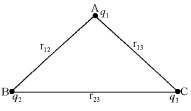
Write the definition of electrostatic at any point. Also write its S.I. units. As shown in the figure, three points charges $q_1$, $q _2$ and $q _3$ are placed at points $A, B$ and $C$ respectively. Drive an expression for the electrostatic potential energy of this system.

Image
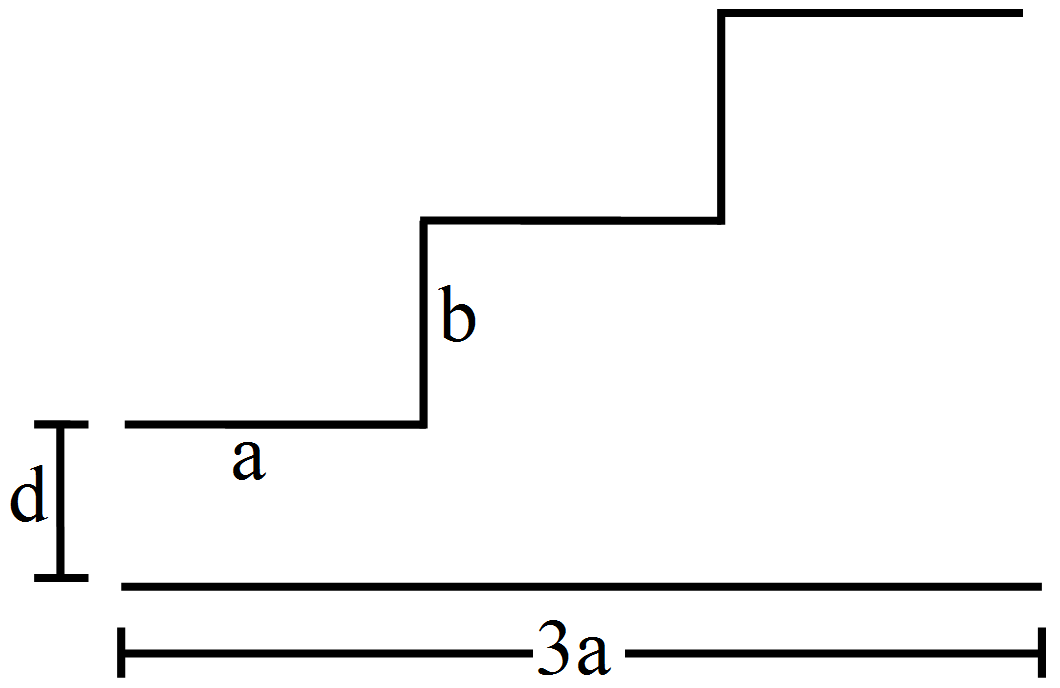
A capacitor is made of a flat plate of area A and a second plate having a stair-like structure as shown in figure. The width of each stair is a and the height is b. Find the capacitance of the assembly.
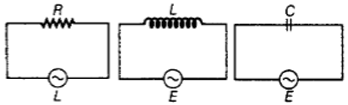
$i$. What do you understand by the sharpness of resonance in a series $L-C-R$ circuit? Derive an expression for $Q$ factor of the circuit.
$ii$. Three electrical circuits having $AC$ sources of variable frequency are shown in the figures.
Initially, the current flowing in each of these is same. If the frequency of the applied $AC$ source is increased, how will the current flowing in these circuits be affected? Give the reason for your answer.
Image ​​​​​​​
$A 2\ kg$ block is placed over a $4\ kg$ block and both are placed on a smooth horizontal surface. The coefficient of friction between the blocks is $0.20.$ Find the acceleration of the two blocks if a horizontal force of $12N$ is applied to:
  1. The upper block.
  2. The lower block. Take $g = 10\ m/s^2.$