Question
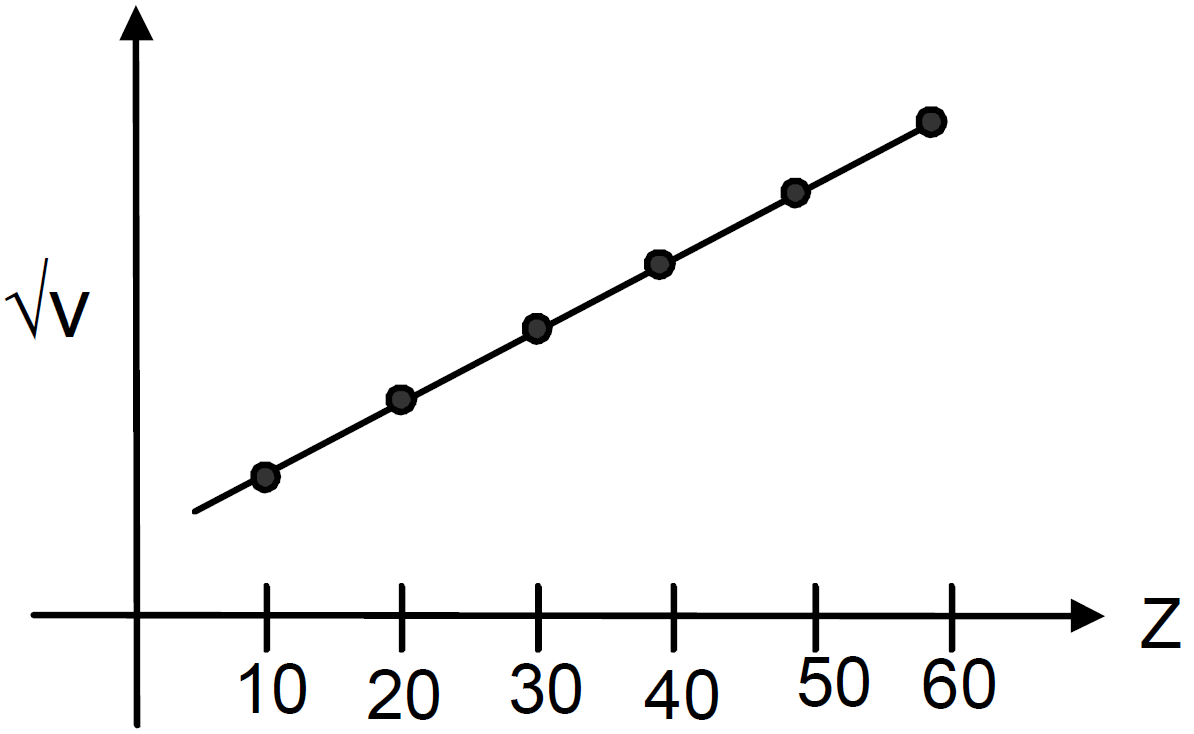
The $\text{K}_\beta\ X-$rays from certain elements are given below. Draw a Moseley-type plot of $\sqrt{\text{v}}$ versus $Z$ for $\text{K}_\beta$ radiation.
Element
$Ne$ $P$ $Ca$ $Mn$ $Zn$ $Br$
Energy $(keV)$
$0.858$ $2.14$ $4.02$ $6.51$ $9.57$ $13.3$

Answer


$\text{K}_\text{B}$ radiation is when the e jumps from
$n = 3$ to $n = 1 ($here $n$ is principal quantum no$)$
$\Delta\text{E}=\text{hv}=\text{Rhc(z-h)}^2\Big(\frac{1}{2^2}-\frac{1}{3^2}\Big)$
$\sqrt{\text{v}}=\sqrt{\frac{9\text{RC}}{8}}(\text{z}-\text{h})$
$\therefore\sqrt{\text{v}}\propto\text{z}$
Second method :
We can directly get value of $v\ b$
$hv =$ Energy
$\Rightarrow\text{v}=\frac{\text{Energy(in Kev)}}{\text{h}}$
This we have to find out $\sqrt{\text{v}}$ and draw the same graph as above.

Need a full question paper?

Generate a complete, print-ready paper with questions like this in minutes — across 16+ boards, with answer keys.

Start Generating Free

Similar questions

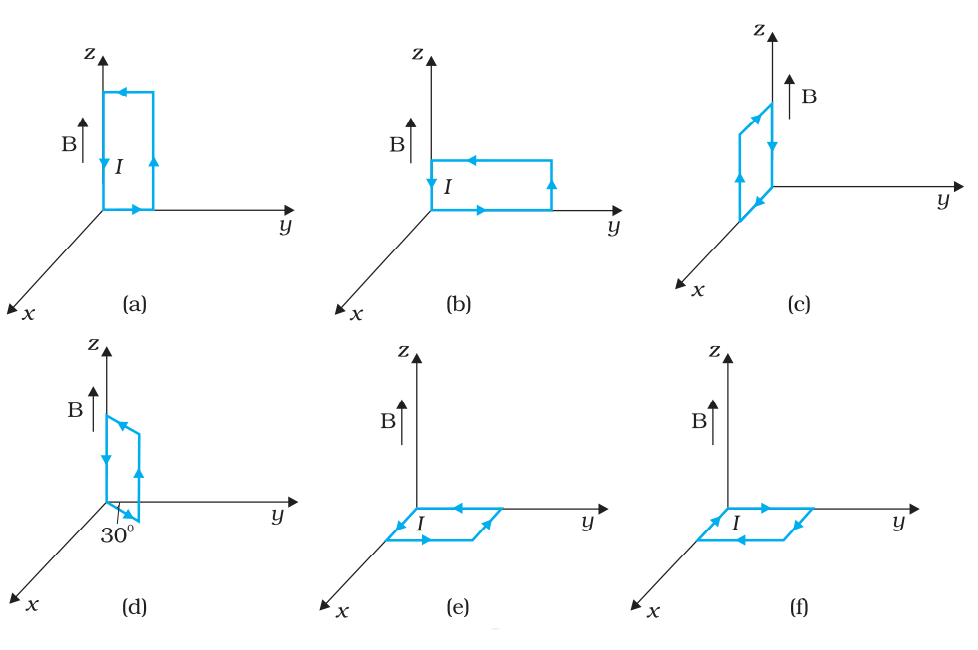
A uniform magnetic field of $3000 G$ is established along the positive $z-$ direction. $A$ rectangular loop of sides $10 \ cm$ and $5 \ cm$ carries a current of $12 A$. What is the torque on the loop in the different cases shown in Fig.? What is the force on each case? Which case corresponds to stable equilibrium?
Two small spheres, each having a mass of 20g, are suspended from a common point by two insulating strings of length 40cm each. The spheres are identically charged and the separation between the balls at equilibrium is found to be 4cm. Find the charge on each sphere.
The optical properties of a medium are governed by the relative permitivity $(\epsilon_\text{r})$ and relative permeability $(\mu_\text{r})$. The refractive index is defined as $\sqrt{\mu_\text{r}\epsilon_\text{r}}=\text{n}$. For ordinary material $\epsilon_\text{r}=0$ and $\mu_\text{r}<0$ and the positive sign is taken for the square root. In $1964, $ a Russian scientist $V$. Veselago postulated the existence of material with $\epsilon_\text{r}=0$ and $\mu_\text{r}<0$. Since then such 'metamaterials' have been produced in the laboratories and their optical properties studied. For such materials $\text{n}=-\sqrt{\mu_1\epsilon_1}$. As light enters a medium of such refractive index the phases travel away from the direction of propagation.
  1. According to the description above show that if rays of light enter such a medium from air $($refractive index $= 1)$ at an angle ? In $2^{nd}$ quadrant, them the refracted beam is in the $3^{rd}$ quadrant.
  2. Prove that Snell's law holds for such a medium.
What do you mean by modulation ? Define modulation index. For an amplitude modulated wave the maximum and minimum amplitude is ' $a$ ' and ' $b$ '. Calculate modulation index for it.
(a) Estimate the average drift speed of conduction electrons in a copper wire of cross-sectional area $1.0 \times 10^{-7} m ^2$ carrying a current of 1.5 A. Assume that each copper atom contributes roughly one conduction electron. The density of copper is $9.0 \times 10^3 kg / m ^3$, and its atomic mass is $63.5 u$. (b) Compare the drift speed obtained above with, (i) thermal speeds of copper atoms at ordinary temperatures, (ii) speed of propagation of electric field along the conductor which causes the drift motion.
A sound wave of frequency 100Hz is travelling in air. The speed of sound in air is 350m/s.
  1. By how much is the phase changed at a given point in 2.5ms?
  2. What is the phase difference at a given instant between two points separated by a distance of 10.0cm along the direction of propagation?
A neutron star has a density equal to that of the nuclear matter. Assuming the star to be spherical, find the radius of a neutron star whose mass is $4.0 \times 10^{30}kg \ ($twice the mass of the sun$)$.
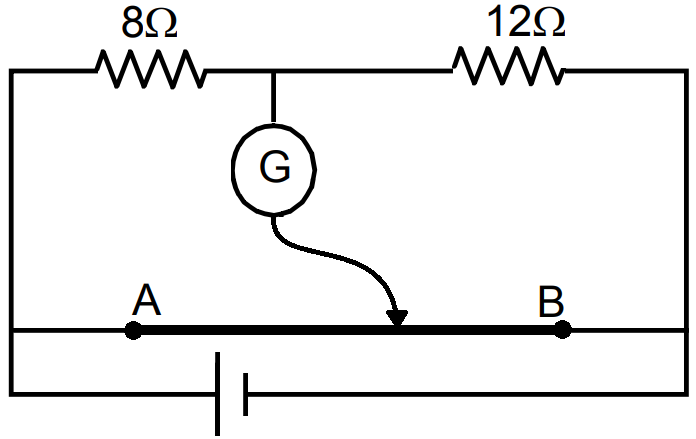
The potentiometer wire AB shown in the figure. is 40cm long. Where should the free end of the galvanometer be connected on AB so that the galvanometer may show zero deflection?
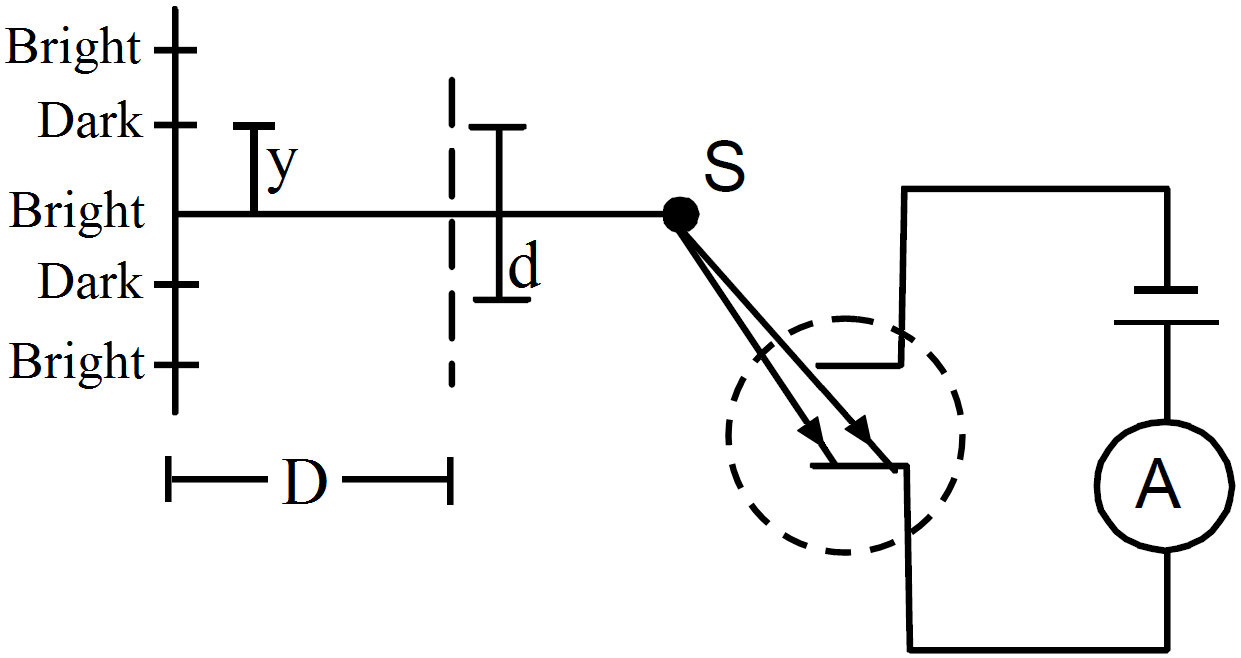
In the arrangement shown in figure $y = 1.0\ mm. d = 0.24\ mm$ end $D = 1.2m$. The work function of the materiel of the emitter is $2.2\ eV$. Find the stopping potential $V$ needed to stop the photocurrent.
A 6.5m long ladder rests against a vertical wall reaching a height of 6.0m. A 60kg man stands half way up the ladder.
  1. Find the torque of the force exerted by the man on the ladder about the upper end of the ladder.
  2. Assuming the weight of the ladder to be negligible as compared to the man and assuming the wall to be smooth, find the force exerted by the ground on the ladder.