The capacity of a parallel plate condenser is $10\,\mu \,F$, when the distance between its plates is $8 \,cm$. If the distance between the plates is reduced to $4\, cm$, then the capacity of this parallel plate condenser will be.........$\mu \,F$
Medium


Download our appand get started for free
Experience the future of education. Simply download our apps or reach out to us for more information. Let's shape the future of learning together!No signup needed.*
Similar Questions
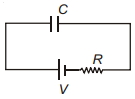
- 1As in the figure, if a capacitor of capacitance $C$ is charged by connecting it with resistance $R$, then energy given by the battery will beView Solution
- 2There is an electric field $E$ in $X$-direction. If the work done on moving a charge $0.2\,C$ through a distance of $2\,m$ along a line making an angle $60^\circ $ with the $X$-axis is $4.0\;J$, what is the value of $E$........ $N/C$View Solution
- 3Three capacitors each of capacitance $C$ and of breakdown voltage $V$ are joined in series. The capacitance and breakdown voltage of the combination will beView Solution
- 4An air filled parallel plate capacitor has capacity $C$. If distance between plates is doubled and it is immersed in a liquid then capacity becomes twice. Dielectric constant of the liquid isView Solution
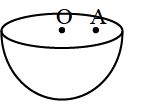
- 5Charge is uniformly distributed on the surface of a hollow hemisphere. Let $O$ and $A$ be two points on the base of the hemisphere and $V_0$ and $V_A$ be the electric potentials at $O$ and $A$ respectively. Then,View Solution
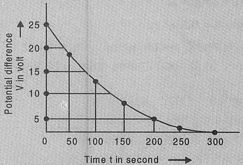
- 6The figure shows an experimental plot for discharging of a capacitor in an $R-C$ circuit. The time constant $\tau$ of this circuit lies betweenView Solution
- 7View SolutionThe angle between the electric lines of force and the equipotential surface is
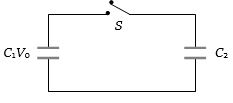
- 8A capacitor of capacity ${C_1}$ is charged to the potential of ${V_o}$. On disconnecting with the battery, it is connected with a capacitor of capacity ${C_2}$ as shown in the adjoining figure. The ratio of energies before and after the connection of switch $S$ will beView Solution
- 9Assertion $(A):$ A spherical equipotential surface is not possible for a point charge.View Solution
Reason $(R):$ A spherical equipotential surface is possible inside a spherical capacitor.
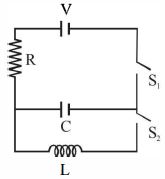
- 10In an $LCR $ circuit as shown below both switches are open initially. Now switch $S_1$ is closed, $S_2$ kept open. ( $q$ is charge on the capacitor and $\tau = RC$ is Capacitive time constant). Which of the following statement is correct?View Solution